
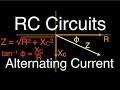
Understanding RC Circuits and Phasor Diagrams

Interactive Video
•
Physics
•
10th - 12th Grade
•
Practice Problem
•
Hard

Nancy Jackson
FREE Resource
10 questions
Show all answers
1.
MULTIPLE CHOICE QUESTION
30 sec • 1 pt
What is the phase relationship between voltage and current in a purely resistive circuit?
Voltage leads current by 90 degrees
Voltage and current are in phase
Current leads voltage by 90 degrees
Voltage lags current by 45 degrees
2.
MULTIPLE CHOICE QUESTION
30 sec • 1 pt
In a capacitive circuit, how does the current relate to the voltage?
Current leads voltage by 90 degrees
Voltage leads current by 45 degrees
Current and voltage are in phase
Current lags voltage by 90 degrees
3.
MULTIPLE CHOICE QUESTION
30 sec • 1 pt
How do you calculate the voltage of the source in an RC circuit using a phasor diagram?
By adding the voltages across the resistor and capacitor directly
By using the Pythagorean theorem on the phasor diagram
By multiplying the voltages across the resistor and capacitor
By subtracting the voltage across the capacitor from the resistor
4.
MULTIPLE CHOICE QUESTION
30 sec • 1 pt
What formula is used to calculate the current in an RC circuit?
I = V / (R + XC)
I = V * (R + XC)
I = V * Z
I = V / Z
5.
MULTIPLE CHOICE QUESTION
30 sec • 1 pt
What does the symbol Z represent in an RC circuit?
Resistance
Reactance
Voltage
Impedance
6.
MULTIPLE CHOICE QUESTION
30 sec • 1 pt
How is the phase angle in an RC circuit typically calculated?
Using the cosine function
Using the tangent function
Using the sine function
Using the cotangent function
7.
MULTIPLE CHOICE QUESTION
30 sec • 1 pt
What is the total opposition to electron flow in an AC circuit called?
Reactance
Conductance
Impedance
Resistance
Access all questions and much more by creating a free account
Create resources
Host any resource
Get auto-graded reports

Continue with Google

Continue with Email

Continue with Classlink

Continue with Clever
or continue with

Microsoft
%20(1).png)
Apple

Others
Already have an account?

