
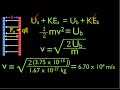
Electric Potential Energy and Proton Motion Quiz

Interactive Video
•
Physics
•
9th - 10th Grade
•
Practice Problem
•
Hard

Jennifer Brown
FREE Resource
10 questions
Show all answers
1.
MULTIPLE CHOICE QUESTION
30 sec • 1 pt
What is the main objective of the video tutorial?
To calculate the electric field strength and proton velocity between parallel plates.
To learn about magnetic fields and their effects.
To understand the concept of gravitational potential energy.
To study the properties of semiconductors.
2.
MULTIPLE CHOICE QUESTION
30 sec • 1 pt
How is the electric field strength between two parallel plates calculated?
By subtracting the potential energy from the charge and distance between the plates.
By adding the potential energy to the charge and distance between the plates.
By multiplying the potential energy by the charge and distance between the plates.
By dividing the potential energy by the charge and distance between the plates.
3.
MULTIPLE CHOICE QUESTION
30 sec • 1 pt
What is the unit of electric field strength?
Newtons per Coulomb
Joules per meter
Coulombs per Newton
Meters per Joule
4.
MULTIPLE CHOICE QUESTION
30 sec • 1 pt
What is the electric force required to hold a proton at the positive plate?
4.5 x 10^-16 Newtons
3.5 x 10^-16 Newtons
2.5 x 10^-16 Newtons
1.5 x 10^-16 Newtons
5.
MULTIPLE CHOICE QUESTION
30 sec • 1 pt
How is the electric force on a proton calculated?
By subtracting the charge of the proton from the electric field strength.
By adding the charge of the proton to the electric field strength.
By dividing the charge of the proton by the electric field strength.
By multiplying the charge of the proton by the electric field strength.
6.
MULTIPLE CHOICE QUESTION
30 sec • 1 pt
What happens to the potential energy of a proton as it moves from the positive to the negative plate?
It is converted into kinetic energy.
It is converted into sound energy.
It is converted into thermal energy.
It remains constant.
7.
MULTIPLE CHOICE QUESTION
30 sec • 1 pt
What is the velocity of the proton just before it strikes the negative plate?
4.7 x 10^4 meters per second
3.7 x 10^4 meters per second
6.7 x 10^4 meters per second
5.7 x 10^4 meters per second
Access all questions and much more by creating a free account
Create resources
Host any resource
Get auto-graded reports

Continue with Google

Continue with Email

Continue with Microsoft
or continue with

%20(1).png)
Apple

Others
By signing up, you agree to our Terms of Service & Privacy Policy
Already have an account?


