
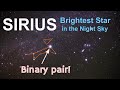
Exploring Sirius: The Brightest Star

Interactive Video
•
Physics
•
9th - 10th Grade
•
Practice Problem
•
Hard

Jennifer Brown
FREE Resource
10 questions
Show all answers
1.
MULTIPLE CHOICE QUESTION
30 sec • 1 pt
What is the distance of Sirius from our solar system?
15.8 light years
4.2 light years
8.6 light years
12.3 light years
2.
MULTIPLE CHOICE QUESTION
30 sec • 1 pt
Which type of star is Sirius B classified as?
Red giant
Main sequence star
Neutron star
White dwarf
3.
MULTIPLE CHOICE QUESTION
30 sec • 1 pt
How often do Sirius A and B orbit each other?
Every 50 years
Every 100 years
Every 25 years
Every 10 years
4.
MULTIPLE CHOICE QUESTION
30 sec • 1 pt
What is the approximate temperature of Sirius A?
12,500 Kelvin
10,000 Kelvin
7,500 Kelvin
5,000 Kelvin
5.
MULTIPLE CHOICE QUESTION
30 sec • 1 pt
In the Hertzsprung-Russell diagram, how does Sirius A compare to the Sun?
Sirius A is cooler and brighter
Sirius A is hotter and dimmer
Sirius A is hotter and brighter
Sirius A is cooler and dimmer
6.
MULTIPLE CHOICE QUESTION
30 sec • 1 pt
What is the nickname given to Sirius B?
The Giant Star
The Pup Star
The Red Star
The Blue Star
7.
MULTIPLE CHOICE QUESTION
30 sec • 1 pt
Which of the following is NOT brighter than Sirius in the night sky?
Betelgeuse
Mars
The Moon
Jupiter
Access all questions and much more by creating a free account
Create resources
Host any resource
Get auto-graded reports

Continue with Google

Continue with Email

Continue with Classlink

Continue with Clever
or continue with

Microsoft
%20(1).png)
Apple

Others
Already have an account?


