
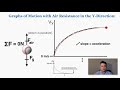
Understanding Air Resistance and Projectile Motion

Interactive Video
•
Physics
•
9th - 10th Grade
•
Practice Problem
•
Hard

Jennifer Brown
FREE Resource
10 questions
Show all answers
1.
MULTIPLE CHOICE QUESTION
30 sec • 1 pt
What happens to the force of air resistance as an object's velocity increases?
It decreases.
It remains constant.
It increases.
It fluctuates randomly.
2.
MULTIPLE CHOICE QUESTION
30 sec • 1 pt
How does the path of a projectile change when air resistance is introduced?
It forms a straight line.
It becomes asymmetrical and shorter.
It remains a perfect parabola.
It becomes a perfect circle.
3.
MULTIPLE CHOICE QUESTION
30 sec • 1 pt
What is terminal velocity?
The speed at which an object starts moving.
The speed at which gravity stops acting.
The maximum speed an object can reach when forces are balanced.
The speed at which air resistance is zero.
4.
MULTIPLE CHOICE QUESTION
30 sec • 1 pt
What happens to the acceleration of an object as it reaches terminal velocity?
It becomes zero.
It increases.
It decreases to a negative value.
It fluctuates.
5.
MULTIPLE CHOICE QUESTION
30 sec • 1 pt
What is the primary focus when graphing objects experiencing air resistance?
The x-direction
The y-direction
Both x and y directions equally
Neither x nor y directions
6.
MULTIPLE CHOICE QUESTION
30 sec • 1 pt
When an object moves from air to water, what force becomes significant?
Magnetic force
Gravitational force
Buoyant force
Frictional force
7.
MULTIPLE CHOICE QUESTION
30 sec • 1 pt
How does the buoyant force affect an object moving through water?
It makes the object move in circles.
It has no effect on the object's speed.
It decreases the object's speed.
It increases the object's speed.
Access all questions and much more by creating a free account
Create resources
Host any resource
Get auto-graded reports

Continue with Google

Continue with Email

Continue with Classlink

Continue with Clever
or continue with

Microsoft
%20(1).png)
Apple

Others
Already have an account?


