
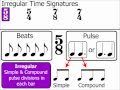
Understanding Irregular Time Signatures

Interactive Video
•
Performing Arts
•
9th - 10th Grade
•
Practice Problem
•
Hard

Jennifer Brown
FREE Resource
10 questions
Show all answers
1.
MULTIPLE CHOICE QUESTION
30 sec • 1 pt
What makes irregular time signatures different from simple and compound time signatures?
They are always quadruple.
They have equal pulses.
They are always duple.
They contain both simple and compound divisions.
2.
MULTIPLE CHOICE QUESTION
30 sec • 1 pt
In a 5/8 time signature, how many pulses are there in each bar?
One
Four
Two
Three
3.
MULTIPLE CHOICE QUESTION
30 sec • 1 pt
Why is the 5/8 time signature not considered duple?
Because it has three pulses.
Because each pulse is not equal.
Because it is a compound time signature.
Because it is a simple time signature.
4.
MULTIPLE CHOICE QUESTION
30 sec • 1 pt
Which famous piece of music uses the 5/4 time signature?
Beethoven's Symphony No. 5
Mars from The Planets by Holst
Mozart's Requiem
Bach's Brandenburg Concerto
5.
MULTIPLE CHOICE QUESTION
30 sec • 1 pt
What is a characteristic of the 5/4 time signature?
It has four equal pulses.
It is a simple time signature.
It has five crotchet beats per bar.
It is always used in classical music.
6.
MULTIPLE CHOICE QUESTION
30 sec • 1 pt
What is a septuple time signature?
A time signature with five beats.
A time signature with seven beats.
A time signature with three beats.
A time signature with four beats.
7.
MULTIPLE CHOICE QUESTION
30 sec • 1 pt
In a 7/8 time signature, how can the pulses be grouped?
Four groups of one Quaver.
One group of seven Quavers.
Two groups of three Quavers and one group of two.
Three groups of two Quavers.
Access all questions and much more by creating a free account
Create resources
Host any resource
Get auto-graded reports

Continue with Google

Continue with Email

Continue with Classlink

Continue with Clever
or continue with

Microsoft
%20(1).png)
Apple

Others
Already have an account?

