
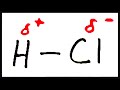
Understanding Lewis Theory and Bond Polarity

Interactive Video
•
Chemistry
•
10th - 12th Grade
•
Practice Problem
•
Hard

Jennifer Brown
FREE Resource
10 questions
Show all answers
1.
MULTIPLE CHOICE QUESTION
30 sec • 1 pt
What is one of the main limitations of Lewis Theory when representing electrons in molecules like HCl?
It ignores the presence of lone pairs.
It cannot represent ionic bonds.
It only applies to diatomic molecules.
It assumes electrons are always shared equally.
2.
MULTIPLE CHOICE QUESTION
30 sec • 1 pt
What happens to HCl molecules when exposed to an electric field?
Chlorine atoms are attracted to the positive plate.
Hydrogen atoms are attracted to the positive plate.
Chlorine atoms are attracted to the negative plate.
They align randomly.
3.
MULTIPLE CHOICE QUESTION
30 sec • 1 pt
How can bond polarity be represented visually?
By drawing a circle around the molecule.
Using a double-headed arrow.
With a lowercase delta and an arrow.
Using a zigzag line.
4.
MULTIPLE CHOICE QUESTION
30 sec • 1 pt
What does electronegativity measure?
The number of protons in an atom.
The ability of an atom to attract electrons.
The size of an atom.
The mass of an atom.
5.
MULTIPLE CHOICE QUESTION
30 sec • 1 pt
Which element is the most electronegative among the halogens?
Fluorine
Iodine
Bromine
Chlorine
6.
MULTIPLE CHOICE QUESTION
30 sec • 1 pt
How does electronegativity change across a period in the periodic table?
It fluctuates randomly.
It increases.
It remains constant.
It decreases.
7.
MULTIPLE CHOICE QUESTION
30 sec • 1 pt
What type of bond is formed when two identical atoms share electrons?
Pure covalent bond
Polar covalent bond
Ionic bond
Metallic bond
Access all questions and much more by creating a free account
Create resources
Host any resource
Get auto-graded reports

Continue with Google

Continue with Email

Continue with Microsoft
or continue with

%20(1).png)
Apple

Others
By signing up, you agree to our Terms of Service & Privacy Policy
Already have an account?


