
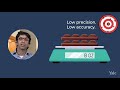
Understanding Measurements: Precision and Accuracy

Interactive Video
•
Science
•
9th - 10th Grade
•
Hard

Evelyn Hayes
FREE Resource
5 questions
Show all answers
1.
MULTIPLE CHOICE QUESTION
30 sec • 1 pt
Why is it important for scientists to understand the limitations of their measurements?
To avoid using any measuring tools
To understand the potential errors and improve accuracy
To make sure their measurements are perfect
To ensure they always get the same result
2.
MULTIPLE CHOICE QUESTION
30 sec • 1 pt
In the example of weighing chocolate, what issue arises if the scale is not calibrated correctly?
The scale will not turn on
The measurements will be precise but not accurate
The measurements will be both precise and accurate
The scale will weigh everything as zero
3.
MULTIPLE CHOICE QUESTION
30 sec • 1 pt
What does it mean if a measurement is precise but not accurate?
The measurement is both consistent and close to the true value
The measurement is close to the true value but not consistent
The measurement is consistent but not close to the true value
The measurement is neither consistent nor close to the true value
4.
MULTIPLE CHOICE QUESTION
30 sec • 1 pt
What is the ideal scenario for scientific measurements?
Measurements are both precise and accurate
Measurements are accurate but not precise
Measurements are precise but not accurate
Measurements are neither precise nor accurate
5.
MULTIPLE CHOICE QUESTION
30 sec • 1 pt
What humorous note does the speaker end on regarding extra chocolate in brownies?
Extra chocolate is always bad
Extra chocolate is not accurate but delicious
Extra chocolate makes the brownies inedible
Extra chocolate is both accurate and delicious
Access all questions and much more by creating a free account
Create resources
Host any resource
Get auto-graded reports

Continue with Google

Continue with Email

Continue with Classlink

Continue with Clever
or continue with

Microsoft
%20(1).png)
Apple

Others
Already have an account?


