
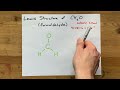
Understanding Lewis Structures for Formaldehyde

Interactive Video
•
Chemistry
•
9th - 10th Grade
•
Practice Problem
•
Hard

Evelyn Hayes
FREE Resource
5 questions
Show all answers
1.
MULTIPLE CHOICE QUESTION
30 sec • 1 pt
What is the primary characteristic of non-metals that allows them to form molecular compounds?
They have high melting points.
They are good conductors of electricity.
They share electrons.
They have metallic luster.
2.
MULTIPLE CHOICE QUESTION
30 sec • 1 pt
How many valence electrons does carbon contribute when drawing the Lewis structure for formaldehyde?
Eight
Four
Two
Six
3.
MULTIPLE CHOICE QUESTION
30 sec • 1 pt
In the initial Lewis structure for formaldehyde, which atom is placed at the center?
Hydrogen
Oxygen
Carbon
Nitrogen
4.
MULTIPLE CHOICE QUESTION
30 sec • 1 pt
What is the total number of valence electrons used in the Lewis structure of formaldehyde?
Sixteen
Ten
Twelve
Fourteen
5.
MULTIPLE CHOICE QUESTION
30 sec • 1 pt
How is the octet rule satisfied for the central carbon atom in formaldehyde's Lewis structure?
By adding more hydrogen atoms
By forming a triple bond with oxygen
By moving lone pairs from oxygen to form a double bond
By adding extra electrons to carbon
Access all questions and much more by creating a free account
Create resources
Host any resource
Get auto-graded reports

Continue with Google

Continue with Email

Continue with Microsoft
or continue with

%20(1).png)
Apple

Others
By signing up, you agree to our Terms of Service & Privacy Policy
Already have an account?

