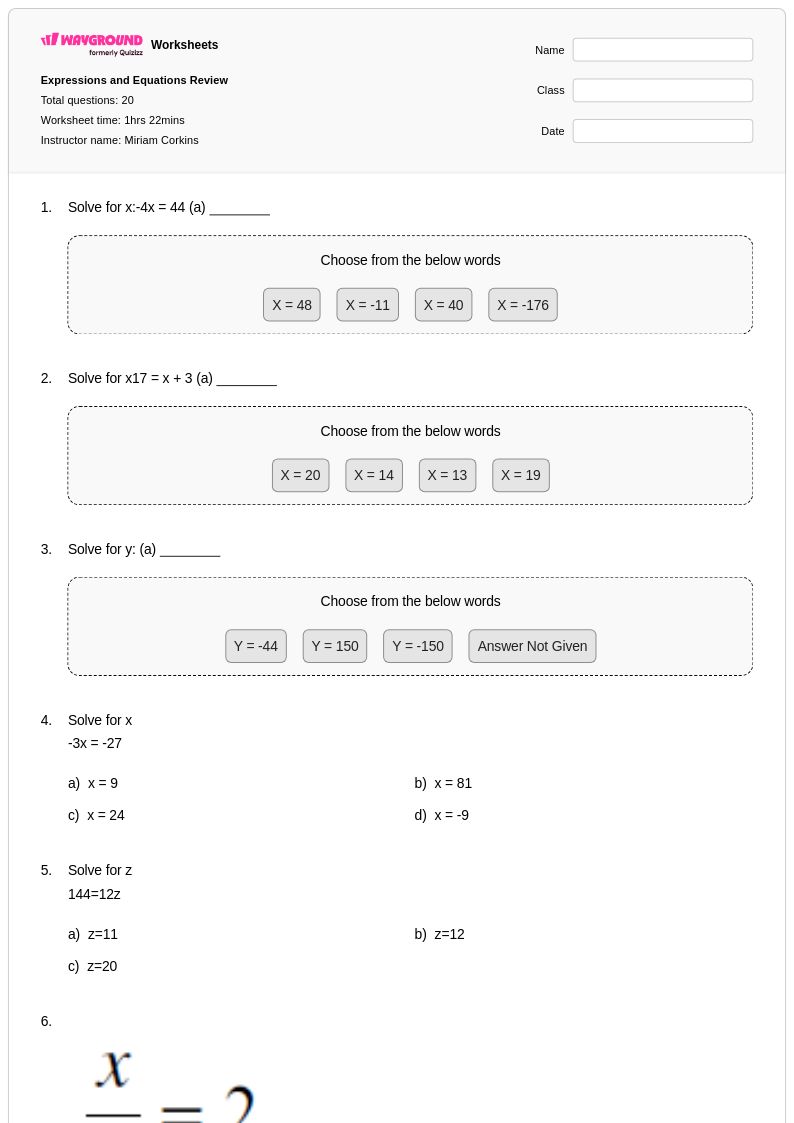
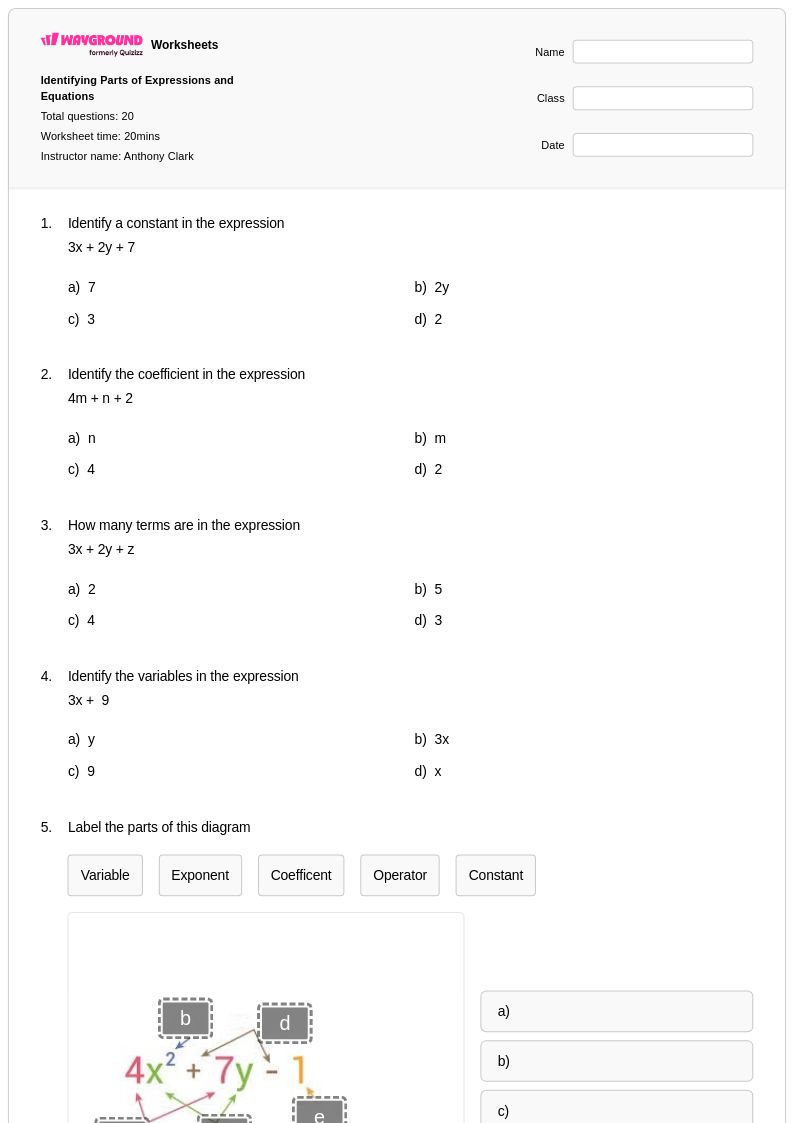
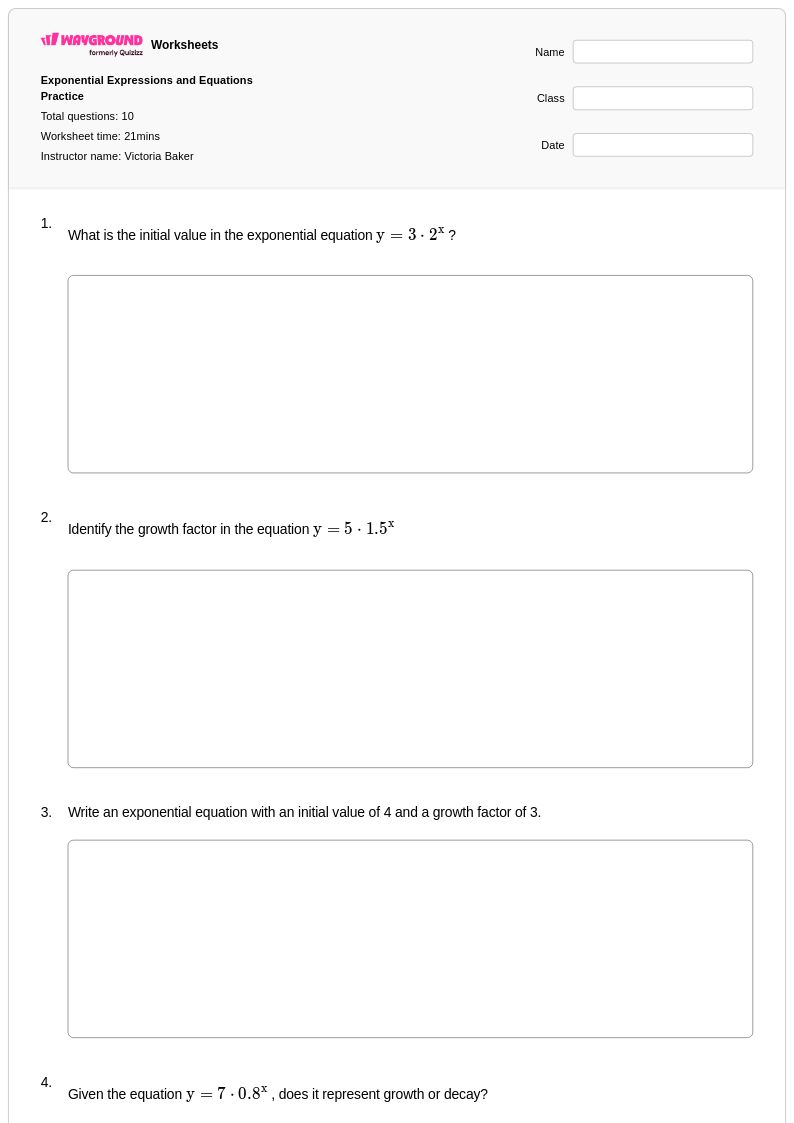
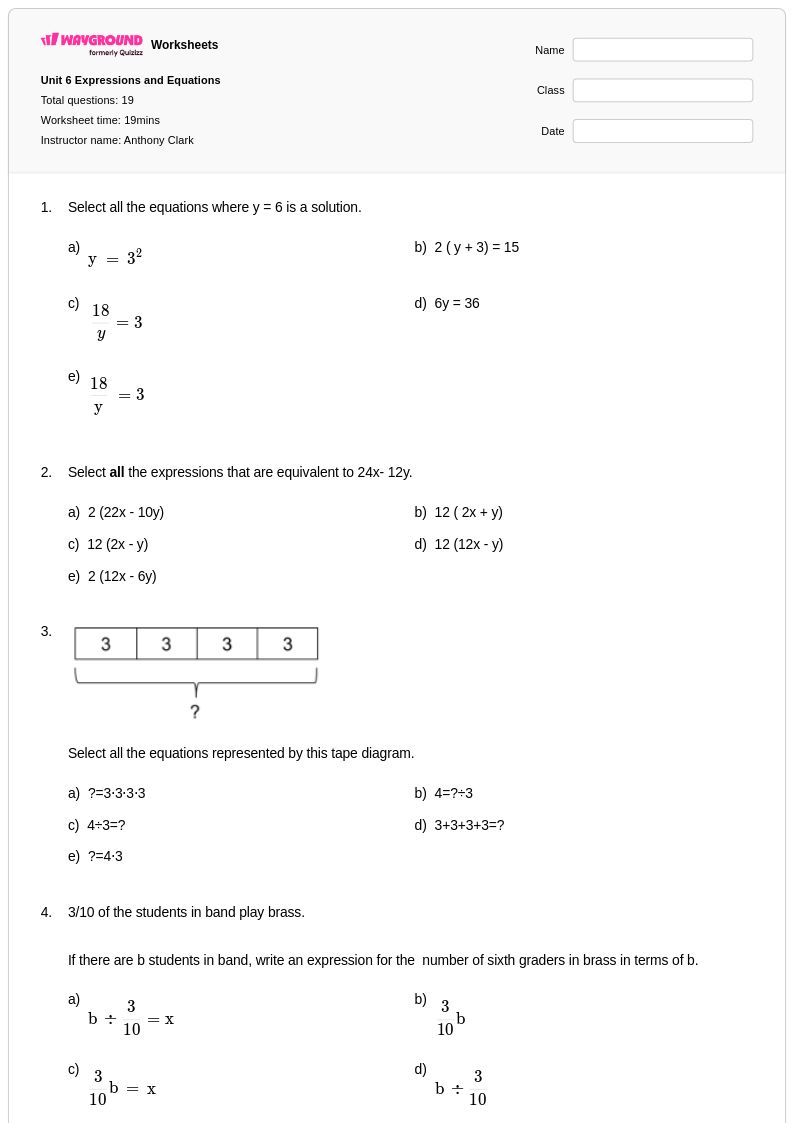
Free Printable Expressions and Equations Worksheets for Class 9
Class 9 expressions and equations worksheets from Wayground provide comprehensive printables and practice problems with answer keys to help students master algebraic manipulation, equation solving, and mathematical reasoning skills.
Explore printable Expressions and Equations worksheets for Class 9
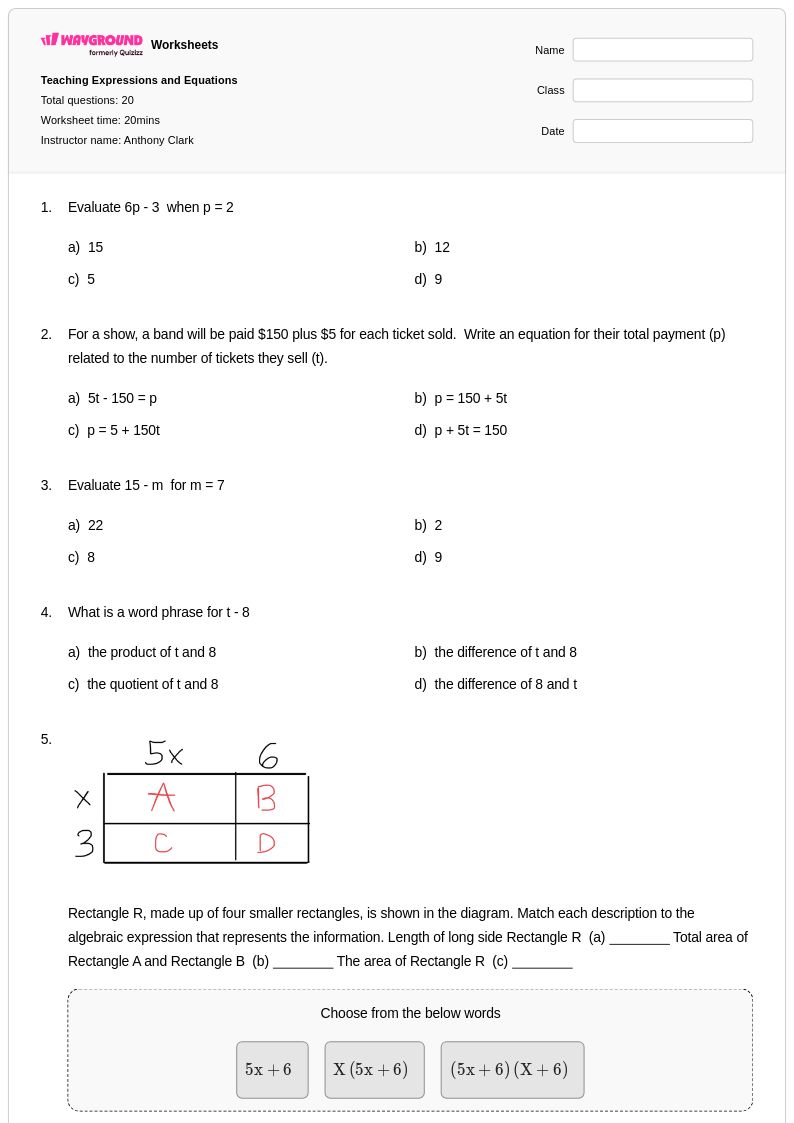
Class 9 expressions and equations worksheets available through Wayground (formerly Quizizz) provide comprehensive practice opportunities for students mastering fundamental algebraic concepts. These carefully designed resources strengthen essential skills including simplifying algebraic expressions, solving linear equations, working with variables and constants, and understanding the relationship between expressions and their equivalent forms. Students develop proficiency in combining like terms, applying the distributive property, isolating variables, and translating word problems into algebraic representations. Each worksheet collection includes detailed answer keys and is available as free printables in convenient pdf format, making them accessible for both classroom instruction and independent practice. The practice problems progress systematically from basic expression manipulation to more complex multi-step equation solving, ensuring students build confidence while reinforcing critical algebraic reasoning skills.
Wayground (formerly Quizizz) empowers educators with millions of teacher-created resources specifically focused on Class 9 expressions and equations, supported by robust search and filtering capabilities that allow instructors to locate materials aligned with specific learning standards and curriculum requirements. The platform's differentiation tools enable teachers to customize worksheets based on individual student needs, whether for remediation of foundational concepts or enrichment activities for advanced learners. These flexible resources are available in both printable and digital formats, including downloadable pdf versions, providing seamless integration into diverse instructional environments. Teachers can efficiently plan lessons, create targeted skill practice sessions, and implement data-driven interventions using these comprehensive worksheet collections, ultimately supporting student success in developing algebraic thinking and problem-solving competencies essential for advanced mathematics coursework.
FAQs
How do I teach expressions and equations in 9th grade?
By Grade 9, most students have seen linear equations before — the challenge is closing gaps and extending to new contexts, not re-teaching from scratch. A useful diagnostic first move: give students a short set of multi-step equations and watch where they break down. Students who struggle with rational coefficients need different remediation than students who can solve equations but can't set one up from a word problem. Grade 9 also introduces or deepens work with literal equations (solving for one variable in terms of others), which is worth explicit instruction because it looks unfamiliar even to students who are solid on numerical equations.
What should 9th graders practice with expressions and equations worksheets?
At Grade 9, priority practice areas include: multi-step linear equations with rational coefficients, solving literal equations for a specified variable, translating complex word problems into algebraic equations, and simplifying expressions involving multiple operations. Students preparing for Algebra 1 assessments also benefit from practice on equations with variables on both sides and recognizing special cases — no solution or identity — since these appear on standardized tests and trip up students who've only practiced equations with clean integer solutions.
What mistakes do 9th graders commonly make with expressions and equations?
Three errors show up repeatedly. First, sign errors when distributing a negative across a binomial — this is the single most common algebra mistake at any grade, and Grade 9 is no exception. Second, students solving literal equations (like solving A = lw for l) revert to guessing rather than applying inverse operations, because the absence of numbers makes the procedure feel different even when it isn't. Third, on multi-step word problems, students solve for x but forget to answer the actual question — x might be the number of hours, but the question asked for total cost.
How do I use Wayground's Grade 9 expressions and equations worksheets?
Each worksheet includes a complete answer key, so it's ready to use for practice, review, or test prep without additional prep work. Assign it as a digital quiz on Wayground for immediate feedback on which problems students are missing, or download the PDF for a paper-based session — useful before a unit test when you want students working through problems without device distractions. The Wayground for Teachers app lets you scan printed submissions for grading if you go the paper route.
How does Common Core sequence expressions and equations leading into Grade 9?
Common Core's Grade 8 standards bring students to multi-step linear equations, equations with variables on both sides, and an introduction to systems of equations. Grade 9 Algebra 1 — where Common Core's high school algebra standards begin — extends this to solving equations and inequalities in one variable, rearranging formulas, and reasoning about the structure of expressions. The critical progression step is that students move from solving equations procedurally to understanding why solution methods work, which is what makes Grade 9 algebra the gateway to all subsequent high school math.
How can I support Grade 9 students who are still struggling with foundational equation-solving?
For students with significant gaps, Wayground's reduced answer choices accommodation can help build confidence on equation-solving problems by narrowing the decision space while they rebuild fluency. The Read Aloud feature is worth enabling for students whose reading challenges slow them down on word problems — it removes a barrier that has nothing to do with their algebra ability. Both accommodations are set per student and don't affect how the assignment appears to the rest of the class.