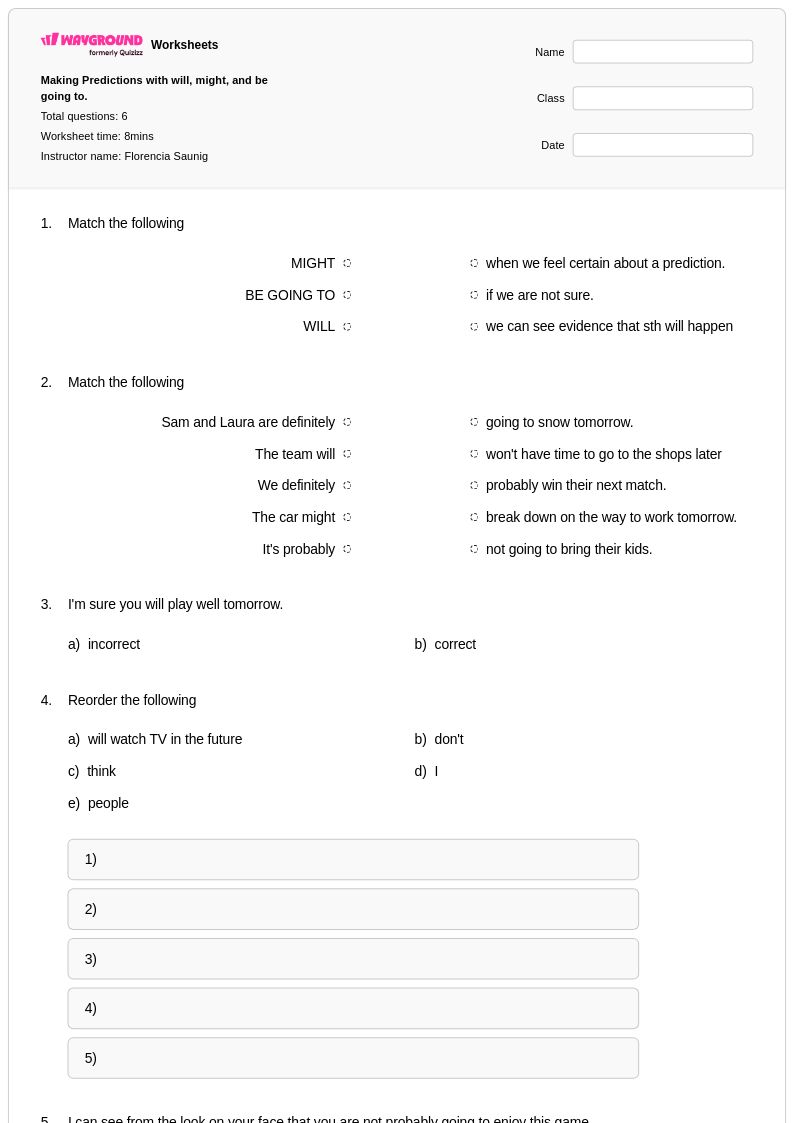
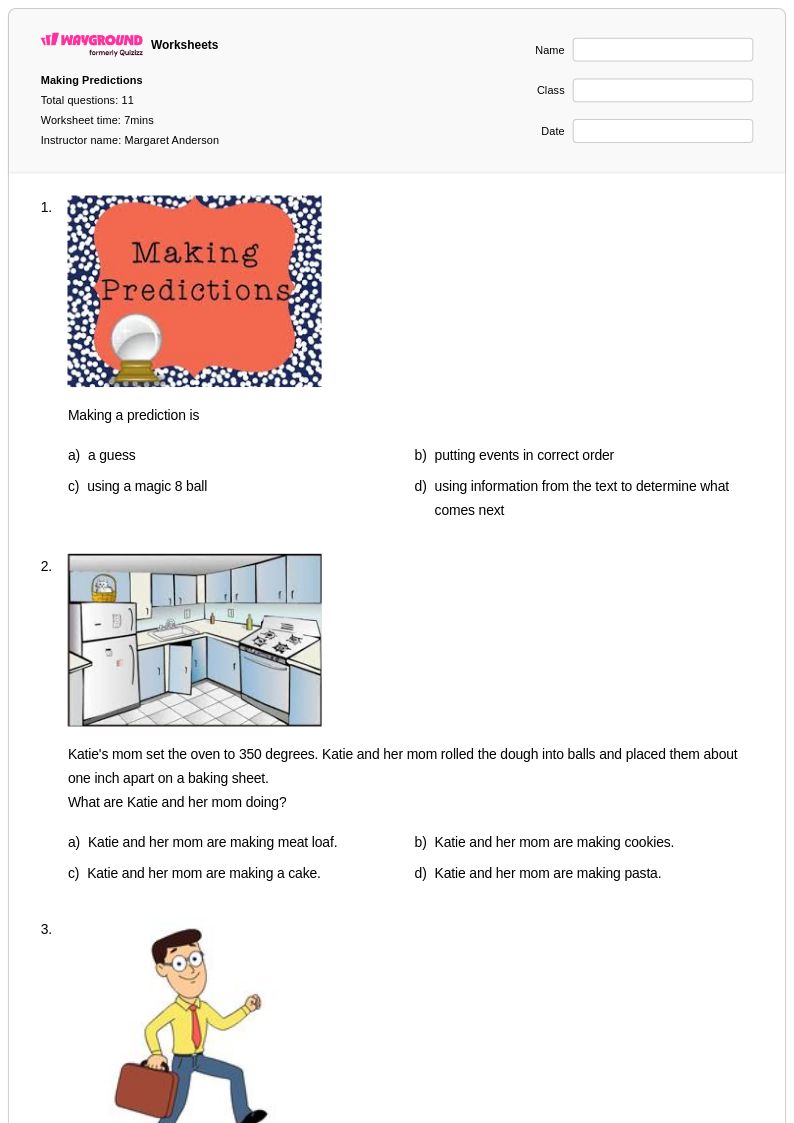
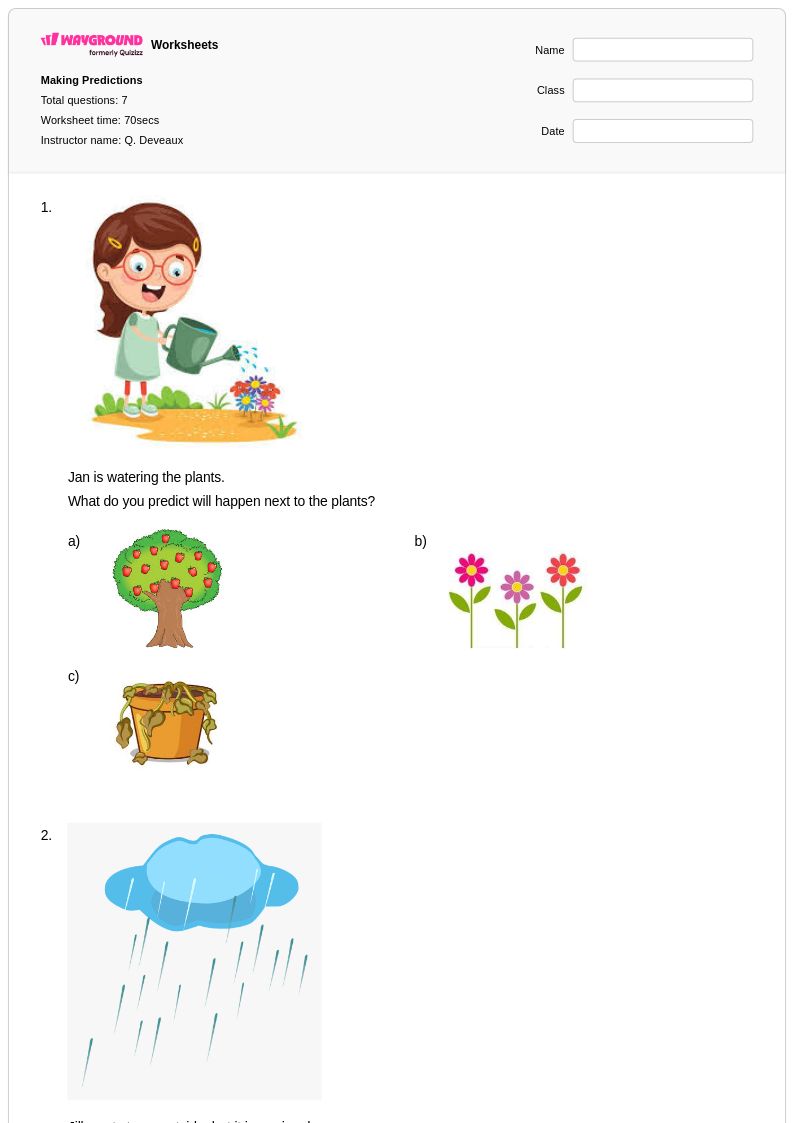
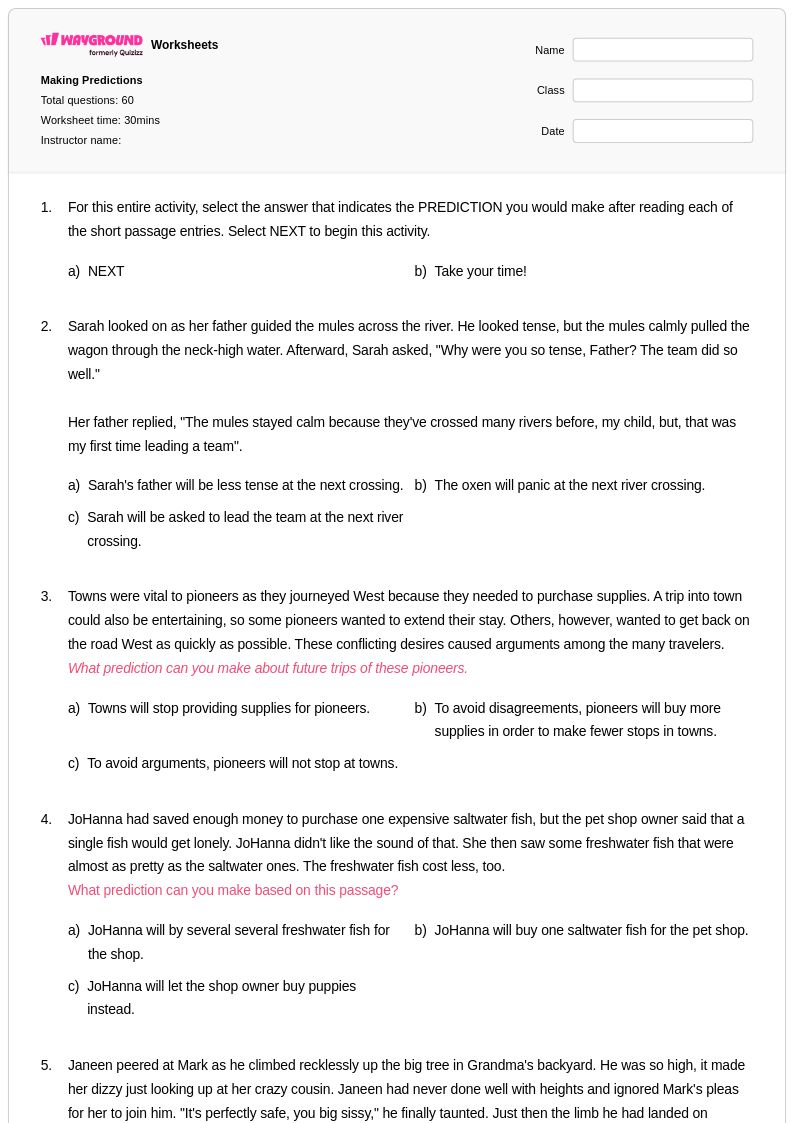
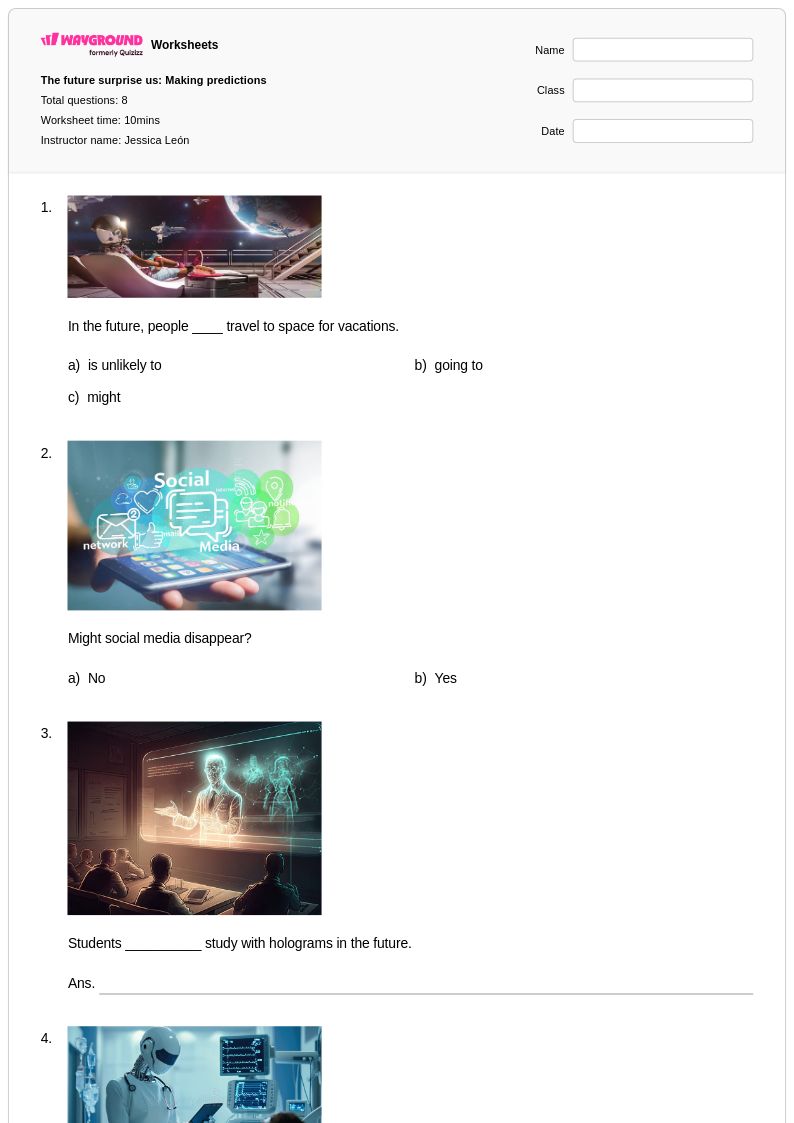
Enhance students' reading skills with free making predictions worksheets and printables from Wayground that help learners anticipate story outcomes through engaging practice problems and comprehensive answer keys.
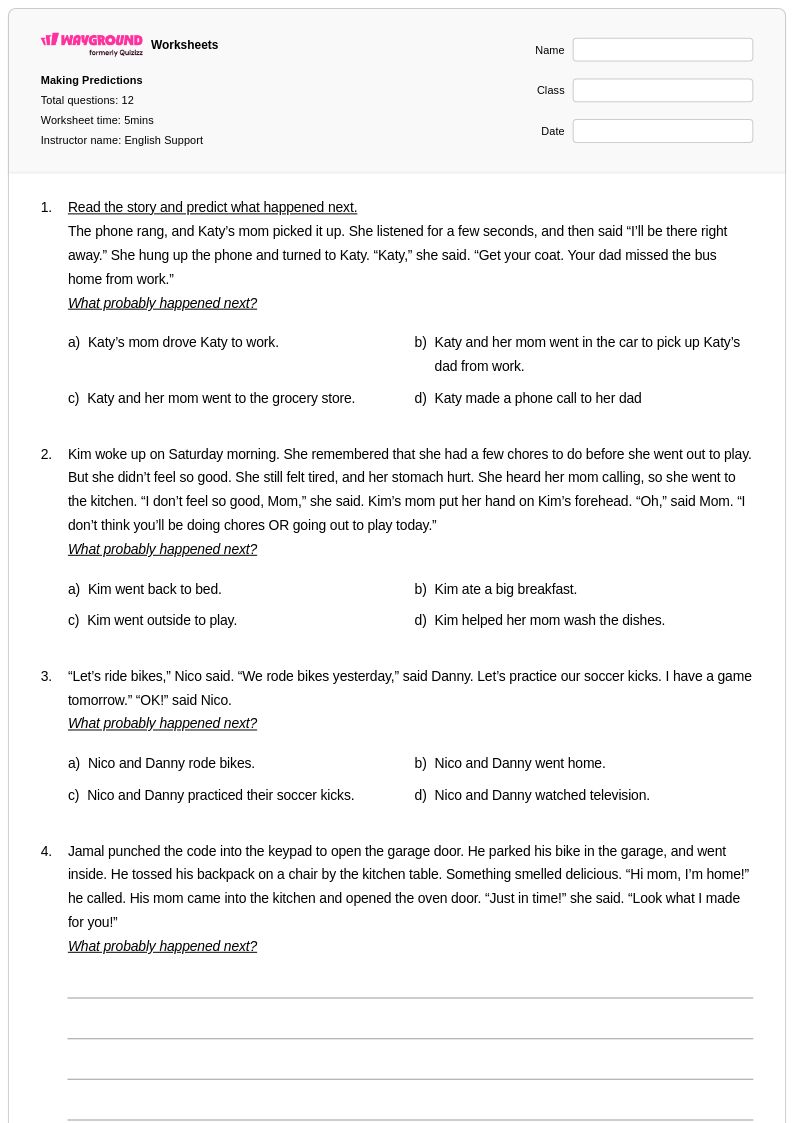
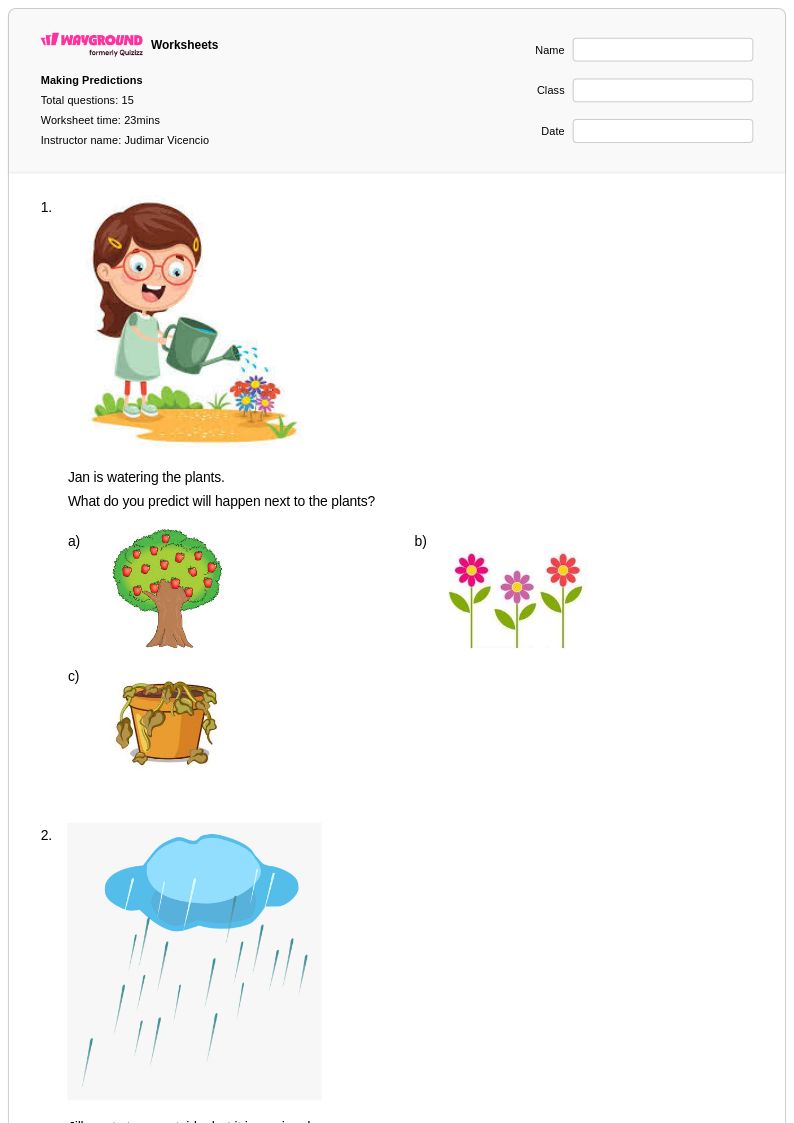
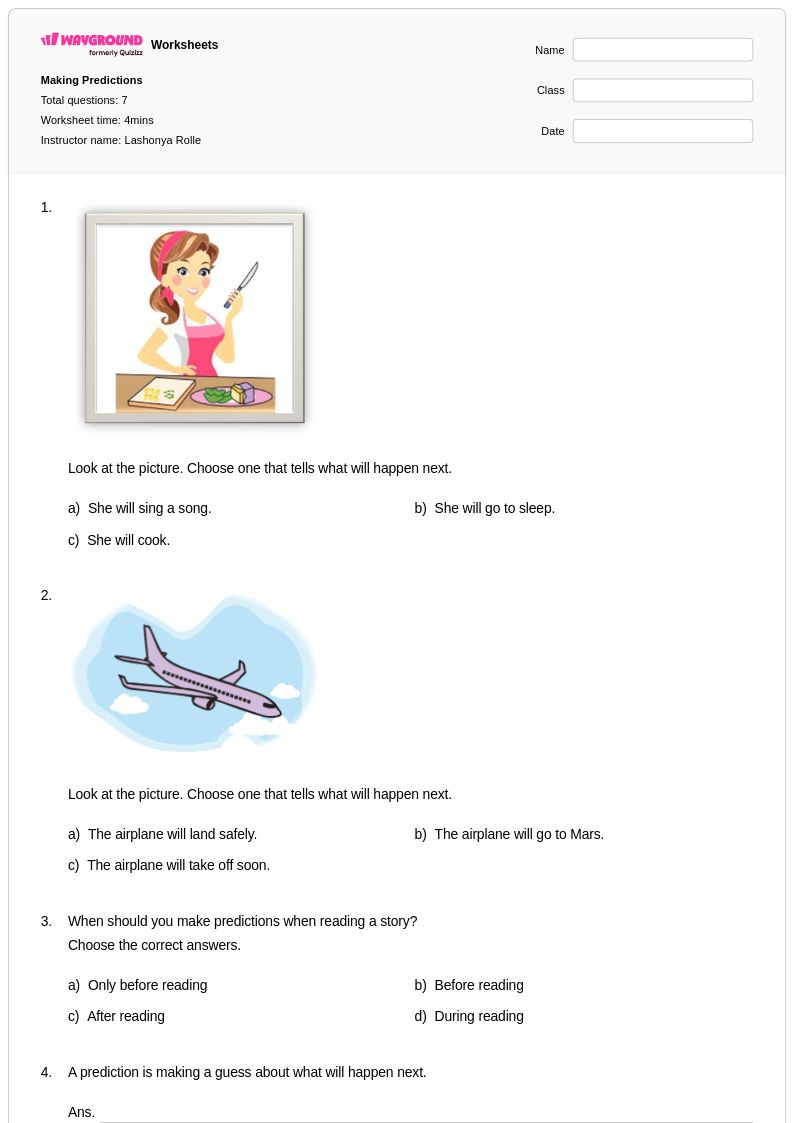
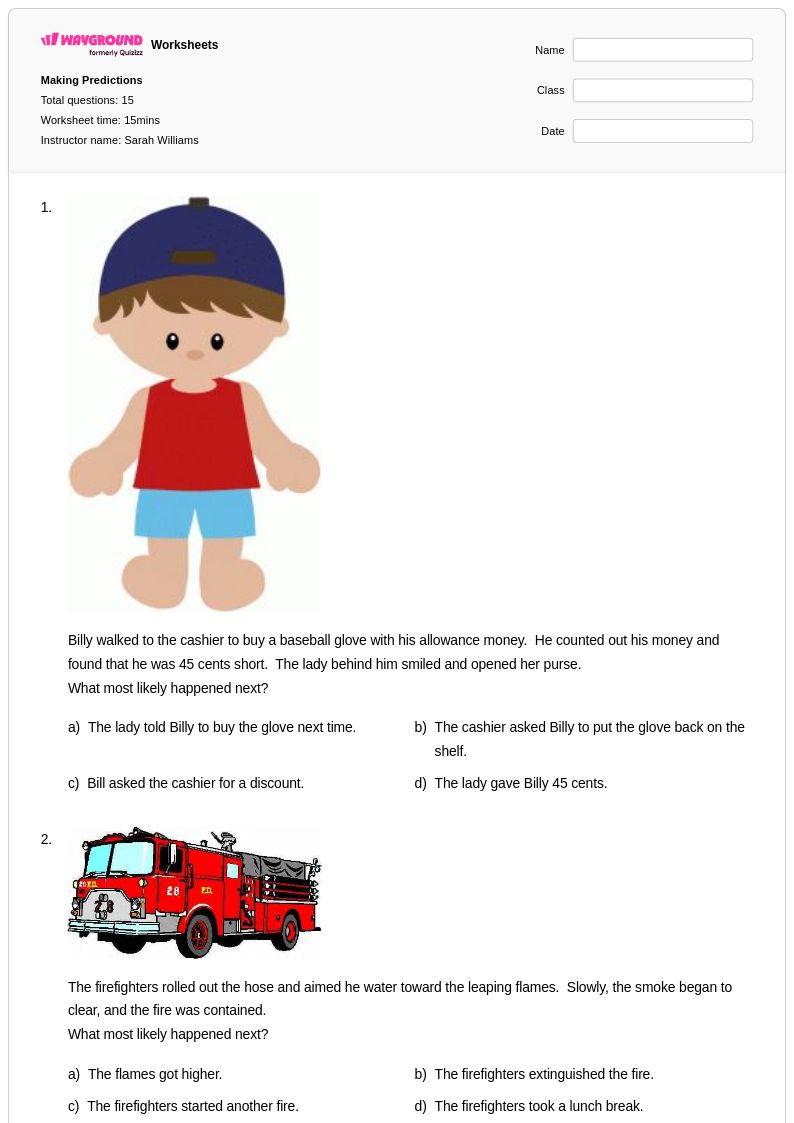
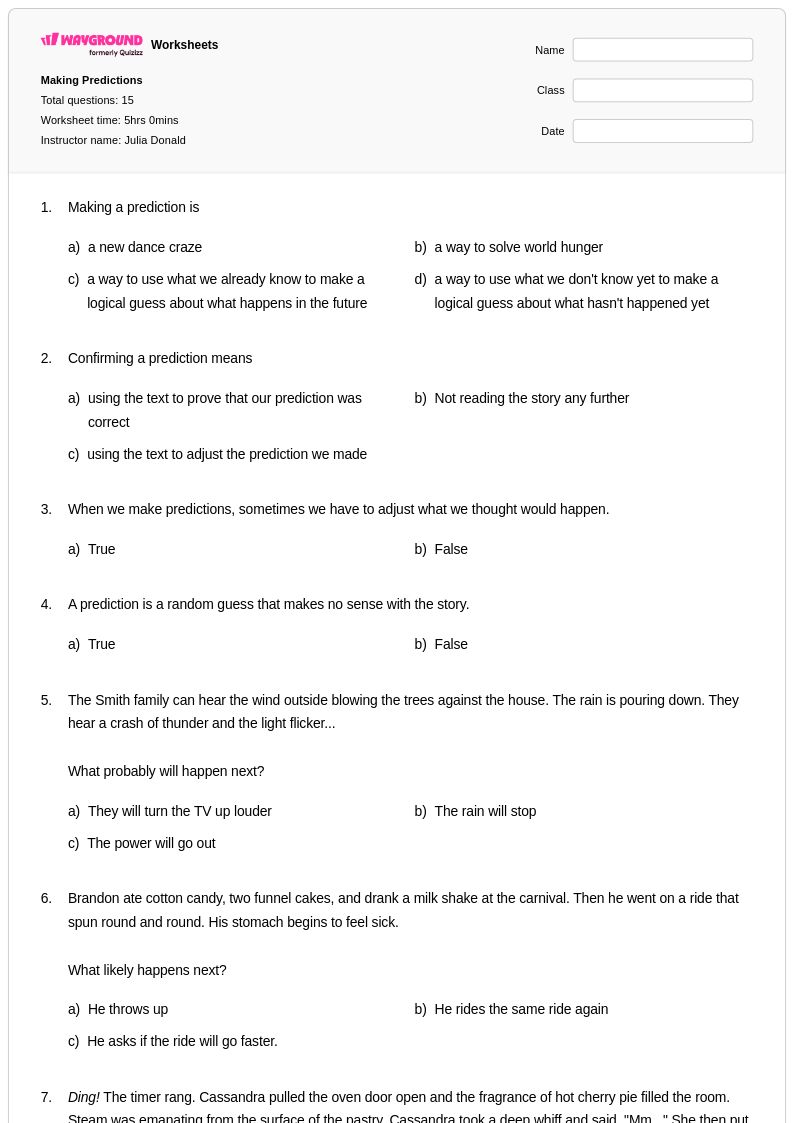
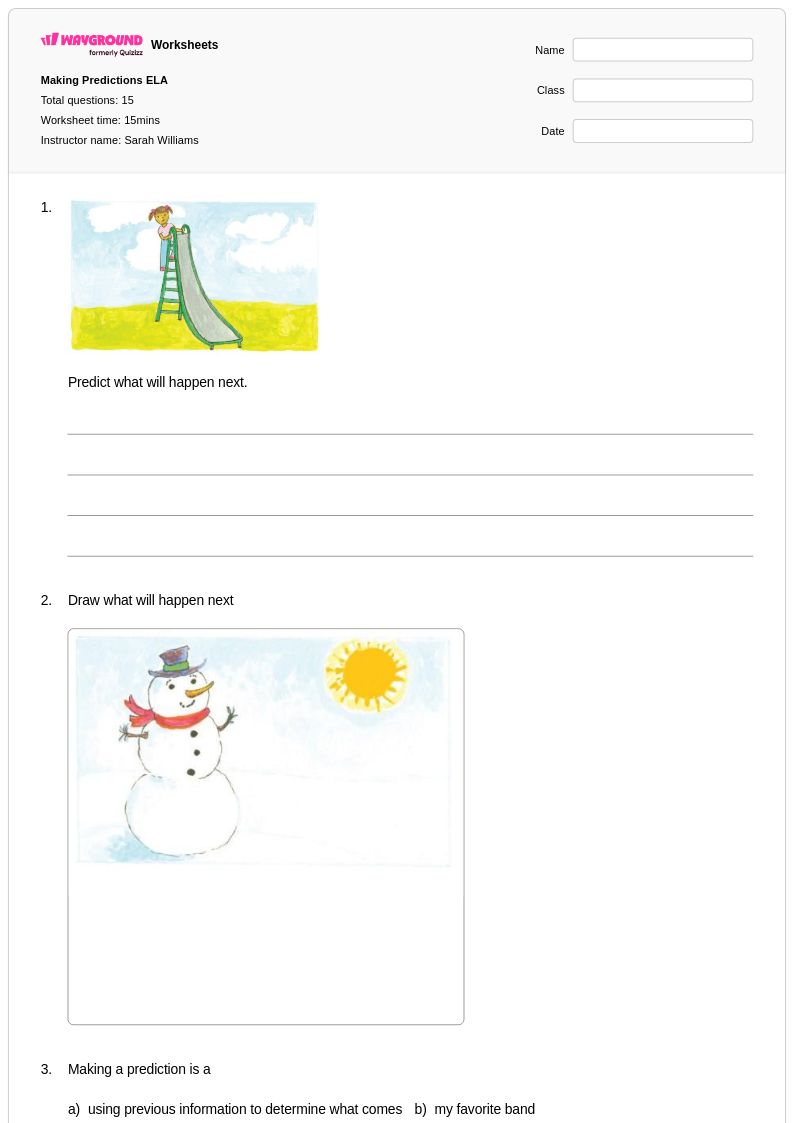
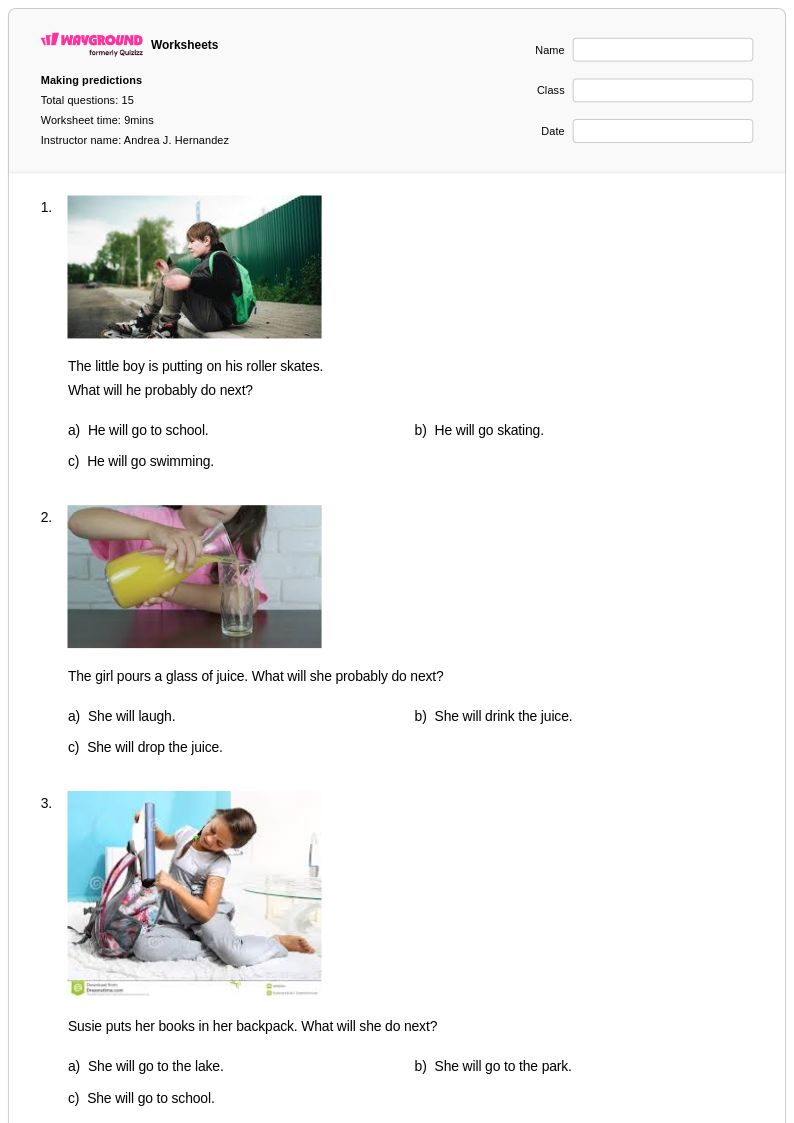
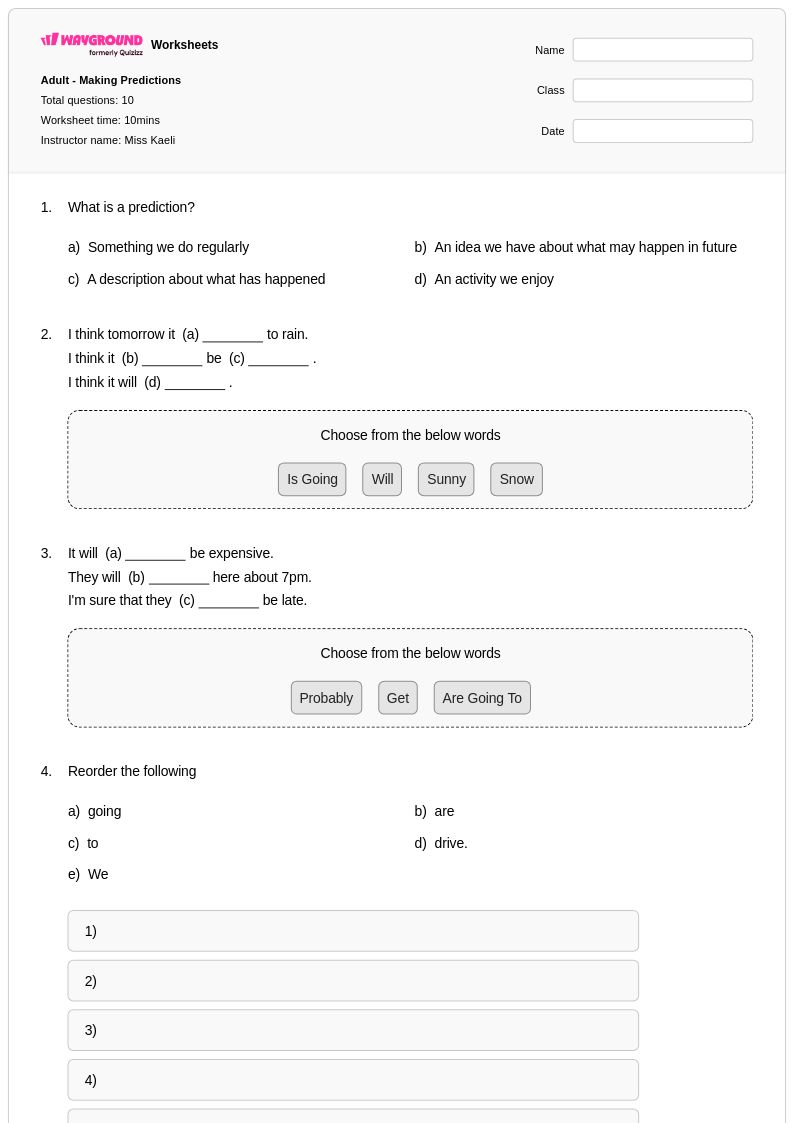
Making predictions worksheets available through Wayground (formerly Quizizz) provide students with structured opportunities to develop this essential reading comprehension strategy through guided practice and interactive exercises. These educational resources focus on teaching learners how to use textual evidence, prior knowledge, and contextual clues to make informed predictions about story outcomes, character actions, and plot developments. The worksheets strengthen critical thinking skills by requiring students to justify their predictions with supporting evidence from the text, creating a foundation for deeper literary analysis and comprehension. Each printable resource includes comprehensive practice problems that progress from basic prediction activities to more complex analytical tasks, with answer keys provided to support both independent learning and classroom instruction. These free materials offer educators ready-to-use pdf formats that can be seamlessly integrated into lesson plans focused on building predictive reading skills.
Wayground (formerly Quizizz) supports educators with an extensive collection of teacher-created making predictions worksheets, drawing from millions of educational resources developed by classroom professionals worldwide. The platform's robust search and filtering capabilities allow teachers to quickly locate materials that align with specific learning objectives and standards requirements, while differentiation tools enable customization for diverse learner needs and ability levels. These worksheets are available in both printable pdf formats and digital versions, providing flexibility for various instructional settings and learning preferences. Teachers can utilize these resources for targeted skill practice, remediation support for struggling readers, enrichment activities for advanced learners, and comprehensive lesson planning that addresses prediction strategies across different text types and genres. The platform's organizational features streamline the process of finding age-appropriate content that builds students' ability to anticipate textual developments while strengthening overall reading comprehension proficiency.
FAQs
How do I teach making predictions in reading?
Teaching making predictions works best when students are explicitly shown how to combine textual evidence, prior knowledge, and contextual clues before drawing conclusions about what comes next. Start by modeling the think-aloud process with a short passage, verbalizing how you notice specific details and connect them to a prediction. Gradually release responsibility by having students practice with guided texts before predicting independently. Reinforcing the habit of justifying predictions with evidence from the text builds both critical thinking and deeper comprehension.
What exercises help students practice making predictions?
Effective prediction practice exercises include stop-and-predict activities where students pause at key moments in a text and write what they expect to happen next, along with compare-and-revise tasks where they return to their prediction after reading to evaluate its accuracy. Worksheets that progress from basic prediction prompts to tasks requiring textual evidence help build this skill incrementally. Practicing across both fiction and nonfiction texts ensures students can apply prediction strategies to story outcomes, character actions, plot developments, and informational content alike.
What common mistakes do students make when learning to make predictions?
The most frequent mistake is making predictions based purely on personal opinion or imagination rather than evidence from the text, which undermines the reading comprehension purpose of the strategy. Students also commonly confuse predicting with summarizing, restating what already happened rather than anticipating what comes next. Another error is failing to revise predictions as new information emerges, treating an initial prediction as fixed rather than as a living hypothesis. Requiring students to cite specific textual evidence alongside every prediction directly addresses all three of these patterns.
How can I differentiate making predictions instruction for struggling readers?
For struggling readers, reduce cognitive load by starting with highly visual or familiar texts where contextual clues are obvious, and provide sentence frames such as 'I predict ___ because the text says ___' to scaffold the justification process. On Wayground, teachers can enable the Read Aloud accommodation so students hear the passage read to them, and can reduce answer choices for students who need additional support during digital practice. Extended time settings can also be assigned individually so struggling readers have space to process text without pressure, while the rest of the class works at the default pace.
How do I use making predictions worksheets in my classroom?
Making predictions worksheets on Wayground are available as printable PDFs for traditional classroom use and in digital formats for technology-integrated environments, giving teachers flexibility across instructional settings. Digital versions can be hosted as a quiz directly on Wayground, making it easy to assign prediction practice for independent work, small group sessions, or homework. Each worksheet includes a comprehensive answer key, supporting both teacher-led instruction and independent student learning.
How is making predictions different in fiction versus nonfiction texts?
In fiction, predictions typically focus on story outcomes, character decisions, and plot developments, with students drawing on narrative patterns and character motivation as evidence. In nonfiction, predictions are grounded in topic knowledge, text structure, and informational clues such as headings, captions, and prior content, with students anticipating what information or argument will come next. Teaching students to recognize these differences helps them apply the prediction strategy appropriately across text types rather than defaulting to a single approach.