
Wayground
Domain, Range, and Functions - Printable Mathematics Worksheets - Wayground

Domain, Range, and Functions

20 questions

8th - 9th Grade

Mathematics

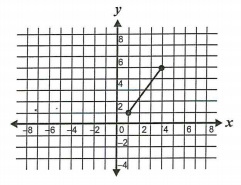
Domain, Range, and Functions is a free printable mathematics worksheet for Grades 8–9 Algebra I students. It contains 20 multiple-choice questions that ask learners to determine whether tables, mapping diagrams, graphs, and relations represent functions, including by applying the vertical line test and identifying when one x-value is paired with multiple y-values. The worksheet also builds accuracy in finding domain and range from tables and graphs. Students select values in least-to-greatest order and interpret interval notation, set-builder notation, inequalities, endpoints, and unbounded intervals, including cases involving all real numbers. Use it for guided practice, independent review, or a quick check of students’ understanding. A complete answer key is included with this free printable worksheet.

Worksheet settings

Font size

S
M
L
XL
Worksheets

Domain, Range, and Functions

Total questions: 20

Name
Class
Date
1.
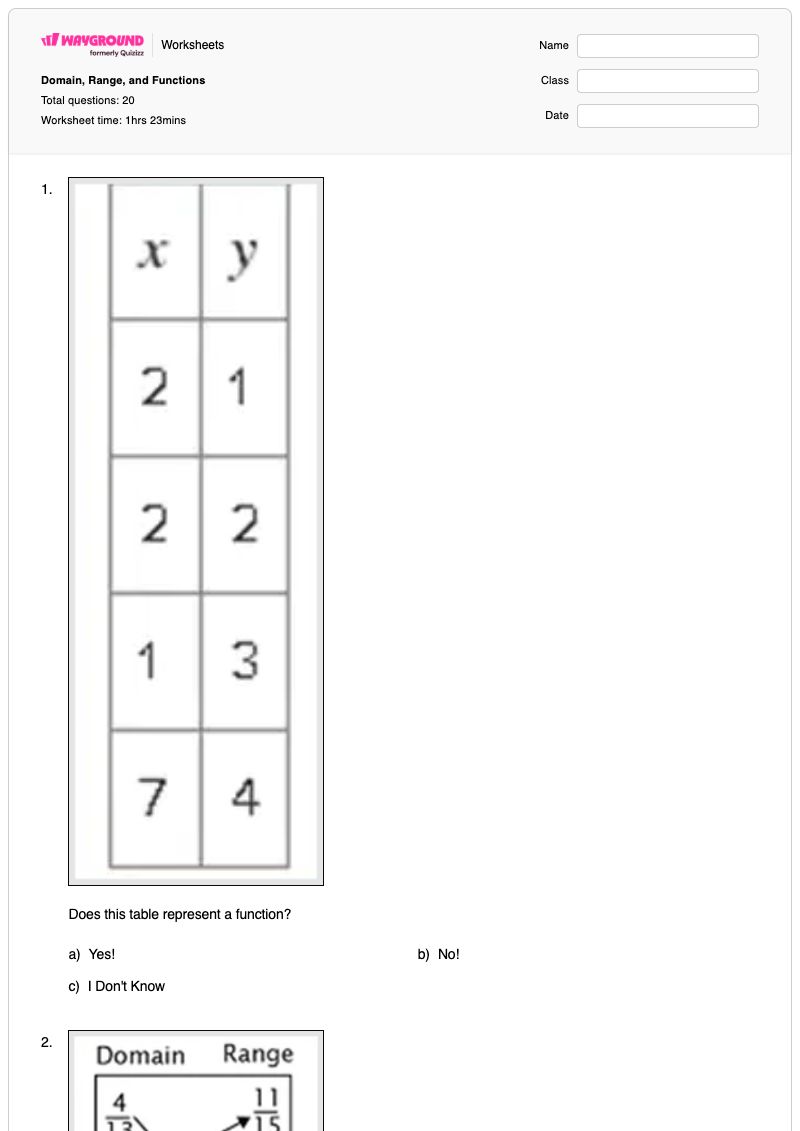
Does this table represent a function?
a)
Yes!
b)
No!
c)
I Don't Know
2.
Does this Mapping Diagram repersent a function?
a)
Function
b)
No Function
c)
I Don't Know
3.
Is this graph a function? (Vertical Line test)
a)
Yes
b)
No
c)
I Don't Know
4.
Is this relation a Function?
a)
Yes
b)
No
c)
I Don't Know
5.
The table of values are shown. What is the range of the relation? From least to greatest. 
a)
(-4,-8,-3)
b)
(-3,2,6)
c)
(-8,-4,4)
d)
(6,2,-3)
6.
Is the relation a function? Why?
a)
Yes, because the x-value 11 has two y-values pair with it.
b)
Yes, because each x-value has only one y-value paired with it.
c)
No, because the x-value 11 has two y-values pair with it.
d)
No, because each x-value has only one y-value paired with it.
7.
a)
Function
b)
Not a Function
8.
a)
Function
b)
Not a Function
9.
What is the domain of the graph?
a)
-3 ≤ x ≤ 3
b)
3 ≤ x ≤ -3
c)
-2 ≤ x ≤ 10
d)
-3 ≤ x ≤ 10
10.
What is the range of the graph?
a)
-2 < y < 10
b)
-3 < x < 3
c)
-2 ≤ y ≤ 10
d)
-3≤ x ≤ 3
11.
What is the domain of the graph?
a)
{x| -∞ ≤ x ≤ ∞}
b)
(-∞,∞)
c)
-3 ≤ x ≤ 3
d)
-15 ≤ y ≤ 9
12.
What is the range of the graph?
a)
-15 < y < ∞
b)
(-∞, ∞)
c)
(-15, ∞)
d)
[-15, ∞)
13.
What is the domain of the function?
a)
{x| x = all real numbers}
b)
{x| -2 < x < 4}
c)
{x| -2 ≤ x ≤ 4}
d)
{x| -6 ≤ x ≤ 3}
14.
What is the range of this functions?
a)
{y| -6 ≤ y ≤ 3}
b)
{y| -6 < y < 3}
c)
{y|y = all real numbers}
d)
{y| -2 ≤ y ≤ 4}
15.
What is the domain of the graph?
a)
x≤0
b)
x≥0
c)
All real numbers
d)
y≥0
16.
What is the range of the graph?
a)
x≤0
b)
y≥0
c)
y≤0
d)
All real numbers
17.
What is the domain of the function?
a)
x>3 
b)
x≥-3
c)
y≤4
d)
y<4
18.
What is the range of the graph?
a)
1 ≤ x ≤ 5
b)
1 < x < 5
c)
1 ≤ y ≤ 5
d)
1 < y < 5
19.
What is the range of the function given below?
a)
0 ≤ y ≤ 7
b)
-2 ≤ y ≤ 4
c)
.2 ≤ y ≤ 4
d)
All real numbers
20.
What is the domain of the graph?
a)
-7 ≤ x < 5
b)
-3 ≤ x < 1
c)
-3 ≤ y < 1
d)
-7 ≤ y < 5
Answer Key

Domain, Range, and Functions

Total questions: 20

1.
b) No!
2.
b) No Function
3.
a) Yes
4.
b) No
5.
c) (-8,-4,4)
6.
c) No, because the x-value 11 has two y-values pair with it.
7.
a) Function
8.
b) Not a Function
9.
a) -3 ≤ x ≤ 3
10.
c) -2 ≤ y ≤ 10
11.
b) (-∞,∞)
12.
d) [-15, ∞)
13.
c) {x| -2 ≤ x ≤ 4}
14.
a) {y| -6 ≤ y ≤ 3}
15.
b) x≥0
16.
d) All real numbers
17.
b) x≥-3
18.
c) 1 ≤ y ≤ 5
19.
b) -2 ≤ y ≤ 4
20.
a) -7 ≤ x < 5

FAQs

What does the Domain, Range, and Functions worksheet cover?

This Grade 8–9 Algebra I worksheet uses 20 multiple-choice questions to assess two connected skills: identifying functions from tables, mapping diagrams, relations, and graphs, and determining domain and range from tables and graphs. Students apply the vertical line test, recognize when an x-value has multiple y-values, and interpret answers using inequalities, interval notation, and set-builder notation.

How can I use this worksheet to teach functions, domain, and range?

Begin by reviewing that a function assigns only one y-value to each x-value, then model the vertical line test and one example involving a repeated x-value. Have students explain their choices on the function-identification items before moving to the domain-and-range questions, where they read x-values and y-values from tables or graphs and select the correct notation. Ask students to justify whether endpoints are included and whether the graph extends across all real numbers.

What mistakes should I watch for on this functions, domain, and range worksheet?

Students may confuse domain with range by selecting y-values for a domain question or x-values for a range question. They may also mark a relation as a function even when one x-value is paired with two y-values, or misapply the vertical line test. On the graph items, watch for reversed inequality symbols, omitted endpoint inclusion, and confusing interval notation such as a bounded interval with all real numbers.

How do I assign and grade this worksheet?

This Domain, Range, and Functions worksheet is available as a printable PDF and as a digital quiz on Wayground, with a complete answer key for all 20 multiple-choice questions. You can assign the digital version for online responses or print copies for students; printable submissions can be graded by scanning student work with the Wayground for Teachers app.

How can I differentiate this domain, range, and functions worksheet?

Use the worksheet’s Advanced Settings to adjust font spacing and font size so the graph, table, and mapping-diagram questions are easier to read. You can also select a dyslexia-friendly font or translate the worksheet into another language when helpful for students working through the function-identification and domain-and-range items.

Where can I find more worksheets like this on Wayground?

Wayground offers a comprehensive collection of free printable worksheets and practice problems across subjects, with downloadable PDFs and answer keys to help students master essential skills and concepts. Browse more resources at https://wayground.com/en-us/worksheets.