
 Worksheets
Linear Programming Practice - Algebra 2
Total questions: 13
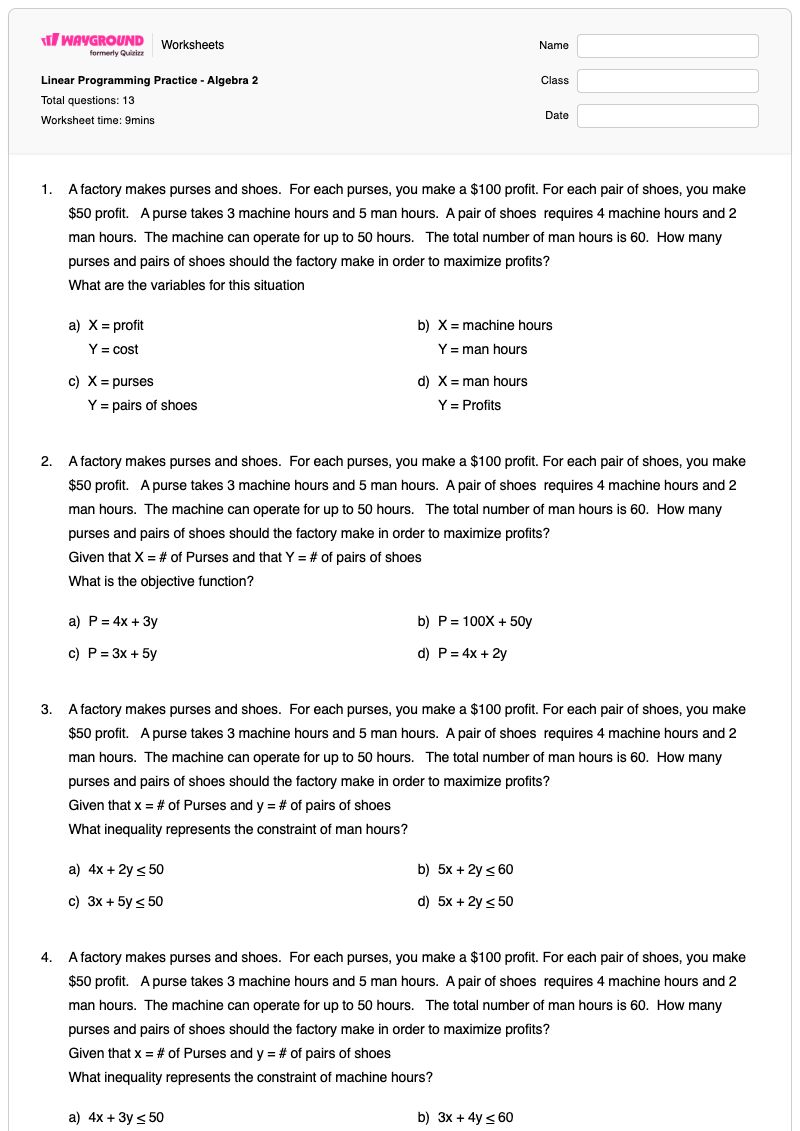
A factory makes purses and shoes. For each purses, you make a $100 profit. For each pair of shoes, you make $50 profit. A purse takes 3 machine hours and 5 man hours. A pair of shoes requires 4 machine hours and 2 man hours. The machine can operate for up to 50 hours. The total number of man hours is 60. How many purses and pairs of shoes should the factory make in order to maximize profits?
What are the variables for this situation
X = profit
Y = cost
X = machine hours
Y = man hours
X = purses
Y = pairs of shoes
X = man hours
Y = Profits
A factory makes purses and shoes. For each purses, you make a $100 profit. For each pair of shoes, you make $50 profit. A purse takes 3 machine hours and 5 man hours. A pair of shoes requires 4 machine hours and 2 man hours. The machine can operate for up to 50 hours. The total number of man hours is 60. How many purses and pairs of shoes should the factory make in order to maximize profits?
Given that X = # of Purses and that Y = # of pairs of shoes
What is the objective function?
P = 4x + 3y
P = 100X + 50y
P = 3x + 5y
P = 4x + 2y
A factory makes purses and shoes. For each purses, you make a $100 profit. For each pair of shoes, you make $50 profit. A purse takes 3 machine hours and 5 man hours. A pair of shoes requires 4 machine hours and 2 man hours. The machine can operate for up to 50 hours. The total number of man hours is 60. How many purses and pairs of shoes should the factory make in order to maximize profits?
Given that x = # of Purses and y = # of pairs of shoes
What inequality represents the constraint of man hours?
4x + 2y < 50
5x + 2y < 60
3x + 5y < 50
5x + 2y < 50
A factory makes purses and shoes. For each purses, you make a $100 profit. For each pair of shoes, you make $50 profit. A purse takes 3 machine hours and 5 man hours. A pair of shoes requires 4 machine hours and 2 man hours. The machine can operate for up to 50 hours. The total number of man hours is 60. How many purses and pairs of shoes should the factory make in order to maximize profits?
Given that x = # of Purses and y = # of pairs of shoes
What inequality represents the constraint of machine hours?
4x + 3y < 50
3x + 4y < 60
3x + 4y < 50
5x + 2y < 60
The Wily Monka Chocolate Factory makes 2 kinds of candies: Everlasting Goobstoopers and Monka Bars. The profit for a case of Everlasting Goob Stoopers is $20. The profit for a case of Monka Bars is $35. The goobstoopers have to have 4 machine hours and 5 man hours. The Monka bar has to have 5 machine hours and 10 man hours. There are only 410 machine hours and 700 Man hours available. How many cases of each kind of candy should the factory make to maximize profit?
How would you define your varaibles for this problem?
x = Profit
y = cst
x = cases of Everlasting Goobstoopers
Y = cases of Monka Bars
x = candies
y = hours
x = man hours
y = machine hours
The Wily Monka Chocolate Factory makes 2 kinds of candies: Everlasting Goobstoopers and Monka Bars. The profit for a case of Everlasting Goob Stoopers is $20. The profit for a case of Monka Bars is $35. The goobstoopers have to have 4 machine hours and 5 man hours. The Monka bar has to have 5 machine hours and 10 man hours. There are only 410 machine hours and 700 Man hours available. How many cases of each kind of candy should the factory make to maximize profit?
Given that x = cases od Everlastign Goobstoopers and y = cases of Monka Bars
What is the objective function?
P = 20x + 35y
P = 4x + 5y
P = 35x + 20y
P = 5x + 10y
The Wily Monka Chocolate Factory makes 2 kinds of candies: Everlasting Goobstoopers and Monka Bars. The profit for a case of Everlasting Goob Stoopers is $20. The profit for a case of Monka Bars is $35. The goobstoopers have to have 4 machine hours and 5 man hours. The Monka bar has to have 5 machine hours and 10 man hours. There are only 410 machine hours and 700 Man hours available. How many cases of each kind of candy should the factory make to maximize profit?
Given that x = cases od Everlastign Goobstoopers and y = cases of Monka Bars
What are the TWO constraint inequalities?
4x + 5y < 410
4x + 5y < 700
5x + 10y < 410
5x + 10y < 700
A factory makes soccer balls and basketballs. The soccer ball requires 4 hours in the fabrication department and the basketball requires 2 hours in the fabrication department. The soccer ball requires 1 hour in the finishing department and the basketball requires 2 hours in the finishing department. The fabrication department has 100 hours available per day and the finishing department has 40 hour available per day. If the profit on the soccer ball is $8 and the profit on the basketball is $10, how many of each should be produced each day to maximize profit?
Define your variables.
x = fabrication hours
y = finishing hours
x = Profit
y = cost
x = # of workers in the factory
y = the # of hours the factory is open
x = # of soccer balls
y =# of basketballs
A factory makes soccer balls and basketballs. The soccer ball requires 4 hours in the fabrication department and the basketball requires 2 hours in the fabrication department. The soccer ball requires 1 hour in the finishing department and the basketball requires 2 hours in the finishing department. The fabrication department has 100 hours available per day and the finishing department has 40 hour available per day. If the profit on the soccer ball is $8 and the profit on the basketball is $10, how many of each should be produced each day to maximize profit?
Given that x = # of soccer balls and y = # of basketballs
What is the objective function?
P = 10x + 8y
P = 8x + 10y
P = 4x + 2y
P = x + 2y
A factory makes soccer balls and basketballs. The soccer ball requires 4 hours in the fabrication department and the basketball requires 2 hours in the fabrication department. The soccer ball requires 1 hour in the finishing department and the basketball requires 2 hours in the finishing department. The fabrication department has 100 hours available per day and the finishing department has 40 hour available per day. If the profit on the soccer ball is $8 and the profit on the basketball is $10, how many of each should be produced each day to maximize profit?
Given that x = # of soccer balls and y = # of basketballs
What are the TWO inequalities that represent the constraints?
4x + 2y < 40
4x + 2y < 100
x + 2y < 40
x + 2y < 100
A farmer can plant up to 6 acres of land with soybeans and corn. Her use of a necessary pesticide is limited by federal regulations to 15 gallons for her entire 6 acres. Soybeans require 2 gallons of pesticide for every acre planted and corn requires 3 gallons per acre. The profit the farmer makes by earning $4,000 for every acre of soybeans she plants and $3,000 for every acre she plants with barley can be modeled by P=4000x+3000y . If x represents acres of soybeans and y represents acres of corns, which inequalities represent the constraints of the problem?
x≥0
y≥0
x+y≥6
3x+2y≥15
x≥0
y≥0
x+y≤6
2x+3y≤15
x≥0
y≥0
4000x+y≤6
2x+600y≤15
P=4000x+3000y

Select an objective function that models the total profit from cobblers and pies.
P=2x+3y
P=5x+6y
P=3x+2y
P=3x+5y
A farmer has a field where he can plant either wheat or barley or a combination of both. Each hectare of wheat requires 3 units of water and 2 units of fertilizer, while each hectare of barley requires 2 units of water and 3 units of fertilizer. If the farmer has 15 units of water and 15 units of fertilizer available, which of the following represents the constraint for the fertilizer?
2x+3y≤15
3x+2y≤15
2x+2y≤15
3x+3y≤15
Answer KeyLinear Programming Practice - Algebra 2
Total questions: 13
X = purses
Y = pairs of shoes
P = 100X + 50y
5x + 2y < 60
3x + 4y < 50
x = cases of Everlasting Goobstoopers
Y = cases of Monka Bars
P = 20x + 35y
4x + 5y < 410
, d)5x + 10y < 700
x = # of soccer balls
y =# of basketballs
P = 8x + 10y
4x + 2y < 100
, c)x + 2y < 40
x≥0
y≥0
x+y≤6
2x+3y≤15
P=3x+5y
2x+3y≤15