

Wayground
SLO Algebra 2: Transformations  - Printable Mathematics Worksheets - Wayground

SLO Algebra 2: Transformations

20 questions

10th - 10th Grade

Mathematics

SLO Algebra 2: Transformations is a Grade 10 mathematics worksheet with 20 multiple-choice questions on transforming parent functions. Students interpret graphs and equations involving reflections across the x- and y-axes, horizontal and vertical translations, vertical stretches and compressions, and changes to quadratic and absolute value functions. The questions ask students to connect algebraic notation with visual effects, identify an equation from a graph, describe transformations in words, and compare the width of transformed parabolas. This free printable worksheet supports practice or formative assessment of function transformations and includes a complete answer key for efficient checking.

Worksheet settings

Font size

S
M
L
XL
Worksheets

SLO Algebra 2: Transformations

Total questions: 20

Name
Class
Date
1.
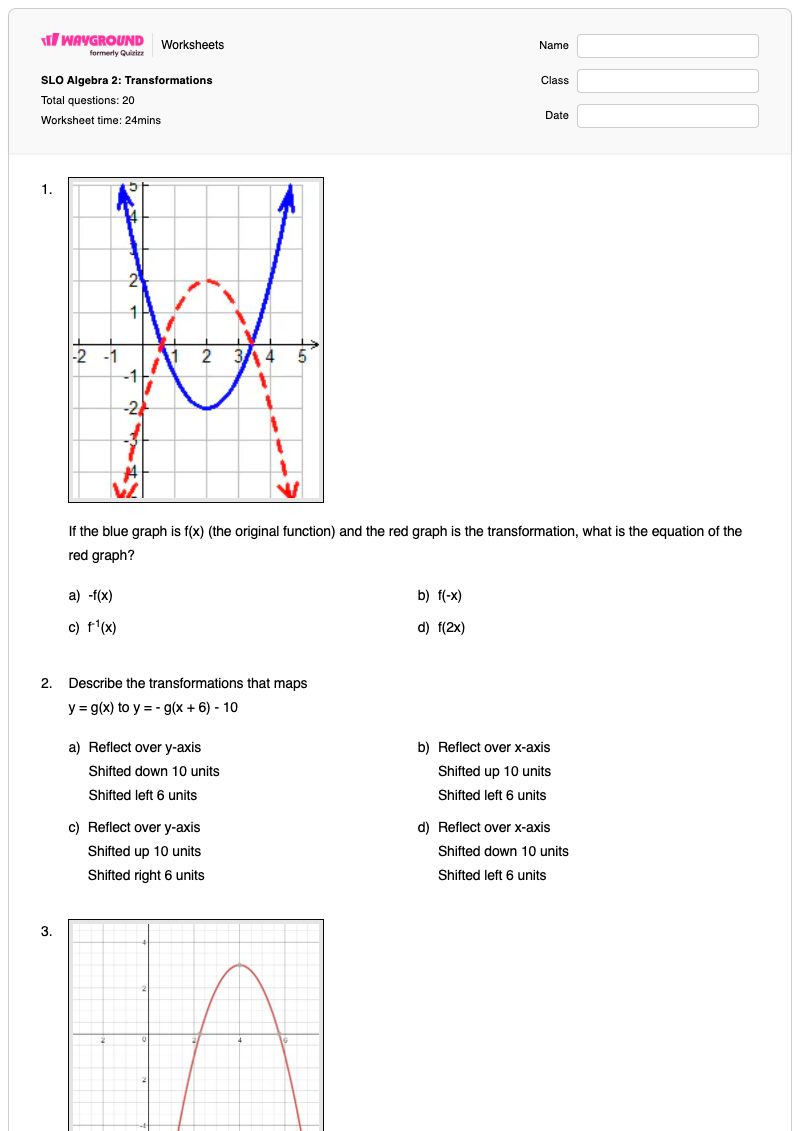
If the blue graph is f(x) (the original function) and the red graph is the transformation, what is the equation of the red graph?
a)
-f(x)
b)
f(-x)
c)
f-1(x)
d)
f(2x)
2.
Describe the transformations that maps
y = g(x) to y = - g(x + 6) - 10
a)
Reflect over y-axis
Shifted down 10 units
Shifted left 6 units
b)
Reflect over x-axis
Shifted up 10 units
Shifted left 6 units
c)
Reflect over y-axis
Shifted up 10 units
Shifted right 6 units
d)
Reflect over x-axis
Shifted down 10 units
Shifted left 6 units
3.
Which equation represents this graph.
a)
f(x)=(x - 4)2 - 3
b)
f(x)=-(x - 4)2 + 3
c)
f(x)=(x - 4)2 + 3
d)
f(x)=-(x + 4)2 + 3
4.

Describe the transformation from the parent graph

a)

Reflect over x, right 3, down 4

b)

Reflect over y, right 3, down 4

c)

Reflect over x, right 3, up 4

d)

Reflect over y, left 3, down 4

5.

Parent function:
f(x)=∣x∣f\left(x\right)=\left|x\right|  
Describe how the following graph is related to the parent graph: f(x)=12∣x∣f\left(x\right)=\frac{1}{2}\left|x\right|  

a)

Compresses closer/ More narrow

b)

Gets wider 

c)

Shifts up

d)

Shifts down

6.
The graph shows the function f(x)=x2 in blue and another function g(x) in red.  Which could be the equation for g(x)?
a)
A.  g(x) = 2x2
b)
B.  g(x) = 1/2x2
c)
C.  g(x) = x2 + 2
d)
D.  g(x) = (x + 2)2
7.

Which transformation will occur if f(x) = x is replaced with 2f(x)?

a)

Vertical stretch by a factor of 2

b)

Vertical compression by a factor of 1/2

c)

Vertical translation up by 2 units.

d)

Horizontal compression by a factor of 1/2

8.
Describe the transformation of the equation below from the parent function of y = I x I
y = -2 I x - 3 I + 3
a)
reflected over x axis, stretched by 2, right 3, up 3
b)
reflected over x axis, stretched by 2, left 3 up 3.
c)
reflected over x axis, shrunk by 2, right 3, up 3
d)
reflected over the x axis, shrunk by 2, left 3, up 3
9.

What does the transformation f(x) → 13f(x)+4f\left(x\right)\ \rightarrow\ \frac{1}{3}f\left(x\right)+4 do to the graph of  f(x)f\left(x\right)  ?

a)

Shrinks the graph vertically by a factor of 1/3 and translates up 4 units.

b)

Stretches the graph by a factor of 3 and translates up 4 units.

c)

Translates the graph left 1/3 of a unit and up 4 units.

d)

Translates the graph right 3 unites and down 4 units.

10.

In the equation f(x)=5(x+3)2-10 what effect does the 5 do when compared to the parent function?

a)

Vertical stretch by a factor of 5

b)

Vertical compress by a factor of 5

c)

Reflect over x-axis

d)

Vertical shift up 5 units

11.

Which equation below is a quadratic function translated up 5 units, left 4 and vertically stretched twice as tall?

a)

f(x)=12(x−4)2−5f\left(x\right)=\frac{1}{2}\left(x-4\right)^2-5

b)

f(x)=2(x−5)2+4f\left(x\right)=2\left(x-5\right)^2+4

c)

f(x)=2(x+4)2+5f\left(x\right)=2\left(x+4\right)^2+5

d)

f(x)=(2x−4)2+5f\left(x\right)=\left(2x-4\right)^2+5 y = -x2 - 5

12.

A) 1/2f(x)

B) 3f(x)

C) 0.3f(x)

D) 7f(x)

Which order is correct from thinner to wider.

a)

D, B, A, C

b)

C, A, B, D

c)

B, A, C, D

d)

A, B, C, D

13.

Given f(x)=x−8+3f\left(x\right)=\sqrt[]{x-8}+3 , apply −5g(x−7)+9-5g\left(x-7\right)+9 .

a)

g(x)=−5x−15−6g\left(x\right)=-5\sqrt[]{x-15}-6

b)

g(x)=−5x−15+12g\left(x\right)=-5\sqrt[]{x-15}+12

c)

g(x)=x+40−6g\left(x\right)=\sqrt[]{x+40}-6

d)

g(x)=−5x+40+6g\left(x\right)=-5\sqrt[]{x+40}+6

14.

Write an absolute value function given the following transformations from the parent function:

Reflection across the x-axis

Vertical shift right 2 units

Horizontal shift down 7 units

a)

y=−∣x+2∣−7y=-|x+2|-7  

b)

y=∣x−2∣−7y=|x-2|-7  

c)

y=−∣x−2∣−7y=-|x-2|-7  

d)

y=−∣x−2∣+7y=-|x-2|+7  

15.

Describe the transformation that occurred

h(x) = 1/5f(x)

a)

Up 5 Units

b)

vertical compression by a factor of 1/5

c)

vertical stretch by a factor of 1/5

d)

Down 5 Units

16.
a)
g(x)=x3+1
b)
g(x)=x3-1
c)
g(x)=(x-1)3
d)
g(x)=(x+1)3
17.

Which of the following notations describes the transformation needed to transform the red graph f(x) to the blue graph?

a)

g(x)=−5f(x−4)+1g\left(x\right)=-5f\left(x-4\right)+1

b)

g(x)=5f(x−4)+1g\left(x\right)=5f\left(x-4\right)+1

c)

g(x)=−15f(x−4)+1g\left(x\right)=-\frac{1}{5}f\left(x-4\right)+1

d)

g(x)=−5f(x+4)+1g\left(x\right)=-5f\left(x+4\right)+1

18.

What is the function of the new graph of f(x) after we apply the transformation g(x)=−f(x−3)−1g\left(x\right)=-f\left(x-3\right)-1  ?

a)

g(x) = −(x−4)2+1g\left(x\right)\ =\ -\left(x-4\right)^2+1  

b)

g(x) = −∣x−3∣−1g\left(x\right)\ =\ -\left|x-3\right|-1  

c)

g(x) = (x−3)2−1g\left(x\right)\ =\ \left(x-3\right)^2-1  

d)

g(x) = −(x+4)2+1g\left(x\right)\ =\ -\left(x+4\right)^2+1  

19.

f(x)=(x+2)2−7 f\left(x\right)=\left(x+2\right)^2-7\  is transformed by g(x)=f(x−12)+10g\left(x\right)=f\left(x-12\right)+10 . What is the function of the transformation graph?

a)

g(x)=(x−10)2+3g\left(x\right)=\left(x-10\right)^2+3  

b)

g(x)=(x+10)2−3g\left(x\right)=\left(x+10\right)^2-3  

c)

g(x)=(x−10)2g\left(x\right)=\left(x-10\right)^2  

d)

g(x)=(x−3)2+10g\left(x\right)=\left(x-3\right)^2+10  

20.

f(x)=−5(x+2)3−4f\left(x\right)=-5\left(x+2\right)^3-4  is translated three units to the right and two units up. What function represents the transformation?

a)

f(x)=−5(x−1)3−2f\left(x\right)=-5\left(x-1\right)^3-2  

b)

f(x)=−5(x+5)3−6f\left(x\right)=-5\left(x+5\right)^3-6  

c)

f(x)=−5(x−1)3−6f\left(x\right)=-5\left(x-1\right)^3-6  

d)

f(x)=−5(x−1)3+2f\left(x\right)=-5\left(x-1\right)^3+2  

Answer Key

SLO Algebra 2: Transformations

Total questions: 20

1.
a) -f(x)
2.
d) Reflect over x-axis
Shifted down 10 units
Shifted left 6 units
3.
b) f(x)=-(x - 4)2 + 3
4.
a)

Reflect over x, right 3, down 4

5.
b)

Gets wider 

6.
a) A.  g(x) = 2x2
7.
a)

Vertical stretch by a factor of 2

8.
a) reflected over x axis, stretched by 2, right 3, up 3
9.
a)

Shrinks the graph vertically by a factor of 1/3 and translates up 4 units.

10.
a)

Vertical stretch by a factor of 5

11.
c)

f(x)=2(x+4)2+5f\left(x\right)=2\left(x+4\right)^2+5

12.
a)

D, B, A, C

13.
a)

g(x)=−5x−15−6g\left(x\right)=-5\sqrt[]{x-15}-6

14.
c)

y=−∣x−2∣−7y=-|x-2|-7  

15.
b)

vertical compression by a factor of 1/5

16.
c) g(x)=(x-1)3
17.
a)

g(x)=−5f(x−4)+1g\left(x\right)=-5f\left(x-4\right)+1

18.
a)

g(x) = −(x−4)2+1g\left(x\right)\ =\ -\left(x-4\right)^2+1  

19.
a)

g(x)=(x−10)2+3g\left(x\right)=\left(x-10\right)^2+3  

20.
a)

f(x)=−5(x−1)3−2f\left(x\right)=-5\left(x-1\right)^3-2  

FAQs

What does this Algebra 2 transformations worksheet cover?

This worksheet uses 20 multiple-choice questions to assess how students interpret transformations of parent functions from graphs and equations. Students identify reflections, horizontal and vertical shifts, vertical stretches and compressions, and changes to quadratic and absolute value graphs, such as recognizing that a coefficient of 2 creates a vertical stretch.

How can I use this worksheet to teach function transformations?

Introduce the parent function first, then have students annotate each equation for outside changes, inside changes, and signs before selecting an answer. Use the graph-to-equation items and the questions comparing narrower or wider parabolas to prompt students to explain why a transformation changes orientation, position, or width.

What mistakes should I watch for when students complete this worksheet?

Watch for students reversing the effects of expressions inside the function, such as treating g(x + 6) as a shift right instead of left. Students may also confuse reflection over the x-axis with reflection over the y-axis, or mistake a vertical compression such as 1/5 f(x) for a stretch; the graph-based items can reveal these errors.

How do I assign and grade this transformations worksheet?

Wayground provides this worksheet as a printable PDF and as a digital quiz, and it includes a complete answer key for all 20 multiple-choice questions. You can grade printable submissions by scanning student work with the Wayground for Teachers app, or review responses through the digital quiz.

How can I differentiate this function transformations worksheet for my students?

For the equation- and graph-heavy multiple-choice items, use the worksheet’s Advanced Settings to adjust font spacing or choose a larger font size for easier tracking. You can also select a dyslexia-friendly font or translate the worksheet into another language when those options will help students interpret the transformation descriptions.

Where can I find more worksheets like this on Wayground?

Wayground offers a broad collection of free printable worksheets and practice problems across subjects, with downloadable PDFs and answer keys to support essential skills and concepts. Browse more resources at https://wayground.com/en-us/worksheets.