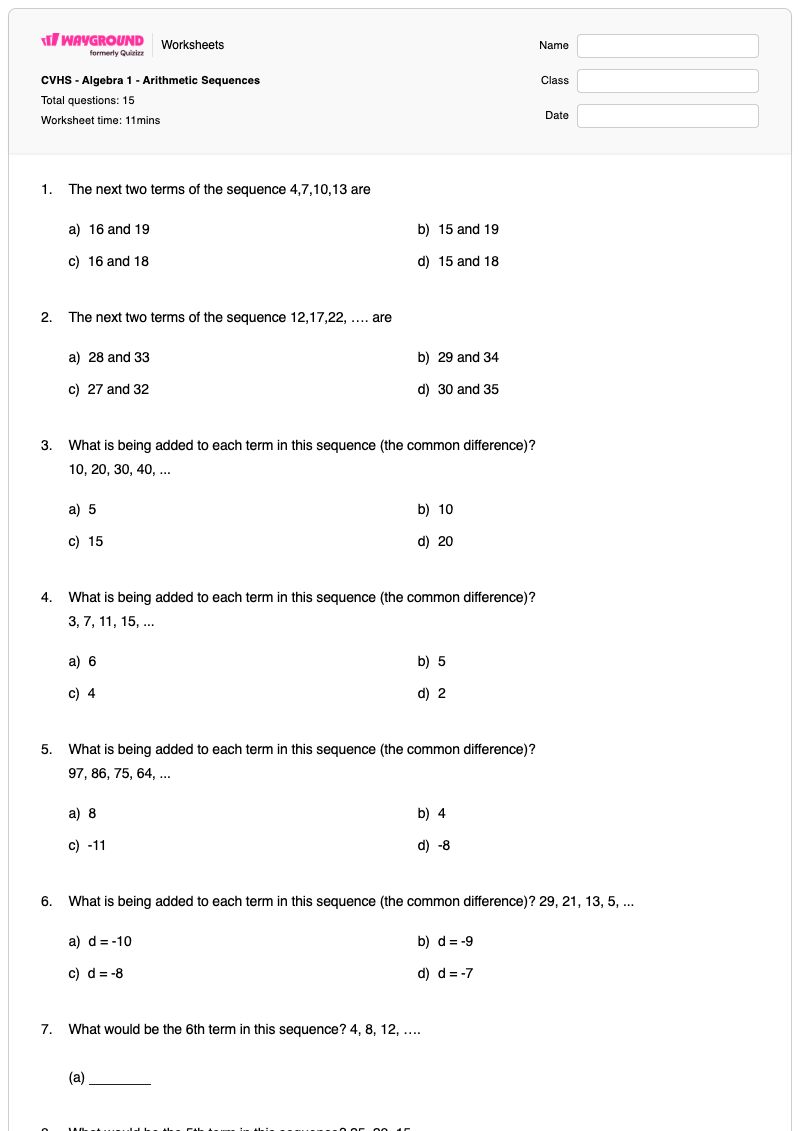
This Grade 9 Algebra I worksheet develops students’ ability to recognize and extend arithmetic sequences. Students identify the common difference in increasing and decreasing sequences, including sequences with negative differences, calculate specified terms such as the fifth or sixth term, and match a sequence to its corresponding table.
The 15-item practice set includes 8 multiple-choice questions and 7 fill-in-the-blank questions. It moves from identifying the amount added to each term to using that pattern to find later terms, with sequences that include positive, negative, and larger numerical values. This free printable worksheet is designed for mathematics instruction, independent practice, review, or quick assessment, and it includes a complete answer key for efficient checking.
Worksheet settings
Font size
S
M
L
XL
Worksheets
CVHS - Algebra 1 - Arithmetic Sequences
Total questions: 15
Name
Class
Date
1.
The next two terms of the sequence 4,7,10,13 are
a)
16 and 19
b)
15 and 19
c)
16 and 18
d)
15 and 18
2.
The next two terms of the sequence 12,17,22, …. are
a)
28 and 33
b)
29 and 34
c)
27 and 32
d)
30 and 35
3.
What is being added to each term in this sequence (the common difference)?
10, 20, 30, 40, ...
a)
5
b)
10
c)
15
d)
20
4.
What is being added to each term in this sequence (the common difference)?
3, 7, 11, 15, ...
a)
6
b)
5
c)
4
d)
2
5.
What is being added to each term in this sequence (the common difference)?
97, 86, 75, 64, ...
a)
8
b)
4
c)
-11
d)
-8
6.
What is being added to each term in this sequence (the common difference)? 29, 21, 13, 5, ...
a)
d = -10
b)
d = -9
c)
d = -8
d)
d = -7
7.
What would be the 6th term in this sequence? 4, 8, 12, ….
(a)
8.
What would be the 5th term in this sequence? 25, 20, 15, ….
(a)
9.
What would be the 5th term in this sequence? -18,-16,-14,...
(a)
10.
What would be the 6th term in this sequence? 50, 100, 150, ...
(a)
11.
What is being added to each term in this sequence (the common difference)? 3, 6, 9, 12,...
(a)
12.
What is being added to each term in this sequence (the common difference)? 13,26,39,...
(a)
13.
What is being added to each term in this sequence (the common difference)? 25, 20, 15, … (Hint: Your answer will be a negative number!)
(a)
14.
Which table matches the sequence? 12, 9, 6
a)
b)
c)
15.
Which table matches the sequence? 5, 7, 9
a)
b)
c)
Answer Key
CVHS - Algebra 1 - Arithmetic Sequences
Total questions: 15
1.
a) 16 and 19
2.
c)
27 and 32
3.
b)
10
4.
c)
4
5.
c)
-11
6.
c)
d = -8
7.
24
8.
5
9.
-10
10.
300
11.
3
12.
13
13.
-5
14.
c)
15.
b)
140 %
Browse by subjects
Browse by grades
Browse by format
FAQs
What does this arithmetic sequences worksheet help Grade 9 students learn?
This Grade 9 Algebra I worksheet helps students identify the common difference in arithmetic sequences and use it to find later terms, such as the fifth or sixth term. Its 15 questions combine multiple-choice items, fill-in-the-blank responses, and sequence-to-table matching, including increasing sequences, decreasing sequences, and negative common differences.
How can I use this worksheet to teach arithmetic sequences?
Introduce the worksheet by having students compare consecutive terms and describe what is added or subtracted each time. Then use the common-difference questions before asking students to find fifth and sixth terms, and discuss how the matching-table items represent the same sequence pattern in a different format.
What mistakes should I watch for when students complete this arithmetic sequences worksheet?
Watch for students choosing the size of the terms instead of the change between consecutive terms, especially in sequences such as 97, 86, 75, 64, where the common difference is negative. Students may also continue a decreasing sequence in the wrong direction, count the starting term incorrectly when finding a fifth or sixth term, or select a table that does not preserve the sequence’s difference.
How do I assign and grade this arithmetic sequences worksheet?
The worksheet is available as a printable PDF and as a digital quiz on Wayground, and it includes a complete answer key for all 15 items. You can grade printable student submissions by scanning their work with the Wayground for Teachers app, or review responses through the digital version.
How can I differentiate this arithmetic sequences worksheet for my students?
In the worksheet’s Advanced Settings, adjust font spacing or choose a larger font size to make the sequence lists, answer choices, and fill-in-the-blank items easier to read. You can also enable a dyslexia-friendly font or translate the worksheet into another language while keeping the arithmetic-sequence practice format.
Where can I find more free worksheets like this on Wayground?
Wayground offers a comprehensive collection of free printable worksheets and practice problems across subjects, with downloadable PDFs and answer keys to support mastery of essential skills and concepts. Browse more resources at https://wayground.com/en-us/worksheets.

 Worksheets


