
WorksheetsAnatomy and Physiology Unit 1 Part 1!
Total questions: 23
Answer KeyAnatomy and Physiology Unit 1 Part 1!
Total questions: 23
anterior, ventral
the study of cells, the study of tissues
strong base

23 questions
9th - 12th Grade
Science
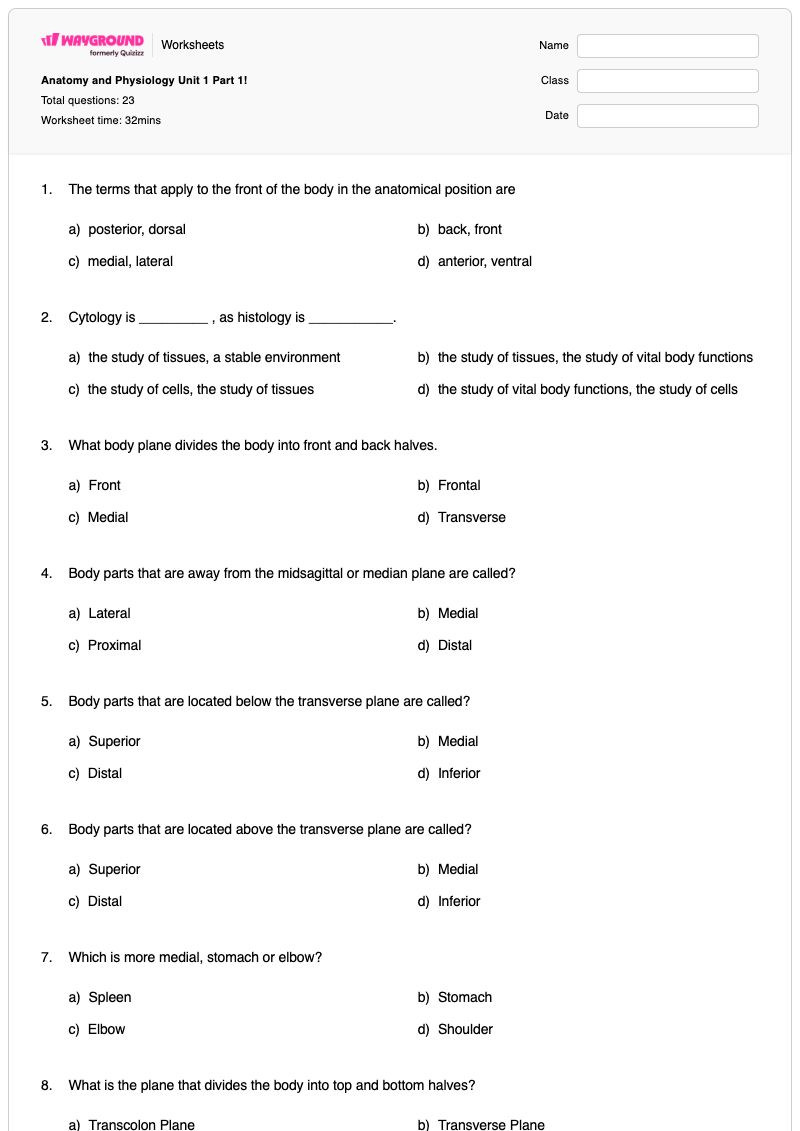
Anatomy and Physiology Unit 1 Part 1 is a Grade 9–12 science worksheet for introducing foundational medical and biological terminology. Its 23 multiple-choice questions ask students to identify anatomical directions, body planes, anatomical position, and positional relationships such as proximal, distal, medial, lateral, superior, and inferior. Students also distinguish cytology from histology and review levels of biological organization, including cells, tissues, organs, and organ systems, along with the role of mitochondria. This free printable worksheet helps students connect vocabulary to body orientation diagrams and examples, making it useful for an anatomy and physiology unit opener, guided practice, or a knowledge check. The consistent multiple-choice format lets teachers quickly identify whether students can apply directional terms and recognize basic cell and tissue concepts. A complete answer key is included for efficient review and grading.
Worksheet settings
Font size
Worksheets
Answer Keyanterior, ventral
the study of cells, the study of tissues
strong base
This 23-question multiple-choice worksheet covers anatomical position, directional terms, body planes, and basic biological organization. Students identify terms such as anterior, ventral, lateral, superior, inferior, and proximal; interpret frontal and transverse planes; distinguish cytology from histology; and recognize cells, tissues, organs, organ systems, and mitochondria. Completing these items builds the vocabulary and classification skills needed to describe body structures accurately.
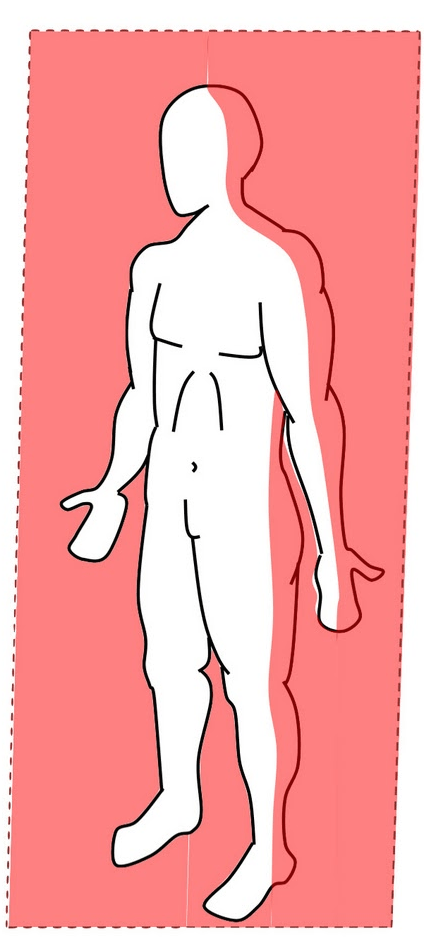
Introduce anatomical position and directional terms first, using a student or diagram to model front versus back, above versus below, and nearer versus farther from the body’s midline. Then have students apply the terms to the worksheet’s body-plane and relationship questions before reviewing cytology, histology, and the progression from cells to tissues, organs, and organ systems. Ask students to explain why an answer such as “stomach” is more medial than “elbow” rather than selecting an option without justification.
Students may reverse anterior and posterior, confuse medial with lateral, or mistake proximal for distal when comparing the knee and ankle. They may also confuse frontal, sagittal, and transverse planes, especially when interpreting the pictured plane questions. In the biology items, check that students distinguish cytology from histology and do not confuse a cell, organelle, tissue, organ, and organ system.
This Anatomy and Physiology worksheet is available as a printable PDF and as a digital quiz on Wayground. It includes a complete answer key, and printable submissions can be graded by scanning student work with the Wayground for Teachers app. Use the digital version for automatic quiz results or the PDF for paper-based practice and review.
Use the worksheet’s Advanced Settings to adjust font spacing or increase the font size so the anatomical terminology and multiple-choice options are easier to read. You can also enable a dyslexia-friendly font or translate the worksheet into another language when those options support access to the body-plane and cell-organization questions.
Wayground offers a broad collection of free printable worksheets and practice problems across subjects, with downloadable PDFs and answer keys to support mastery of essential skills and concepts. Browse more resources at https://wayground.com/en-us/worksheets.