 Worksheets
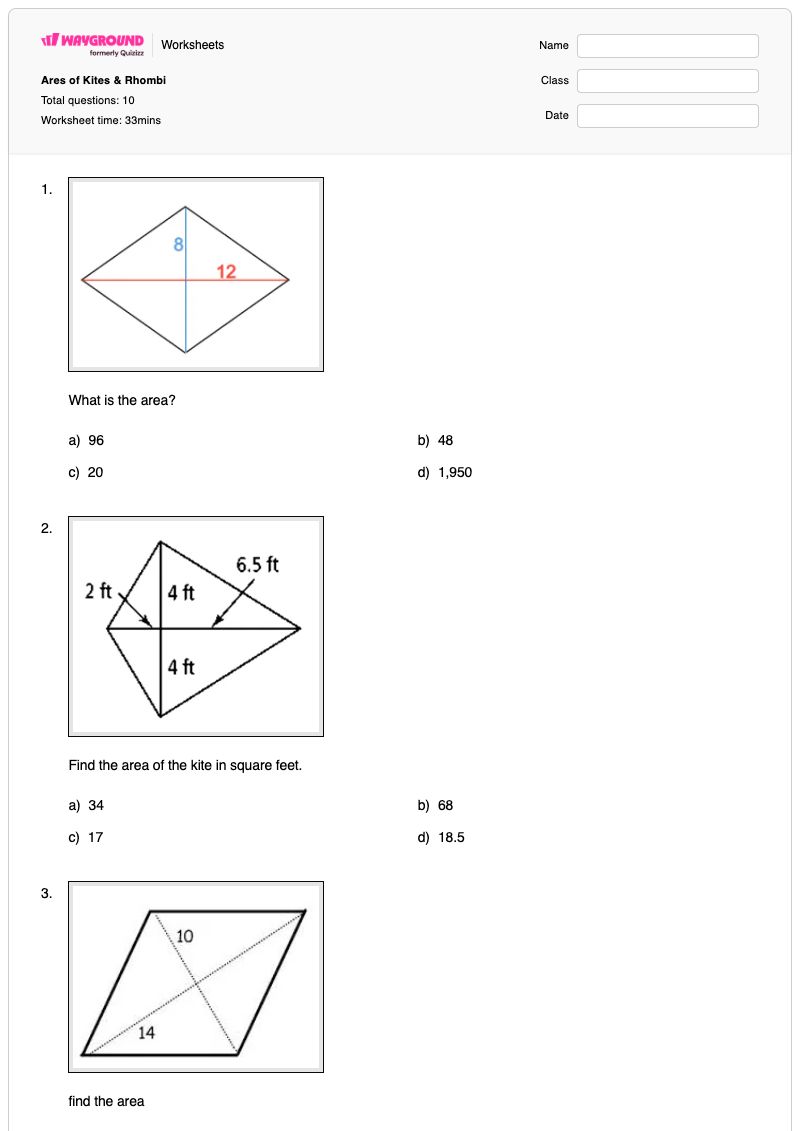
Ares of Kites & Rhombi
Total questions: 10
Name
Class
Date


 Answer Key
Ares of Kites & Rhombi
Total questions: 10
1.
b)
48
2.
a)
34
3.
a)
70
4.
c)
24 m2
5.
c)
36 ft
6.
6.3
7.
a)
P = 38.8 mi
A = 80
8.
c) 78 ft2
9.
c)
c
10.
d)
56 in2

10 questions
9th - 12th Grade
Mathematics
This free printable mathematics worksheet for Grades 9–12 gives students focused practice finding the areas of kites and rhombi from their diagonals. Across 10 items, including nine multiple-choice questions and one fill-in-the-blank question, students calculate areas, determine a missing diagonal, solve for a variable that represents half of a diagonal, and round an answer to the nearest tenth. One item also asks students to find both area and perimeter, reinforcing the difference between these measurements. The worksheet is useful for introducing or reviewing diagonal-based area formulas and checking whether students can select and apply the correct measurements in varied diagrams. Students must interpret square units, distinguish area from perimeter, and recognize when a given value represents only part of a diagonal. It is a free printable worksheet with a complete answer key, making it suitable for independent practice, classwork, homework, or a quick assessment.
Worksheet settings
Font size
WorksheetsAnswer Key48
34
70
24 m2
36 ft
P = 38.8 mi
A = 80
c
56 in2
This Grade 9–12 worksheet covers finding the areas of kites and rhombi using diagonal measurements. Its nine multiple-choice items and one fill-in-the-blank item require students to calculate area, find a missing diagonal, solve for a variable representing half of a diagonal, and distinguish area from perimeter in one combined problem.
Begin by modeling how the diagonal measurements in a kite or rhombus are substituted into the area relationship, then work through a missing-diagonal example from the worksheet. Before students complete the items independently, discuss why the half-diagonal variable in the fill-in-the-blank question must be converted into the requested value and rounded to the nearest tenth. Use the area-and-perimeter question to reinforce that the two measurements require different calculations.
Students may choose a doubled or halved answer when working with diagonal measurements, especially in the question that asks for the other diagonal and the fill-in-the-blank item where x is only half of a diagonal. They may also confuse the area with the perimeter in the combined item, omit square units in area answers, or fail to round the variable value to the nearest tenth. Reviewing the units and asking students to identify what each measurement represents can expose these errors.
The worksheet is available as a printable PDF and as a digital quiz on Wayground, and it includes a complete answer key for all 10 items. For printable submissions, you can scan student work with the Wayground for Teachers app to support grading and review. The PDF option can also help schools reduce screen time while students practise diagonal-based area calculations.
Use the worksheet’s Advanced Settings to adjust font spacing or increase the font size so the diagram-based area questions and answer choices are easier to read. You can also select a dyslexia-friendly font or translate the worksheet into another language when appropriate. These options preserve the worksheet’s focus on kite and rhombus areas, missing diagonals, and the half-diagonal variable.
Wayground offers a comprehensive collection of free printable worksheets and practice problems across subjects, with downloadable PDFs and answer keys to help students master essential skills and concepts. Browse more resources at https://wayground.com/en-us/worksheets.