
Wayground
Area of Parallelograms - Printable Mathematics Worksheets class 5 - Wayground

Area of Parallelograms

16 questions

5th - 6th Grade

Mathematics

Area of Parallelograms is a free printable mathematics worksheet for Grades 5–6 that builds fluency with finding area using the formula A = bh. Students identify parallelograms, recognize parallel sides, distinguish area from perimeter, and interpret area as the amount of space inside a shape. The questions also review appropriate square units and include a rectangle-area item for comparison. The 16-question set uses 14 multiple-choice questions, one matching item, and one multiple-select question. Students calculate areas from diagrams or given measurements, select the missing height when area and height are provided, identify the base, height, and area notation, and apply the formula to solve related problems. This free printable worksheet includes a complete answer key for instruction, independent practice, or assessment.

Worksheet settings

Font size

S
M
L
XL
Worksheets

Area of Parallelograms

Total questions: 16

Name
Class
Date
1.

Find the area of the parallelogram.

a)

42

b)

21

c)

84

d)

Impossible to determine with the information given.

2.

Find the area of the parallelogram.

a)

80

b)

90

c)

720

d)

40

3.

What does area mean?

a)

the distance around a shape

b)

half the distance around a shape

c)

the amount of space outside a shape

d)

the amount of space inside a shape

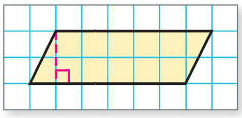
4.
Find the area of the parallelogram.
a)
12 units2
b)
10 units2
c)
13 units2
d)
6 units
5.
What is the area of the rectangle?
a)
15 sq cm
b)
15 cm
c)
2 
d)
16 cm
6.

Match the following

b

Base

A

Area

h

Height

=

equals

7.
What is the area?
a)
3 sq units
b)
6 sq units
c)
12 sq units
d)
9 sq units
8.
Find the missing measure of the parallelogram. 
HEIGHT = 20 feet
AREA = 120 feet2
a)
10 feet
b)
6 feet
c)
8 feet 
d)
12 feet
9.
The distance around an object is called the 
a)
area
b)
perimeter
c)
volume
d)
circumference
10.
What does it mean to be "parallel"? 
a)
lines that intersect
b)
curved lines
c)
lines that never intersect
d)
lines that cross
11.
Why is it called a "parallelogram"?
a)
Because it has sides that are parallel and equal in length
b)
Because there are no parallel sides
c)
The mathematician who made it was Henry Parallelogram
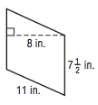
12.
8
a)
88
b)
60
c)
82.5
d)
660
13.

What is the formula to find the area of a parallelogram?

a)

A = lw

b)

A = bw

c)

A = bh

d)

A = lh

14.
What shape is this?
a)
Rectangle
b)
Parallelogram 
c)
Trapezoid
d)
funny
15.
What is the area?
a)
56 square cm
b)
28 square cm
c)
32 square cm
d)
19 square cm
16.

Choose all of the following measurements that are important to finding the area of a parallelogram.

a)

7cm

b)

8cm

c)

4cm

Answer Key

Area of Parallelograms

Total questions: 16

1.
a)

42

2.
a)

80

3.
d)

the amount of space inside a shape

4.
a) 12 units2
5.
a) 15 sq cm
6.

b

 - 

Base

, 

A

 - 

Area

, 

h

 - 

Height

, 

=

 - 

equals

7.
d) 9 sq units
8.
b) 6 feet
9.
b) perimeter
10.
c) lines that never intersect
11.
a) Because it has sides that are parallel and equal in length
12.
b) 60
13.
c)

A = bh

14.
b) Parallelogram 
15.
c) 32 square cm
16.
b)

8cm

, c)

4cm

FAQs

What does the Area of Parallelograms worksheet cover?

This worksheet teaches students to find the area of parallelograms with A = bh, identify the base and height, and express answers in square units. Its 16 items combine multiple-choice calculations and definitions with a matching item and a multiple-select question, including problems that require finding a missing height from a known area.

How can I use this worksheet to teach students to find the area of a parallelogram?

Introduce area as the space inside a shape, then model how the base and perpendicular height fit the formula A = bh. Work through one diagram-based calculation and one missing-height problem before students complete the worksheet’s multiple-choice items. Use the questions about parallel lines, parallelogram features, area, and perimeter to prompt students to explain why the selected formula and units are appropriate.

What mistakes should I watch for when students complete this parallelogram area worksheet?

Watch for students choosing perimeter or circumference when an item asks for area, using a side length instead of the height, or selecting A = lw instead of A = bh. Students may also report linear units rather than square units, confuse the parallelogram with a rectangle or trapezoid, or fail to rearrange the relationship between area, base, and height in the missing-measure problem.

How do I assign and grade the Area of Parallelograms worksheet?

Wayground provides this worksheet as a printable PDF and as a digital quiz, and it includes a complete answer key for all question types. Assign the PDF for paper practice or the digital quiz through Wayground; printable submissions can be graded by scanning student work with the Wayground for Teachers app. The printable option can also support schools that are reducing screen time.

How can I differentiate this area of parallelograms worksheet for my students?

Use the worksheet’s Advanced Settings to adjust font spacing or increase the font size so the formula, measurements, and answer choices are easier to read. You can also enable a dyslexia-friendly font or translate the worksheet into another language, depending on students’ needs. These options apply to the worksheet file, including its diagram-based area questions and matching item.

Where can I find more worksheets like this on Wayground?

Wayground offers a comprehensive collection of free printable worksheets and practice problems across subjects, with downloadable PDFs and answer keys to help students master essential skills and concepts. Browse more resources at https://wayground.com/en-us/worksheets.