This Grade 3 mathematics worksheet helps students find the area of shapes by counting square units and multiplying the number of rows by the number of columns. Students answer 14 multiple-choice questions and one open-ended question using visual area models, shaded shapes, rectangles, square tiles, and real-world contexts such as gardens, floors, rugs, and box lids. The questions also reinforce that area measures the space inside a shape and require students to identify appropriate square units, including square inches, square feet, square centimeters, and square units.
The worksheet is designed for guided practice, independent work, or a quick assessment of students’ understanding of rectangular area. It gives learners repeated opportunities to connect unit-square models with multiplication, interpret dimensions, select the correct area from plausible choices, and explain an area answer in an open-ended item. This is a free printable worksheet with a complete answer key for convenient checking and review.
Worksheet settings
Font size
S
M
L
XL
Worksheets
Find Area Using Square Units
Total questions: 15
Name
Class
Date
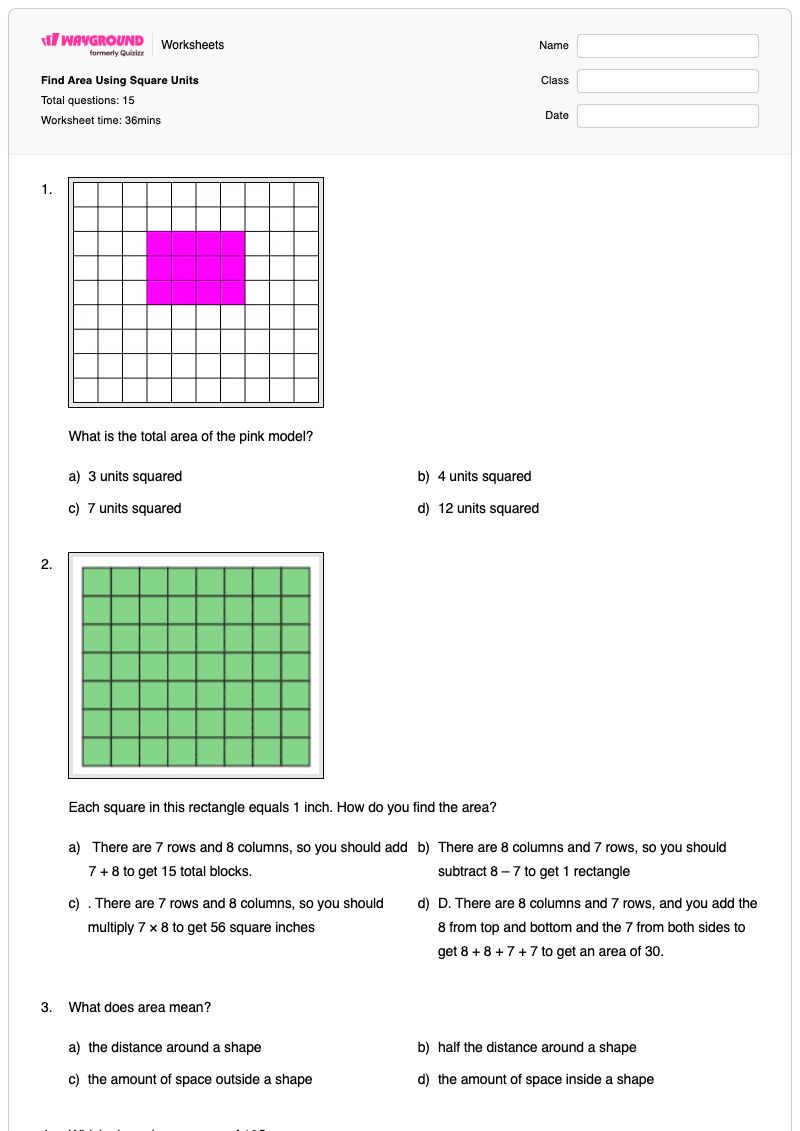
1.
What is the total area of the pink model?
a)
3 units squared
b)
4 units squared
c)
7 units squared
d)
12 units squared
2.
Each square in this rectangle equals 1 inch. How do you find the area?
a)
There are 7 rows and 8 columns, so you should add 7 + 8 to get 15 total blocks.
b)
There are 8 columns and 7 rows, so you should subtract 8 – 7 to get 1 rectangle
c)
. There are 7 rows and 8 columns, so you should multiply 7 × 8 to get 56 square inches
d)
D. There are 8 columns and 7 rows, and you add the 8 from top and bottom and the 7 from both sides to get 8 + 8 + 7 + 7 to get an area of 30.
3.
What does area mean?
a)
the distance around a shape
b)
half the distance around a shape
c)
the amount of space outside a shape
d)
the amount of space inside a shape
4.
Which shape has an area of 18?
a)
b)
c)
d)
5.
4. What is the area of the shaded portion?
a)
10 square units
b)
13 square units
c)
30 square units
d)
20 square units
6.
An artist paints a rectangular board using gray paint. Each square is 1 square foot. What is the area of the rectangle that the artist has painted gray?
a)
16
b)
20
c)
4
d)
5
7.
What is the area of this shape?
a)
36
b)
36 square units
c)
32
d)
32 square units
8.
Which shape has an area of 30 square units?
a)
b)
c)
d)
9.
So what is the area of this rug?
4 lines
10.
Matthew built a rectangular garden to grow food for his family. His garden was 3 feet wide by 7 feet long. What was the area of his garden?
a)
21 sq. ft.
b)
22 sq. ft.
c)
15 sq. ft.
d)
18 sq. ft.
11.
Find the area of the rectangle in square centimeters.
a)
17 sq. cm.
b)
40 sq. cm.
c)
26 sq. cm.
d)
60 sq. cm.
12.
Marcia decided to tile her kitchen floor. What is the area of Marcia's kitchen floor?
a)
5 sq. units
b)
20 sq. units
c)
15 sq. units
d)
10 sq. units
13.
What is the area of the rectangle in square centimeters?
a)
10 sq. cm
b)
15 sq. cm
c)
27 sq. cm
d)
24 sq. cm
14.
Quentin is making a lid for his baseball card box using square tiles. What is the area of Quentin's lid?
a)
16 square units
b)
18 square units
c)
24 square units
d)
28 square units
15.
What is the area of this rectangle in square units?
a)
2 square units
b)
4 square units
c)
6 square units
d)
8 square units
Answer Key
Find Area Using Square Units
Total questions: 15
1.
d)
12 units squared
2.
c) . There are 7 rows and 8 columns, so you should multiply 7 × 8 to get 56 square inches
3.
d) the amount of space inside a shape
4.
a)
5.
c) 30 square units
6.
b)
20
7.
b)
36 square units
8.
d)
9.
n/a
10.
a)
21 sq. ft.
11.
d)
60 sq. cm.
12.
b)
20 sq. units
13.
c)
27 sq. cm
14.
c)
24 square units
15.
d)
8 square units
140 %
Browse by subjects
Browse by grades
Browse by format
FAQs
What does the Find Area Using Square Units worksheet cover?
This Grade 3 worksheet focuses on finding area by counting unit squares and multiplying the number of rows by the number of columns. Its 14 multiple-choice items and one open-ended item use area models, shaded shapes, rectangles, square tiles, and real-world situations, helping students connect visual units with measurements such as square inches, square feet, and square centimeters.
How can I use this worksheet to teach finding area with square units?
Begin by modeling how a rectangle can be covered with unit squares, then show that counting rows and columns leads to multiplication rather than addition of the dimensions. Use the worksheet’s visual models and shaded-shape questions for guided practice before assigning the garden, floor, rug, and tile contexts independently. Ask students to explain both what the square units represent and how their multiplication matches the model.
What mistakes should I watch for when students complete this area worksheet?
Watch for students who confuse area with the distance around a shape, add the number of rows and columns, or choose a numerical answer without the required square-unit label. In the rectangle and tile-model items, students may count only one row or column instead of the total unit squares. For the word problems, check that they multiply the given length and width and report the result in the stated units, such as square feet or square centimeters.
How do I assign and grade this area worksheet?
You can assign this worksheet as a printable PDF or as a digital quiz on Wayground, and it includes a complete answer key for checking the multiple-choice and open-ended responses. Printable submissions can also be graded by scanning student work with the Wayground for Teachers app.
How can I differentiate the area practice on this worksheet?
Use the worksheet’s Advanced Settings to create an alternate version with wider font spacing or a larger font size so students can work more comfortably through the area models and word problems. You can also apply a dyslexia-friendly font or translate the worksheet’s instructions and contexts into another language.
Where can I find more worksheets like this on Wayground?
Wayground offers a comprehensive collection of free printable worksheets and practice problems across all subjects, with downloadable PDFs and answer keys to support mastery of essential skills and concepts. Browse more resources at https://wayground.com/en-us/worksheets.

 Worksheets


