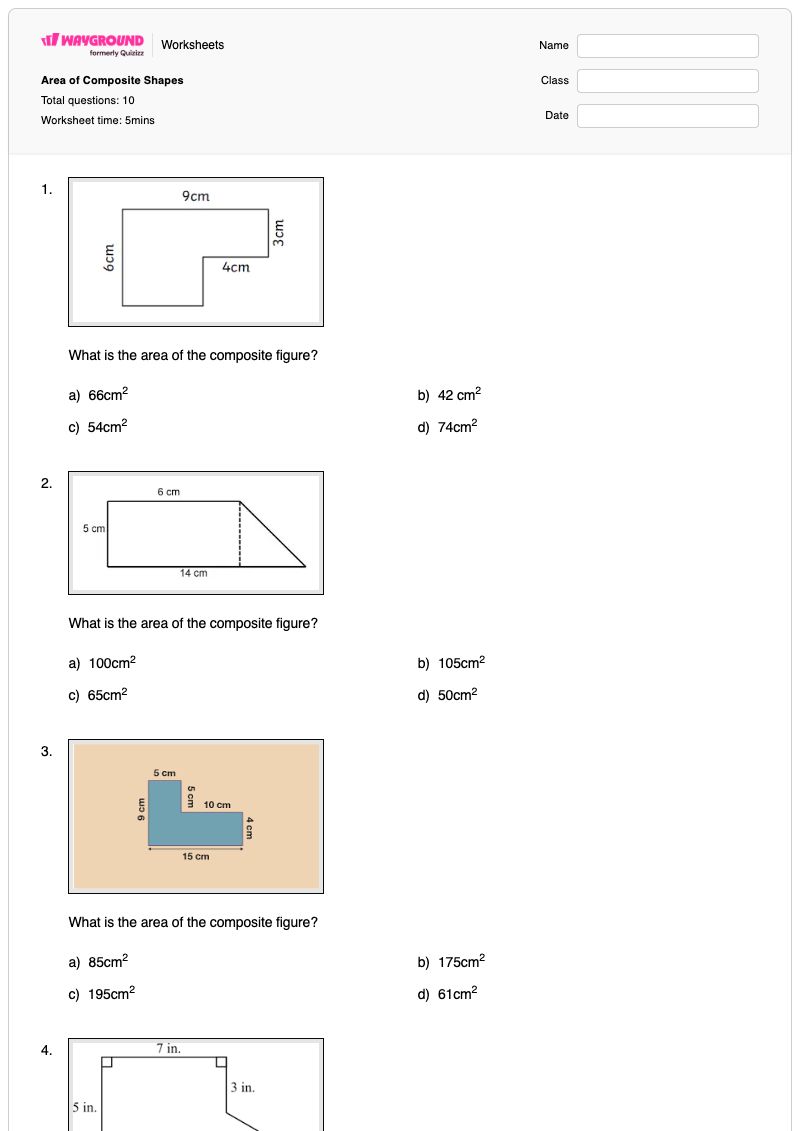
Area of Composite Shapes is a free printable Grade 6 mathematics worksheet with 10 multiple-choice questions. Students determine the area of composite figures by breaking them into simpler regions and selecting the correct answer, working with measurements expressed in square centimeters, square inches, square meters, and square units. The final questions also ask students to find the area of a trapezoid and a parallelogram, reinforcing the formulas that support composite-area problems.
This worksheet is useful for guided practice, independent work, or a quick formative check after teaching area formulas and composite figures. The multiple-choice format lets teachers identify whether students can calculate accurately, choose appropriate operations, and report answers in square units. A complete answer key is included, and the worksheet is available as a free printable PDF for classroom use.
Worksheet settings
Font size
S
M
L
XL
Worksheets
Area of Composite Shapes
Total questions: 10
Name
Class
Date
1.
What is the area of the composite figure?
a)
66cm2
b)
42 cm2
c)
54cm2
d)
74cm2
2.
What is the area of the composite figure?
a)
100cm2
b)
105cm2
c)
65cm2
d)
50cm2
3.
What is the area of the composite figure?
a)
85cm2
b)
175cm2
c)
195cm2
d)
61cm2
4.
What is the area of the composite figure?
a)
40in2
b)
71in2
c)
44in2
d)
81in2
5.
What is the area of the composite figure?
a)
60cm2
b)
52.5cm2
c)
65cm2
d)
80cm2
6.
What is the area of the composite shape?
a)
28u2
b)
24u2
c)
32u2
d)
48u2
7.
What is the area of the composite figure?
a)
329cm2
b)
203cm2
c)
697cm2
d)
359cm2
8.
What is the area of the composite figure?
a)
90cm2
b)
144cm2
c)
54cm2
d)
108cm2
9.
What is the area of the trapezoid?
a)
99m2
b)
198m2
c)
112.5m2
d)
135m2
10.
What is the area of the parallelogram?
a)
576m2
b)
72cm2
c)
291cm2
d)
96cm2
Answer Key
Area of Composite Shapes
Total questions: 10
1.
b)
42 cm2
2.
d)
50cm2
3.
a)
85cm2
4.
a)
40in2
5.
b)
52.5cm2
6.
c)
32u2
7.
b)
203cm2
8.
d)
108cm2
9.
a)
99m2
10.
b)
72cm2
140 %
Browse by subjects
Browse by grades
Browse by format
FAQs
What does the Area of Composite Shapes worksheet cover?
This Grade 6 worksheet contains 10 multiple-choice questions on finding the area of composite figures. Students apply area reasoning to the figures and also solve standalone area problems involving a trapezoid and a parallelogram, selecting answers in square centimeters, square inches, square meters, or square units.
How can I use this worksheet to teach finding the area of composite shapes?
First model how to view a composite figure as simpler regions and decide which area calculations are needed before choosing an answer. Then have students explain why a selected option is reasonable, using the trapezoid and parallelogram questions to review the component formulas that can appear in composite-area work. Use the multiple-choice distractors to prompt discussion about skipped operations, incorrect dimensions, or incorrect units.
What mistakes should I watch for when students complete this composite-area worksheet?
Watch for students choosing a distractor after calculating only one part of a composite figure instead of combining the relevant areas. Students may also confuse the area formulas for the trapezoid and parallelogram, use the wrong measurement unit, or report a numerical answer without square units. Ask students to show the component areas or formula used before selecting an option.
How do I assign and grade this Area of Composite Shapes worksheet?
On Wayground, assign it as a printable PDF or as a digital quiz, depending on whether students should complete the 10 multiple-choice questions on paper or online. The worksheet includes a complete answer key for checking responses, and printable submissions can be graded by scanning student work with the Wayground for Teachers app. The printable format can also support schools that are reducing screen time.
How can I differentiate this composite-area worksheet for my students?
Use the worksheet’s Advanced Settings to adjust font spacing and font size so the area diagrams and multiple-choice options are easier to read. You can also enable a dyslexia-friendly font or translate the worksheet into another language. These options can make the composite-figure questions and the trapezoid and parallelogram items more accessible without changing the practice target.
Where can I find more worksheets like this on Wayground?
Wayground offers a comprehensive collection of free printable worksheets and practice problems across subjects, with downloadable PDFs and answer keys to support essential skills and concepts. Browse more resources at https://wayground.com/en-us/worksheets.


 Worksheets


