

Wayground
Counting squares to find area - Printable Math Worksheets class 4 - Wayground

Counting squares to find area

Dipali Rege

Created by Dipali Rege

12 questions

4th Grade

Math

Updated Oct 2026

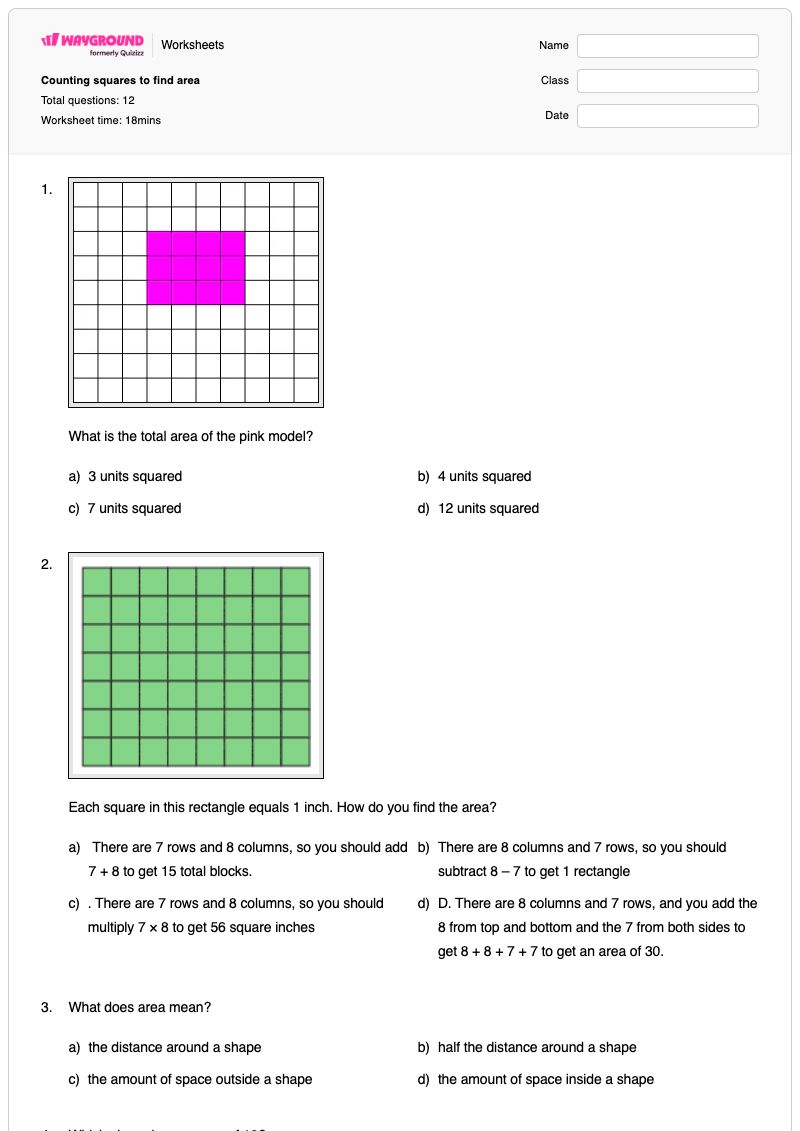
Counting Squares to Find Area is a Grade 4 mathematics worksheet that helps students understand area as the amount of space inside a shape. Students count square units in models, identify shapes with a given area, and determine the area of shaded and tiled figures. They also explain why a rectangle’s rows and columns should be multiplied rather than added, and distinguish area from the distance around a shape. The worksheet includes 12 questions: 10 multiple-choice items and 2 multiple-select items. Questions connect area to practical situations, including estimating fabric for a blanket and paint for a wall, while asking students to select valid models and explanations. This free printable worksheet with an answer key works well for guided practice, independent review, or a quick Grade 4 assessment of counting square units and applying area reasoning.

Worksheet settings

Font size

S
M
L
XL
WaygroundWorksheets

Counting squares to find area

Total questions: 12

Name
Class
Date
1.
What is the total area of the pink model?

What is the total area of the pink model?

a)

3 units squared

b)

4 units squared

c)

7 units squared

d)

12 units squared

2.
Each square in this rectangle equals 1 inch. How do you find the area?
Each square in this rectangle equals 1 inch. How do you find the area? 
a)
 There are 7 rows and 8 columns, so you should add 7 + 8 to get 15 total blocks.
b)
There are 8 columns and 7 rows, so you should subtract 8 – 7 to get 1 rectangle
c)
. There are 7 rows and 8 columns, so you should multiply 7 × 8 to get 56 square inches
d)
D. There are 8 columns and 7 rows, and you add the 8 from top and bottom and the 7 from both sides to get 8 + 8 + 7 + 7 to get an area of 30.
3.
What does area mean?
a)
the distance around a shape
b)
half the distance around a shape
c)
the amount of space outside a shape
d)
the amount of space inside a shape
4.

Which shape has an area of 18?

a)
Which shape has an area of 18?
b)
Which shape has an area of 18?
c)
Which shape has an area of 18?
d)
Which shape has an area of 18?
5.
4. What is the area of the shaded portion?
a)
10 square units
b)
13 square units
c)
30 square units
d)
20 square units
6.
Lilly wants to find the area of this piece of glass using gray square tiles. Each tile has the area of 1 square unit. Which…

Lilly wants to find the area of this piece of glass using gray square tiles. Each tile has the area of 1 square unit. Which models show a way that Lily could find the area of the piece of glass?

a)
Lilly wants to find the area of this piece of glass using gray square tiles. Each tile has the area of 1 square unit. Which…
b)
Lilly wants to find the area of this piece of glass using gray square tiles. Each tile has the area of 1 square unit. Which…
c)
Lilly wants to find the area of this piece of glass using gray square tiles. Each tile has the area of 1 square unit. Which…
d)
Lilly wants to find the area of this piece of glass using gray square tiles. Each tile has the area of 1 square unit. Which…
7.
An artist paints a rectangular board using gray paint. Each square is 1 square foot. What is the area of the rectangle that…

An artist paints a rectangular board using gray paint. Each square is 1 square foot. What is the area of the rectangle that the artist has painted gray?

a)

16

b)

20

c)

4

d)

5

8.

Vince says the area of this shape is 4 square units. Is Vince correct? Choose the best explanation!

a)

Yes, Vince is correct because I count four gray rectangles, so the area is four square units

b)

Yes, Vince is correct because he used four squares to fill in his shape, so the area is four square units.

c)

No, Vince is wrong because he used more than four square units to fill his shape.

d)

No, Vince is wrong because he used rectangles and not squares to fill his shape.

9.

When can we use area in real life?

a)

We can use area to find out how much fabric we need to make a blanket to fit on our bed.

b)

We can use area to find how much boarder we need to go around the outside of a bulletin board.

c)

We can use area to find out how much paint we need to cover a wall.

d)

We can use area to find out how much string we need to cut to make a bracelet for our wrist.

10.
What is the area of this shape?

What is the area of this shape?

a)

36

b)

36 square units

c)

32

d)

32 square units

11.

Which is a way to find area?

a)

Counting the square units inside a shape

b)

Counting the square units around the outside of a shape

12.

Which shape has an area of 30 square units?

a)
Which shape has an area of 30 square units?
b)
Which shape has an area of 30 square units?
c)
Which shape has an area of 30 square units?
d)
Which shape has an area of 30 square units?
WaygroundAnswer Key

Counting squares to find area

Total questions: 12

1.
d)

12 units squared

2.
c) . There are 7 rows and 8 columns, so you should multiply 7 × 8 to get 56 square inches
3.
d) the amount of space inside a shape
4.
a)
5.
c) 30 square units
6.
a) , d)
7.
b)

20

8.
d)

No, Vince is wrong because he used rectangles and not squares to fill his shape.

9.
a)

We can use area to find out how much fabric we need to make a blanket to fit on our bed.

, c)

We can use area to find out how much paint we need to cover a wall.

10.
b)

36 square units

11.
a)

Counting the square units inside a shape

12.
d)

FAQs

What does the Counting Squares to Find Area worksheet cover?

This Grade 4 worksheet develops area reasoning by having students count the square units inside shapes, identify figures with specified areas, and calculate rectangular area by multiplying rows by columns. Its 12 items—10 multiple choice and 2 multiple select—also ask students to distinguish area from the distance around a shape and recognize real-life uses of area.

How can I use this worksheet to teach students to find area by counting squares?

Begin by modeling that area measures the space inside a shape and that each unit square represents one square unit. Use the worksheet’s row-and-column item to demonstrate why a rectangle with 7 rows and 8 columns is found with 7 × 8, then have students explain their choices on the shaded-shape, tile-model, and shape-comparison questions. Finish by discussing which real-life examples require covering a surface rather than measuring around it.

What mistakes should I watch for when students complete this area worksheet?

Watch for students adding or subtracting the number of rows and columns instead of multiplying them, or counting the distance around a figure instead of the square units inside it. Students may also confuse a shape’s number of visible pieces with its total area, overlook that each tile represents one square unit, or select perimeter examples such as measuring around a bulletin board or bracelet in the multiple-select item.

How do I assign and grade this area worksheet?

This worksheet is available as a printable PDF and as a digital quiz on Wayground, and it includes a complete answer key for the 10 multiple-choice and 2 multiple-select questions. Printable submissions can be graded by scanning student work with the Wayground for Teachers app. The PDF option can also support schools that are reducing screen time.

How can I differentiate this counting-squares area worksheet for my students?

Use the worksheet’s Advanced Settings to adjust font spacing and font size so the area diagrams, answer choices, and explanations are easier to read. You can also enable a dyslexia-friendly font or translate the worksheet into another language while students work through the square-unit models and rows-and-columns questions.

Where can I find more worksheets like this on Wayground?

Wayground offers a comprehensive collection of free printable worksheets and practice problems across all subjects, with downloadable PDFs and answer keys to help students master essential skills and concepts. Browse more resources at https://wayground.com/en-us/worksheets.