

Wayground
Author's Point of View and Purpose - Printable English Worksheets class 8 - Wayground

Author's Point of View and Purpose

14 questions

8th - 8th Grade

English

Author's Point of View and Purpose is a free printable Grade 8 English worksheet with 14 multiple-choice questions. It helps students distinguish an author's point of view—the author's opinion or attitude toward a subject—from the author's purpose, or the reason and intention behind the writing. Questions address how purpose affects a text's message, intended audience, credibility, and bias, as well as how tone, word choice, emotional language, personal anecdotes, and arguments reveal what an author is trying to achieve. The worksheet also checks students' understanding of literary points of view. Students identify first-person narration through pronouns such as “I,” “me,” and “my”; second-person narration through “you” and “your”; third-person limited narration through access to one character's thoughts and feelings; and third-person omniscient narration through knowledge of all characters' thoughts and feelings. It is suitable for direct instruction, review, or an independent check of understanding and includes a complete answer key for efficient grading.

Worksheet settings

Font size

S
M
L
XL
Worksheets

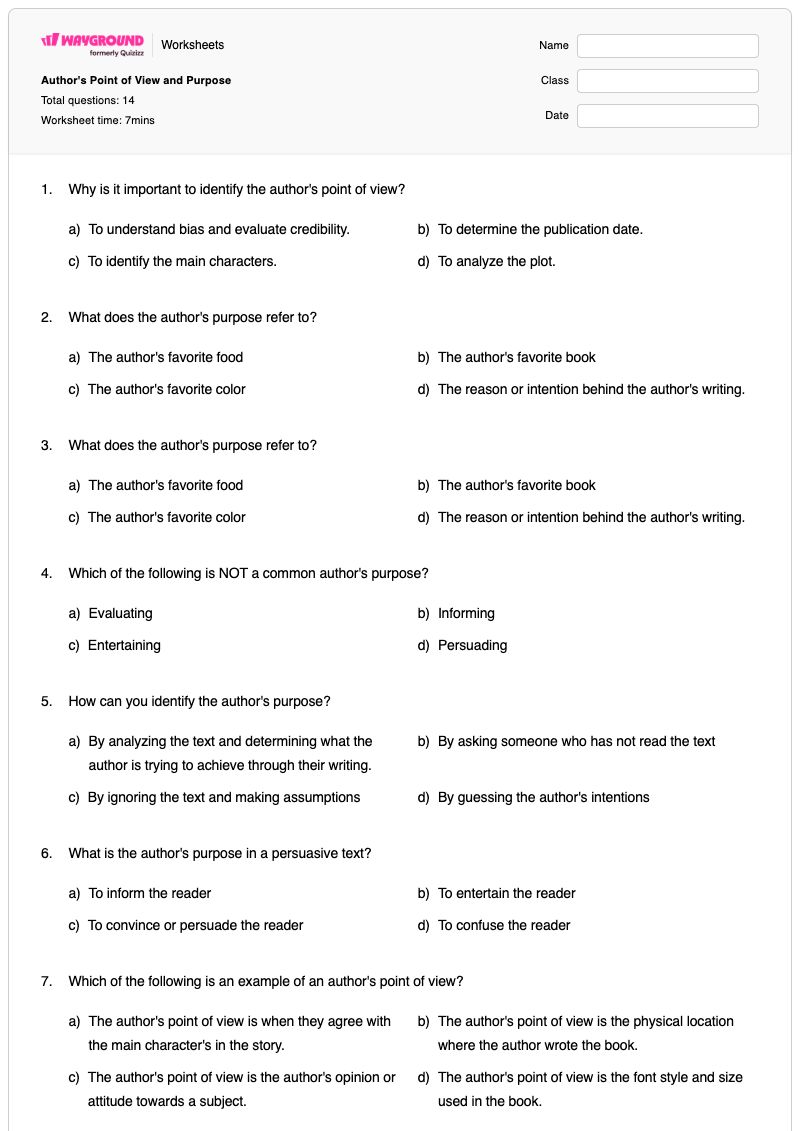
Author's Point of View and Purpose

Total questions: 14

Name
Class
Date
1.

Why is it important to identify the author's point of view?

a)

To understand bias and evaluate credibility.

b)

To determine the publication date.

c)

To identify the main characters.

d)

To analyze the plot.

2.

What does the author's purpose refer to?

a)

The author's favorite food

b)

The author's favorite book

c)

The author's favorite color

d)

The reason or intention behind the author's writing.

3.

What does the author's purpose refer to?

a)

The author's favorite food

b)

The author's favorite book

c)

The author's favorite color

d)

The reason or intention behind the author's writing.

4.

Which of the following is NOT a common author's purpose?

a)

Evaluating

b)

Informing

c)

Entertaining

d)

Persuading

5.

How can you identify the author's purpose?

a)

By analyzing the text and determining what the author is trying to achieve through their writing.

b)

By asking someone who has not read the text

c)

By ignoring the text and making assumptions

d)

By guessing the author's intentions

6.

What is the author's purpose in a persuasive text?

a)

To inform the reader

b)

To entertain the reader

c)

To convince or persuade the reader

d)

To confuse the reader

7.

Which of the following is an example of an author's point of view?

a)

The author's point of view is when they agree with the main character's in the story.

b)

The author's point of view is the physical location where the author wrote the book.

c)

The author's point of view is the author's opinion or attitude towards a subject.

d)

The author's point of view is the font style and size used in the book.

8.

What can you infer about the author's purpose if a text is filled with emotional language and personal anecdotes?

a)

The author's purpose is to educate the reader with scientific evidence.

b)

The author's purpose is to entertain the reader with fictional stories.

c)

The author's purpose is to evoke emotions and connect with the reader on a personal level.

d)

The author's purpose is to provide objective information and facts.

9.

Why is it important to analyze the author's purpose?

a)

To learn about the author's favorite color

b)

To understand the message, intended audience, credibility, and bias of the author's perspective.

c)

To determine the author's shoe size

d)

To find out the author's favorite food

10.

What should you consider when analyzing the author's purpose?

a)

Length of the text

b)

Grammar, punctuation, and spelling

c)

Publication date and location

d)

Tone, choice of words, intended audience, and message or argument.

11.

In literature, which point of view is characterized by the use of pronouns like "I," "me," and "my," providing direct access to the thoughts and feelings of the narrator?

a)

econd person

b)

Third person limited

c)

First person

d)

Omniscient point of view

12.

Which point of view in literature directly addresses the reader, using pronouns like "you" and "your," creating a sense of immediacy and involvement?

a)

First person

b)

Third person limited

c)

Second person

d)

Omniscient point of view

13.

In a narrative employing a third person limited point of view, the narrator has access to the thoughts and feelings of:

a)

All characters in the story

b)

Only one specific character

c)

The narrator themselves

d)

None of the characters

14.

In a story with a third-person omniscient point of view, the narrator possesses knowledge of:

a)

Only the main character's thoughts and feelings

b)

Limited information about all characters

c)

All characters' thoughts and feelings

d)

Only the events happening in the present moment

Answer Key

Author's Point of View and Purpose

Total questions: 14

1.
a)

To understand bias and evaluate credibility.

2.
d)

The reason or intention behind the author's writing.

3.
d)

The reason or intention behind the author's writing.

4.
a)

Evaluating

5.
a)

By analyzing the text and determining what the author is trying to achieve through their writing.

6.
c)

To convince or persuade the reader

7.
c)

The author's point of view is the author's opinion or attitude towards a subject.

8.
c)

The author's purpose is to evoke emotions and connect with the reader on a personal level.

9.
b)

To understand the message, intended audience, credibility, and bias of the author's perspective.

10.
d)

Tone, choice of words, intended audience, and message or argument.

11.
c)

First person

12.
c)

Second person

13.
b)

Only one specific character

14.
c)

All characters' thoughts and feelings

FAQs

What does the Author's Point of View and Purpose worksheet cover?

This Grade 8 English worksheet uses 14 multiple-choice questions to assess how students identify an author's opinion or attitude, determine the reason behind the writing, and analyze clues such as tone, word choice, intended audience, emotional language, and personal anecdotes. It also distinguishes first person, second person, third-person limited, and third-person omniscient points of view by the narrator's pronouns and access to characters' thoughts and feelings.

How can I use this worksheet to teach author's point of view and purpose?

Introduce point of view and purpose separately, then model how a reader uses the text's tone, word choice, audience, and message to infer the author's intention. Before students complete the multiple-choice questions, ask them to explain how a persuasive text differs from a text using emotional language and personal anecdotes, and have them identify which narrator perspective matches pronouns such as “I,” “you,” or “they.” Use students' choices to discuss the evidence behind each answer rather than treating the worksheet as a vocabulary quiz.

What mistakes should I watch for when students complete this worksheet?

Students may confuse the author's point of view—an opinion or attitude—with the author's purpose, which is the reason for writing, or mistake a narrator's point of view for the author's personal opinion. Watch for confusion among first person, second person, third-person limited, and third-person omniscient, especially whether the narrator can access one character's thoughts or all characters' thoughts. Students may also overlook that emotional language and personal anecdotes can signal an attempt to evoke emotion and connect personally with readers.

How do I assign and grade this worksheet?

You can assign Author's Point of View and Purpose as a printable PDF or as a digital quiz on Wayground. The worksheet includes a complete answer key, and printable submissions can be graded by scanning student work with the Wayground for Teachers app. The PDF option also supports classrooms that are reducing screen time.

How can I differentiate this point-of-view and purpose worksheet for my students?

Use the worksheet's Advanced Settings to adjust font spacing and font size so the multiple-choice questions are easier to scan. You can also apply a dyslexia-friendly font or translate the worksheet into another language, helping students focus on distinguishing author's purpose from narrative point of view.

Where can I find more worksheets like this on Wayground?

Wayground offers a broad collection of free printable worksheets and practice problems across subjects, with downloadable PDFs and answer keys to support essential skills and concepts. Browse more resources at https://wayground.com/en-us/worksheets.