Genetic Disorders is a Grade 10 science worksheet that checks students’ understanding of inherited disease, autosomal and sex-linked traits, genetic disorders, mutagens, and pedigree analysis. Students complete one open-ended response, three fill-in-the-blank items, and eleven multiple-choice questions identifying disorders such as Huntington disease, cystic fibrosis, sickle cell disease, and hemophilia, as well as key pedigree symbols and inheritance patterns.
This free printable worksheet with an answer key helps teachers assess whether students can distinguish autosomal traits from sex-linked traits, connect disorders to their defining genetic characteristics, and interpret pedigree notation. Students also identify males, females, affected individuals, unaffected individuals, and carriers in pedigrees before classifying examples as autosomal dominant or sex-linked recessive. It is suitable for Grade 10 science review, independent practice, or a quick formative assessment after instruction on inheritance and genetic disorders.
Worksheet settings
Font size
S
M
L
XL
Worksheets
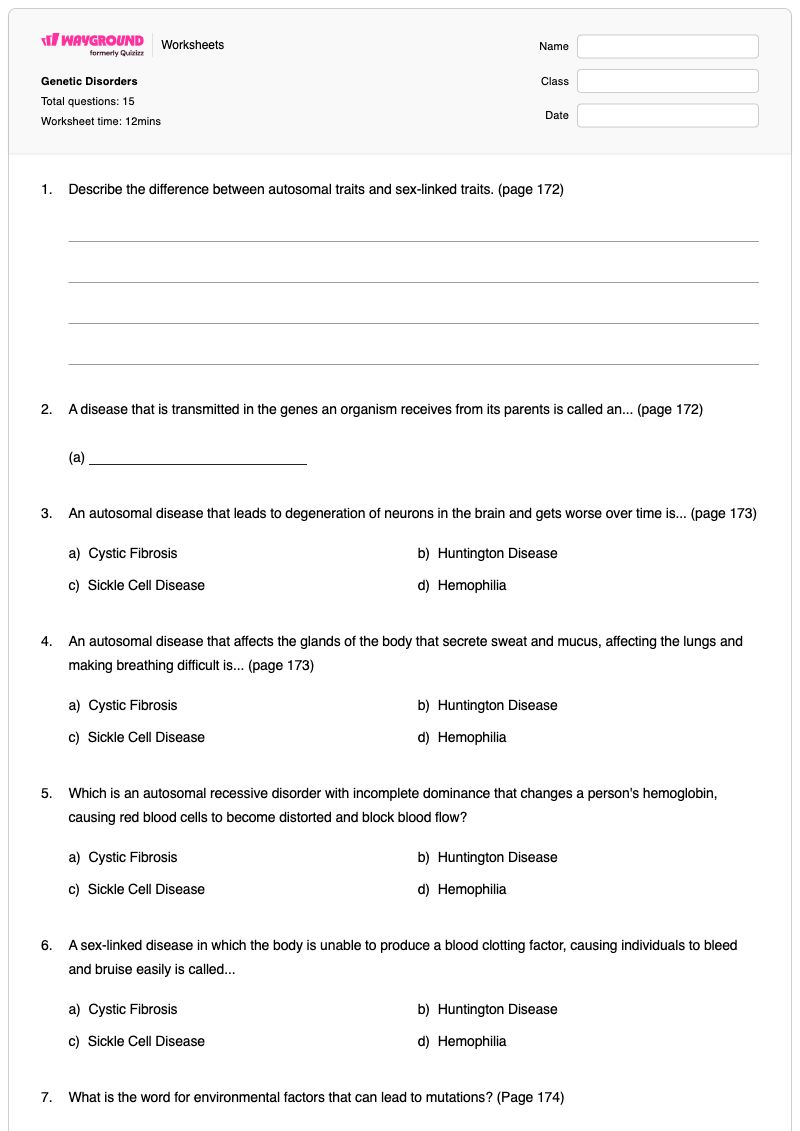
Genetic Disorders
Total questions: 15
Name
Class
Date
1.
Describe the difference between autosomal traits and sex-linked traits. (page 172)
4 lines
2.
A disease that is transmitted in the genes an organism receives from its parents is called an... (page 172)
(a)
3.
An autosomal disease that leads to degeneration of neurons in the brain and gets worse over time is... (page 173)
a)
Cystic Fibrosis
b)
Huntington Disease
c)
Sickle Cell Disease
d)
Hemophilia
4.
An autosomal disease that affects the glands of the body that secrete sweat and mucus, affecting the lungs and making breathing difficult is... (page 173)
a)
Cystic Fibrosis
b)
Huntington Disease
c)
Sickle Cell Disease
d)
Hemophilia
5.
Which is an autosomal recessive disorder with incomplete dominance that changes a person's hemoglobin, causing red blood cells to become distorted and block blood flow?
a)
Cystic Fibrosis
b)
Huntington Disease
c)
Sickle Cell Disease
d)
Hemophilia
6.
A sex-linked disease in which the body is unable to produce a blood clotting factor, causing individuals to bleed and bruise easily is called...
a)
Cystic Fibrosis
b)
Huntington Disease
c)
Sickle Cell Disease
d)
Hemophilia
7.
What is the word for environmental factors that can lead to mutations? (Page 174)
(a)
8.
What is this type of diagram called?
(a)
9.
In pedigrees squares represent
a)
males
b)
females
10.
In pedigrees circles represent
a)
males
b)
females
11.
In pedigrees shaded shapes represent individuals who
a)
have the trait
b)
do not have the trait
c)
are carriers for the trait
12.
In pedigrees nonshaded shapes represent individuals who
a)
have the trait
b)
do not have the trait
c)
are carriers for the trait
13.
In pedigrees half-shaded shapes represent individuals who
a)
have the trait
b)
do not have the trait
c)
are carriers for the trait
14.
Which type of inheritance pattern is most likely shown by this pedigree?
a)
autosomal dominant
b)
autosomal recessive
c)
sex-linked dominant
d)
sex-linked recessive
15.
Which type of inheritance pattern is most likely shown in this pedigree?
a)
autosomal dominant
b)
autosomal recessive
c)
sex-linked dominant
d)
sex-linked recessive
Answer Key
Genetic Disorders
Total questions: 15
1.
n/a
2.
inherited disease
3.
b)
Huntington Disease
4.
a)
Cystic Fibrosis
5.
c)
Sickle Cell Disease
6.
d)
Hemophilia
7.
mutagens
8.
pedigree
9.
a)
males
10.
b)
females
11.
a)
have the trait
12.
b)
do not have the trait
13.
c)
are carriers for the trait
14.
a)
autosomal dominant
15.
d)
sex-linked recessive
140 %
Browse by subjects
Browse by grades
Browse by format
FAQs
What does the Genetic Disorders worksheet cover?
This Grade 10 science worksheet covers inherited diseases, autosomal versus sex-linked traits, genetic disorders, mutagens, and pedigree interpretation. Its 15 items combine one open-ended comparison, three fill-in-the-blank definitions, and 11 multiple-choice questions that identify disorders, decode pedigree symbols, and classify inheritance patterns as autosomal dominant or sex-linked recessive.
How can I use this worksheet to teach genetic disorders and pedigrees?
Introduce the worksheet by reviewing the difference between autosomal and sex-linked traits, then use the disorder-identification questions to connect each condition with its defining feature. After students complete the vocabulary blanks for inherited disease, mutagens, and pedigree, have them annotate the pedigree-symbol questions and explain what evidence supports each inheritance-pattern classification.
What mistakes should I watch for when students complete this worksheet?
Students may confuse autosomal and sex-linked traits, or match a disorder to the wrong characteristic—for example, associating clotting-factor deficiency with a disorder other than hemophilia. In the pedigree section, watch for reversed meanings for squares and circles, shaded and unshaded shapes, or half-shaded carriers, as well as unsupported choices between autosomal dominant and sex-linked recessive inheritance.
How do I assign and grade the Genetic Disorders worksheet?
The worksheet is available as a printable PDF and as a digital quiz on Wayground, and it includes a complete answer key for the fill-in-the-blank and multiple-choice items. Teachers can grade printable student work by scanning it with the Wayground for Teachers app, while the digital version supports online assignment and grading.
How can I differentiate this Genetic Disorders worksheet for my students?
Use the worksheet’s Advanced Settings to adjust font spacing or font size so the open-ended response, vocabulary blanks, and pedigree questions are easier to read. You can also apply a dyslexia-friendly font or translate the worksheet into another language when those options support access to the genetics vocabulary and symbols.
Where can I find more worksheets like this on Wayground?
Wayground offers a comprehensive collection of free printable worksheets and practice problems across all subjects, with downloadable PDFs and answer keys to help students master essential skills and concepts. Browse more resources at https://wayground.com/en-us/worksheets.

 Worksheets


