

Wayground
Dihybrid Crosses - Printable Science Worksheets 9th Grade - Wayground

Dihybrid Crosses

John Hall

Created by John Hall

10 questions

9th Grade

Science

Updated Apr 2026

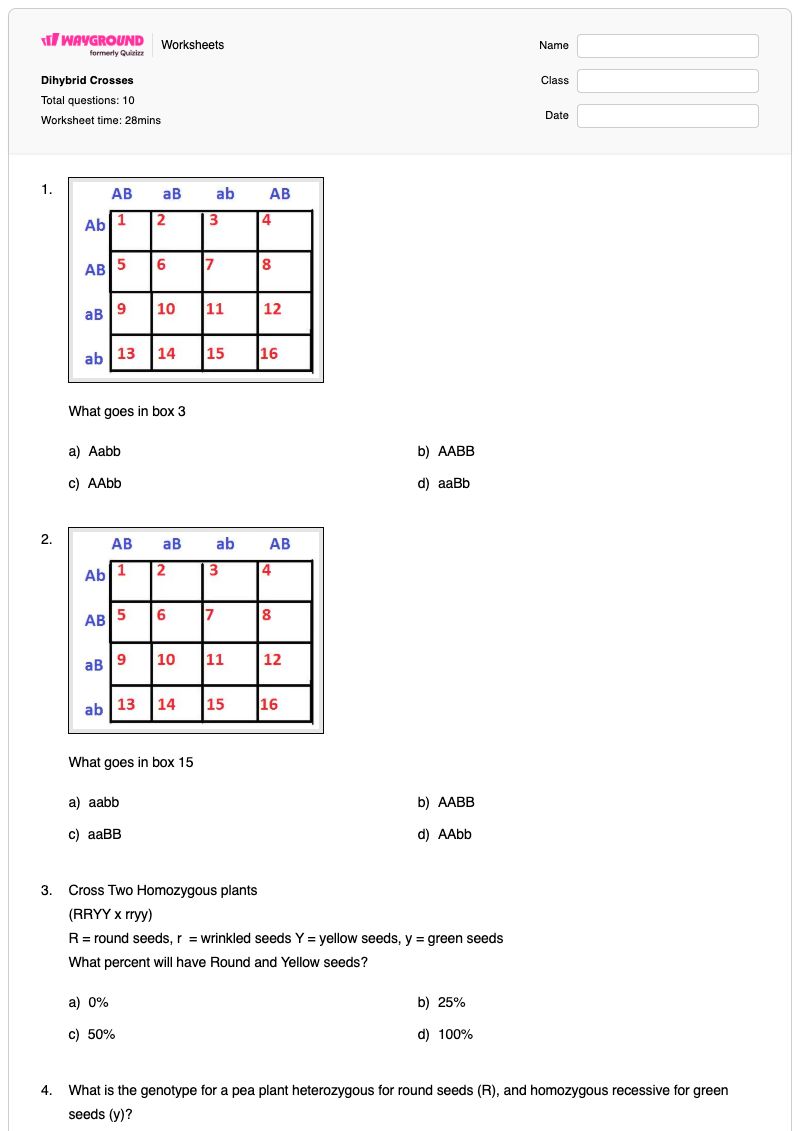
Dihybrid Crosses is a free printable Grade 9 biology worksheet with an answer key that helps students apply inheritance rules to two traits at once. Through 10 multiple-choice questions, students complete missing Punnett square boxes, identify genotypes from descriptions of homozygous and heterozygous traits, and determine offspring probabilities and phenotypes such as round or wrinkled and yellow or green seeds. The worksheet also asks students to interpret results such as 3/16 and 1/16 offspring fractions, recognize that a dihybrid cross involves two traits, and select parental genotypes from dominance information. It provides focused practice connecting allele combinations to observable traits, including examples involving pea plants and mice. This resource is suited to Grade 9 biology instruction, guided practice, review, or a quick assessment of students’ ability to read and reason through dihybrid crosses in multiple-choice format.

Worksheet settings

Font size

S
M
L
XL
WaygroundWorksheets

Dihybrid Crosses

Total questions: 10

Name
Class
Date
1.
What goes in box 3
What goes in box 3
a)
Aabb
b)
AABB
c)
AAbb
d)
aaBb
2.
What goes in box 15

What goes in box 15

a)

aabb

b)

AABB

c)

aaBB

d)

AAbb

3.
Cross Two Homozygous plants
(
RRYY x rryy)
R = round seeds, r  = wrinkled seeds Y = yellow seeds, y = green seeds
What percent will have Round and Yellow seeds? 
a)
0%
b)
25%
c)
50%
d)
100%
4.
What is the genotype for a pea plant heterozygous for round seeds (R), and homozygous recessive for green seeds (y)?
a)
Ry
b)
RRyy
c)
RrYy
d)
Rryy
5.
Using the dihybrid cross and key provided, what is the probability of the offspring being tall and white?
a)
9
b)
2
c)
3
d)
6
6.
In a dihybrid cross
a)
one trait is crossed.
b)
two traits are crossed.
c)
four boxes are needed for the punnett square.
d)
mom's alleles are dominant.
7.
Based off this punnett square, what fraction of the offspring will have wrinkled, yellow seeds?

Based off this punnett square, what fraction of the offspring will have wrinkled, yellow seeds?

a)

9/16

b)

3/16

c)

1/16

d)

16/16

8.
Based off this punnett square, what fraction of the offspring will have wrinkled, green seeds?

Based off this punnett square, what fraction of the offspring will have wrinkled, green seeds?

a)

9/16

b)

3/16

c)

1/16

d)

16/16

9.

What is the genotype for a pea plant homozygous for round seeds (R), and heterozygous for yellow seeds?

a)

RrYy

b)

RRyy

c)

RRYy

d)

rryy

10.

A white mouse with red eyes is crossed with a black mouse with brown eyes. The white mouse is recessive for both of its traits. The black mouse is dominant for both of its traits.

This cross would be

a)

BBEE x bbee

b)

BBEe x BbEe

c)

BbEE x BbEe

d)

BBee x BBEE

WaygroundAnswer Key

Dihybrid Crosses

Total questions: 10

1.
a) Aabb
2.
a)

aabb

3.
d) 100%
4.
d) Rryy
5.
c) 3
6.
b) two traits are crossed.
7.
b)

3/16

8.
c)

1/16

9.
c)

RRYy

10.
a)

BBEE x bbee

FAQs

What does the Dihybrid Crosses worksheet help students learn?

This Grade 9 biology worksheet uses 10 multiple-choice questions to practise interpreting crosses involving two traits. Students complete Punnett square boxes, distinguish homozygous from heterozygous genotypes, identify parental crosses, and calculate phenotype probabilities such as 3/16 or 1/16. These tasks build the skill of connecting allele combinations to predicted offspring traits.

How can I use this worksheet to teach dihybrid crosses?

First model how to read the allele key and place combinations in a dihybrid Punnett square, then work through one genotype-identification item with students. Use the questions about round or wrinkled and yellow or green pea seeds to discuss how genotypes produce phenotypes, and ask students to explain why a result is written as a percentage or fraction. Finish with the mouse cross as an application of dominant and recessive allele notation.

What mistakes should I watch for when students complete this worksheet?

Students may place the wrong allele combination in a Punnett square box, confuse homozygous and heterozygous notation, or select a genotype that does not match the stated traits. They may also treat a dominant phenotype as proof of one specific genotype, or confuse the fractions for wrinkled yellow and wrinkled green offspring. Check that students identify both traits before choosing an answer and read probabilities as parts of the full offspring set.

How do I assign and grade this Dihybrid Crosses worksheet?

The worksheet is available as a printable PDF and as a digital quiz on Wayground, and it includes a complete answer key for the 10 multiple-choice questions. For printable submissions, you can grade student work by scanning it with the Wayground for Teachers app.

How can I differentiate this dihybrid-cross worksheet for my students?

In the worksheet’s Advanced Settings, adjust font spacing or font size so the genotype options and Punnett square question text are easier to read. You can also enable a dyslexia-friendly font or translate the worksheet into another language when that better supports access to the multiple-choice questions.

Where can I find more worksheets like this on Wayground?

Wayground offers a broad collection of free printable worksheets and practice problems across subjects, with downloadable PDFs and answer keys to support mastery of essential skills and concepts. Browse more resources at https://wayground.com/en-us/worksheets.