H. Biology Phylogenetic Trees is a free printable biology worksheet for Grades 9–12 that uses 16 multiple-choice questions to develop phylogenetic tree interpretation. Students identify outgroups, basal taxa, taxa, nodes, and common ancestors; determine relationships from branching patterns; and use derived characteristics to compare organisms. Questions also address taxonomic levels, maximum parsimony, homologous structures, divergent evolution, and the relative timing of adaptations such as tetrapod limbs, amnions, and feathers.
This worksheet gives students practice applying evolutionary classification concepts to tree diagrams, organism comparisons, anatomical evidence, and bacterial relationship data. It is useful for introducing or reviewing how scientists infer descent and relatedness rather than relying on surface appearance alone. Teachers can use the multiple-choice format for independent practice, discussion, or a formative check, then review the reasoning behind answers such as selecting an appropriate outgroup or locating a shared node. The worksheet includes a complete answer key for efficient review and grading.
Worksheet settings
Font size
S
M
L
XL
Worksheets
H. Biology Phylogenetic Trees
Total questions: 16
Name
Class
Date
1.
If you were building a phylogenetic tree of cats, which of the following would be the best outgroup?
a)
wolf
b)
domestic cat
c)
frog
d)
leopard
2.
categories above the kingdom level
a)
Domain
b)
Phylum
c)
Class
d)
Division
3.
branch on a phylogenetic tree that has not diverged significantly from the root ancestor
a)
basal taxon
b)
mitochondria-first hypothesis
c)
sister taxa
d)
polytomy
4.
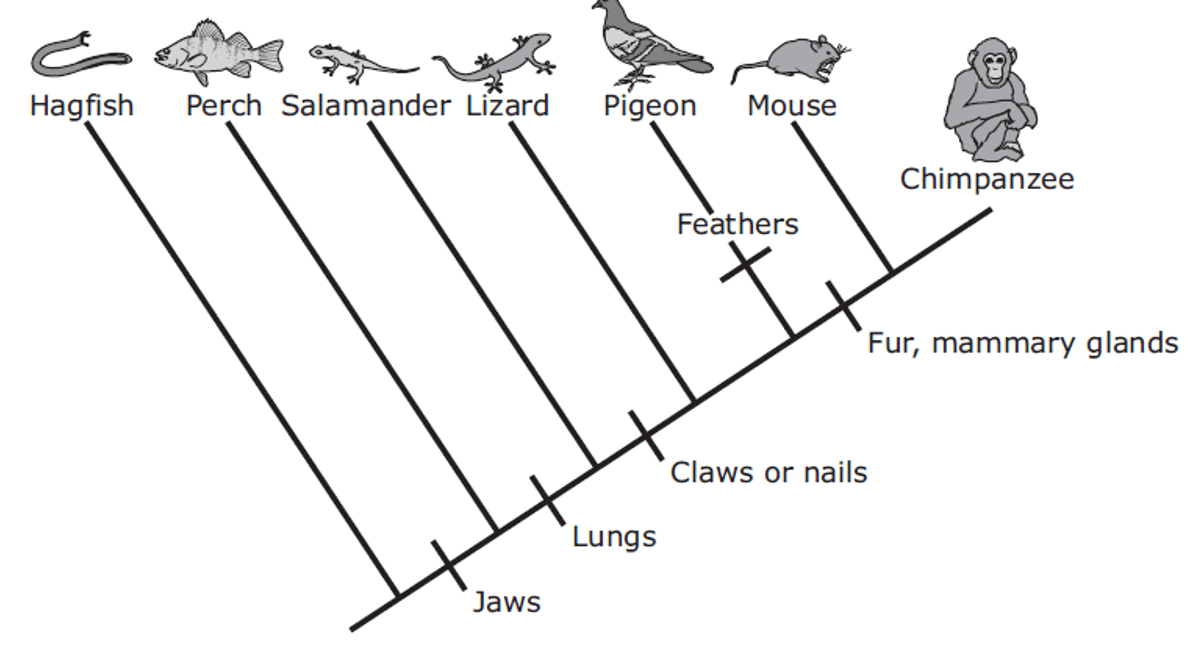
All the animals to the right of the salamander would have the common characteristic of...
a)
Fur
b)
Claws or nails
c)
Lungs
d)
Jaws
5.
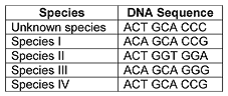
According to this data, the unknown bacterial species is most closely related to:
a)
Species I
b)
Species II
c)
Species III
d)
Species IV
6.
The lizard has all these derived characteristics EXCEPT
a)
Jaws
b)
Lungs
c)
Bipedal
7.
What is the common ancestor of Letters A, B, C, D, E?
a)
1
b)
2
c)
3
8.
Anatomical similarities and differences between various organisms allow us to reconstruct and infer evolutionary history and descent. The bones of the forelimbs (wing or arm) of three animals are shown in the illustration. Which of the following is NOT a reasonable conclusion that can be drawn from the similarities and differences found in this illustration?
a)
Birds, bats, and humans have bones and structures that allow them to function.
b)
Different structures allow for different functions.
c)
Humans live in habitats that are very different from that of birds and bats.
d)
Humans and bats share a closer evolutionary history with each other than with birds.
9.
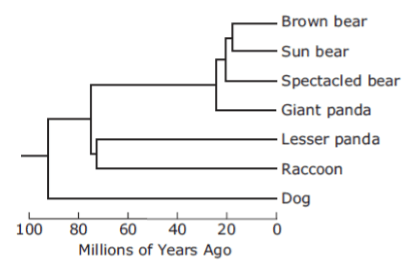
Which trait (adaptation) was developed most recently?
a)
tetrapod limbs
b)
feathers
c)
amnion
d)
They developed at the same time
10.
Who is the closest relative to the brown bear?
a)
Giant panda
b)
Dog
c)
Lesser panda
d)
Sun bear
11.
The groups in a phylogenetic tree are called...
a)
Taxa
b)
Nodes
c)
Roots
d)
Branches
12.
According to maximum parsimony...
a)
The simpler your phylogenetic tree, the better
b)
Phylogenetic trees should have many branches
c)
All organisms in a phylogenetic tree must descend from a common ancestor
d)
Phylogenetic trees must show all traits
13.
Places on a phylogenetic tree where organisms share a common ancestor are called...
a)
Nodes
b)
Branches
c)
Taxa
d)
Species
14.
Phylogenetic trees show...
a)
Homologous structures through divergent evolution
b)
Homologous structures through convergent evolution
c)
Analogous structures through divergent evolution
d)
Analogous structures through convergent evolution
15.
Based on the figure, which organism is most closely related to the polar bear?
a)
black bear
b)
european brown bear
c)
western north american brown bear
d)
asian brown bear
16.
Which evidence would be the most accurate when developing a cladogram?
a)
morphological
b)
molecular
c)
ecological
d)
fossil
Answer Key
H. Biology Phylogenetic Trees
Total questions: 16
1.
c)
frog
2.
a)
Domain
3.
a) basal taxon
4.
b)
Claws or nails
5.
d) Species IV
6.
c)
Bipedal
7.
a)
1
8.
c)
Humans live in habitats that are very different from that of birds and bats.
9.
b)
feathers
10.
d)
Sun bear
11.
a)
Taxa
12.
a)
The simpler your phylogenetic tree, the better
13.
a)
Nodes
14.
a)
Homologous structures through divergent evolution
15.
b)
european brown bear
16.
b)
molecular
140 %
Browse by subjects
Browse by grades
Browse by format
FAQs
What does the H. Biology Phylogenetic Trees worksheet cover?
This Grade 9–12 biology worksheet uses 16 multiple-choice questions to assess how students interpret phylogenetic trees and evolutionary evidence. Students identify features such as outgroups, basal taxa, taxa, nodes, and common ancestors, then use branching patterns and derived traits to determine relatedness, apply maximum parsimony, and distinguish homologous structures shaped by divergent evolution.
How can I use this worksheet to teach students to interpret phylogenetic trees?
Introduce the tree vocabulary first by having students locate the root, branches, nodes, and taxa, then model how a shared node indicates a common ancestor and how an outgroup helps establish comparison. As students work through the multiple-choice items, ask them to justify relationship answers from the branching point or shared derived characteristics rather than from the organisms’ visual appearance. Use the questions about bears, bacterial species, anatomical structures, and adaptation timing for a guided evidence-based discussion.
What mistakes should I watch for when students complete this phylogenetic trees worksheet?
Students may choose the organism that looks most similar instead of the one that shares the most recent common ancestor, or confuse a node with a branch or taxon. They may also select a closely related organism as an outgroup, treat every listed trait as a derived characteristic, or miss the “EXCEPT” and “NOT” wording in questions about traits and anatomical evidence. Check that students use the tree’s branching evidence and read each multiple-choice prompt carefully.
How do I assign and grade this phylogenetic trees worksheet?
The worksheet is available as a printable PDF and as a digital quiz on Wayground, with a complete answer key for all 16 multiple-choice questions. Assign the digital version for online responses, or print the PDF for written work; printable submissions can be graded by scanning student work with the Wayground for Teachers app. The printable option can also support schools that are reducing screen time.
How can I differentiate this phylogenetic trees worksheet for my students?
In the worksheet’s Advanced Settings, adjust font spacing and font size to make the multiple-choice questions and tree-reading prompts easier to scan. You can also enable a dyslexia-friendly font or translate the worksheet into another language when that better supports access to the evolutionary vocabulary and answer choices.
Where can I find more worksheets like this on Wayground?
Wayground offers a broad collection of free printable worksheets and practice problems across all subjects, including downloadable PDFs and answer keys to help students master essential skills and concepts. Browse more resources at https://wayground.com/en-us/worksheets.


 Worksheets