Phylogeny Review is a Grade 9 biology worksheet that uses 20 multiple-choice questions to build students’ understanding of phylogeny and phylogenetic trees. Students identify phylogeny as the evolutionary history of a species or taxonomic group, interpret branching points and common ancestors, compare how closely organisms are related, and determine which groups arose first or are most closely related. The questions also connect tree-based reasoning to evidence such as DNA similarity and shared traits.
The worksheet extends these skills across examples involving dinosaurs, mammals, birds, amniotic eggs, and plant groups. Students classify organisms from cladograms and use characteristics such as vascular tissue, seeds, and light bones to interpret evolutionary relationships. This free printable worksheet is designed for Grade 9 biology review, independent practice, or formative assessment, and it includes a complete answer key for checking student understanding.
Worksheet settings
Font size
S
M
L
XL
Worksheets
Phylogeny Review
Total questions: 20
Name
Class
Date
1.
What is phylongeny?
a)
the study of all phyla in the classification system
b)
the evolutionary history of a species or taxonomic group
c)
the study of plants
d)
the study of animals
2.
According to the diagram, what is the common ancestor of ALL organisms on the phylogenetic tree?
a)
B
b)
C
c)
D
d)
E
3.
Using the diagram, is organism 4 MORE closely related to organism 3 or 5?
a)
3
b)
5
4.
Which group on the cladogram arose FIRST?
a)
Theropods
b)
Allosaurus
c)
Robin
d)
Velociraptor
5.
Do theropods have light bones?
a)
yes
b)
no
6.
Does Allosaurus have light bones?
a)
yes
b)
no
7.
What is the common ancestor of Letters C and E?
a)
1
b)
2
c)
3
d)
4
8.
Who is most closely related to Taxidea taxus?
a)
Lutra lutra
b)
Panthera pardus
c)
Canis latrans
d)
Canis lupus
9.
Two organisms that are closely related would have
a)
very similar DNA sequence
b)
exactly the same DNA sequences
c)
no proteins in common
d)
completely different DNA sequence
10.
Which organism is the most distantly related to all the others?
a)
Raccoon
b)
Dog
c)
Giant Panda
d)
Sun Bear
11.
Which of these animals does not have/produce an amniotic egg?
a)
Turtle
b)
Leopard
c)
Lamprey
d)
All three of these animals produce the amniotic egg
12.
Which group of animals on this tree are most closely related to birds?
a)
Saurischian dinosaurs
b)
Ornithischian dinosaurs
c)
Crocodiles
d)
None of these are related to birds
13.
If a plant has vascular tissue but no seeds, which of the four plant groups here would it fall into?
a)
Ferns
b)
Cone-bearing plants
c)
Mosses
d)
Flowering plants
14.
Phylogeny is usually represented by a tree diagram called a _________ - _____
a)
Genetic Line
b)
Phylogenetic Tree
c)
Photographic Queue
d)
Future Babies
15.
In a phylogenetic tree, the branching points represent common ancestors.
a)
True
b)
False
16.
________________ is the evolutionary history of a group of related organisms.
a)
Phylogeny
b)
Cladistics
c)
Ecology
d)
Physiolgy
17.
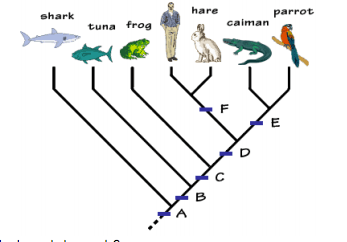
How many animals on this cladogram have lungs?
a)
2
b)
3
c)
5
d)
7
18.
On the cladogram, which organism is the closest relative of the parrot?
a)
Frog
b)
Hare
c)
Caiman
d)
Parrot
19.
This domain contains organisms that have a true nucleus in each of their cells. This domain breaks down into four kingdoms.
a)
Protista
b)
Archaea
c)
Bacteria
d)
Eukarya
20.
Where is the T.rex and frog's common ancestor?
a)
Point A
b)
Point B
c)
Point C
d)
Point D
Answer Key
Phylogeny Review
Total questions: 20
1.
b)
the evolutionary history of a species or taxonomic group
2.
d)
E
3.
a)
3
4.
a)
Theropods
5.
b)
no
6.
a)
yes
7.
b)
2
8.
a)
Lutra lutra
9.
a) very similar DNA sequence
10.
b)
Dog
11.
c)
Lamprey
12.
a)
Saurischian dinosaurs
13.
a)
Ferns
14.
b)
Phylogenetic Tree
15.
a)
True
16.
a)
Phylogeny
17.
c)
5
18.
c)
Caiman
19.
d)
Eukarya
20.
b) Point B
140 %
Browse by subjects
Browse by grades
Browse by format
FAQs
What does the Phylogeny Review worksheet cover?
This Grade 9 biology worksheet uses 20 multiple-choice questions to assess how students interpret phylogenetic trees and cladograms. Students identify common ancestors, compare relatedness, determine branching order, and connect evolutionary relationships with DNA similarity and traits such as amniotic eggs, vascular tissue, and light bones.
How can I use this worksheet to teach students to interpret phylogenetic trees?
First model how to trace branches backward to a shared node, then use the worksheet’s questions about common ancestors, closest relatives, and the group that arose first as guided practice. Ask students to explain which branch or node supports each answer before they complete the remaining multiple-choice items independently. Finish by discussing how the dinosaur, mammal, plant, and DNA examples apply the same tree-reading process.
What mistakes should I watch for when students complete this phylogeny worksheet?
Students may choose the organism label nearest another organism instead of tracing both branches to their most recent common ancestor. They may also confuse “most closely related” with physical similarity, or select “exactly the same DNA sequences” instead of the worksheet’s idea that close relatives have very similar sequences. Check that students distinguish branching points from organism names and carefully apply traits such as seeds, vascular tissue, and amniotic eggs.
How do I assign and grade the Phylogeny Review worksheet?
The Phylogeny Review worksheet is available as a printable PDF and as a digital quiz on Wayground, with a complete answer key for all 20 multiple-choice questions. For printable submissions, you can scan student work with the Wayground for Teachers app to help grade responses. The printable format also gives schools an option for practicing phylogenetic-tree interpretation with less screen use.
How can I differentiate this phylogenetic-tree worksheet for my students?
Under the worksheet’s Advanced Settings, adjust font spacing or choose a larger font size to make the cladogram labels, answer choices, and biology terms easier to read. You can also enable a dyslexia-friendly font or translate the worksheet into another language while students work through the phylogeny questions.
Where can I find more worksheets like this on Wayground?
Wayground offers a comprehensive collection of free printable worksheets and practice problems across subjects, with downloadable PDFs and answer keys to support essential skills and concepts. Browse more resources at https://wayground.com/en-us/worksheets.

 Worksheets