

Wayground
Word Roots Level 3 Week 4 - Printable Science Worksheets 7th Grade - Wayground

Word Roots Level 3 Week 4

Rosine 7

Created by Rosine 7

18 questions

7th Grade

Science

Updated Nov 2025

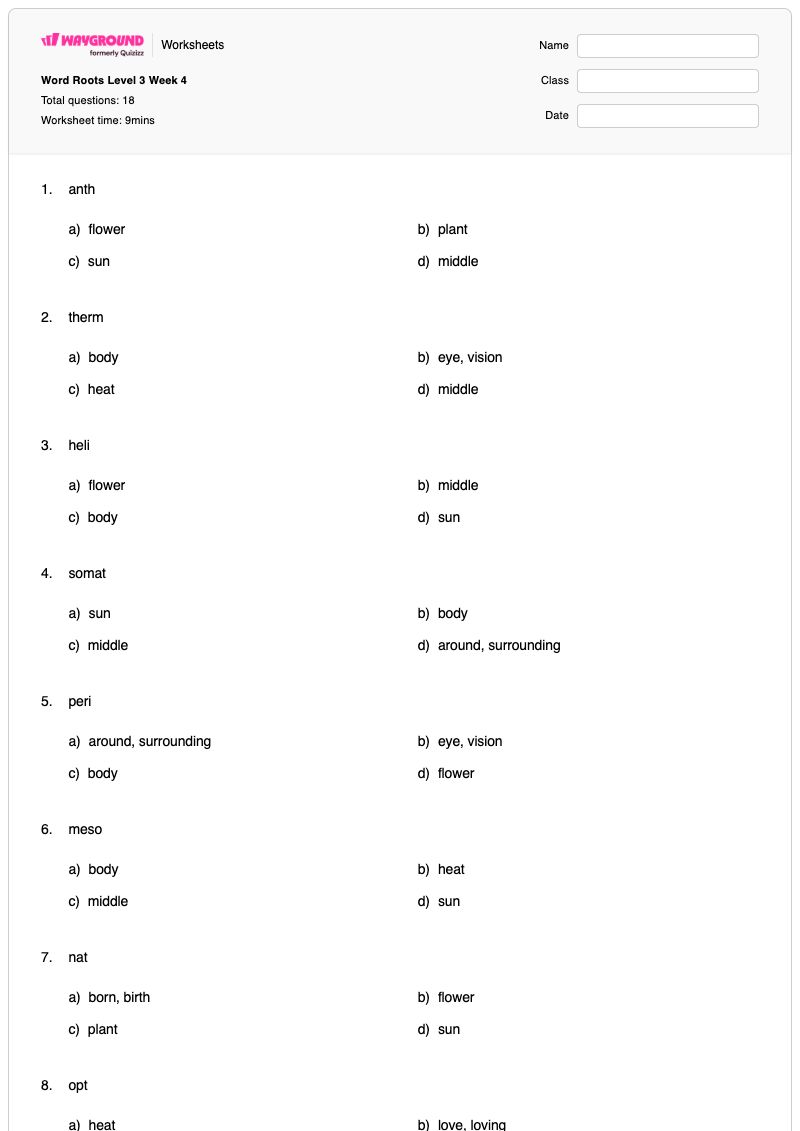
Word Roots Level 3 Week 4 is a Grade 7 English worksheet that builds students’ understanding of Greek and Latin word roots through 18 multiple-choice questions. Students identify the meanings of roots such as anth, therm, heli, somat, peri, meso, nat, opt, phil, and phyte, then apply those meanings to compound terms including perioptic, perianth, perinatal, perihelion, and mesosomatic. This free printable worksheet helps students move from memorizing individual root meanings to using word parts to determine the meanings of unfamiliar vocabulary. The multiple-choice format gives learners repeated practice distinguishing closely related definitions, such as “middle,” “around,” “body,” “sun,” and “flower,” before interpreting roots within complete terms. It is suitable for Grade 7 English instruction, vocabulary review, independent practice, or a quick formative check, and it includes a complete answer key for efficient grading.

Worksheet settings

Font size

S
M
L
XL
WaygroundWorksheets

Word Roots Level 3 Week 4

Total questions: 18

Name
Class
Date
1.

anth

a)

flower

b)

plant

c)

sun

d)

middle

2.

therm

a)

body

b)

eye, vision

c)

heat

d)

middle

3.

heli

a)

flower

b)

middle

c)

body

d)

sun

4.

somat

a)

sun

b)

body

c)

middle

d)

around, surrounding

5.

peri

a)

around, surrounding

b)

eye, vision

c)

body

d)

flower

6.

meso

a)

body

b)

heat

c)

middle

d)

sun

7.

nat

a)

born, birth

b)

flower

c)

plant

d)

sun

8.

opt

a)

heat

b)

love, loving

c)

eye, vision

d)

like, related to

9.

phil

a)

eye, vision

b)

around, surrounding

c)

quality, state

d)

love, loving

10.

phyte

a)

plant

b)

flower

c)

body

d)

heat

11.

perioptic

a)

surrounding the eyeball

b)

the outer part of a flower

c)

point closest to the sun

12.

perianth

a)

plant that requires moderate heat

b)

plant that requires moderate amounts of water

c)

the outer part of a flower

13.

perinatal

a)

the outer part of a flower

b)

thriving in a moderate environment

c)

time surrounding birth

14.

perihelion

a)

point closest to the sun

b)

the middle region of the body

c)

surrounding the eyeball

15.

mesosomatic

a)

outer part of the flower

b)

middle region of the body of vertebrates

c)

thriving in a moderate environment

16.

mesotherm

a)

plant that requires moderate heat

b)

plant that requires moderate amounts of water

c)

the outer part of a flower

17.

mesophilic

a)

middle region of the body of invertebrates

b)

plant that requires moderate amounts of water

c)

thriving in a moderate environment

18.

mesophyte

a)

thriving in a moderate environment

b)

plant that requires moderate heat

c)

plant that requires moderate amounts of water

WaygroundAnswer Key

Word Roots Level 3 Week 4

Total questions: 18

1.
a)

flower

2.
c)

heat

3.
d)

sun

4.
b)

body

5.
a)

around, surrounding

6.
c)

middle

7.
a)

born, birth

8.
c)

eye, vision

9.
d)

love, loving

10.
a)

plant

11.
a)

surrounding the eyeball

12.
c)

the outer part of a flower

13.
c)

time surrounding birth

14.
a)

point closest to the sun

15.
b)

middle region of the body of vertebrates

16.
a)

plant that requires moderate heat

17.
c)

thriving in a moderate environment

18.
c)

plant that requires moderate amounts of water

FAQs

What does the Word Roots Level 3 Week 4 worksheet cover?

This Grade 7 English worksheet covers the meanings of ten roots, including peri (around or surrounding), meso (middle), opt (eye or vision), and phyte (plant). Its 18 multiple-choice questions then ask students to apply those meanings to compound words such as perioptic, perianth, perinatal, perihelion, and mesosomatic, building skill in using word parts to interpret vocabulary.

How can I use this worksheet to teach students to use roots in unfamiliar words?

Introduce the root-meaning items first, asking students to explain how a root such as peri, heli, or somat contributes meaning. Then have students use that evidence to analyze the compound-word items, such as connecting peri with “surrounding” in perioptic and perihelion. Discuss why the surrounding root changes the interpretation depending on the second word part.

What mistakes should I watch for on this word-roots worksheet?

Students may confuse roots with related meanings, such as selecting “flower” for phyte or “plant” for anth, or mixing up peri (around) and meso (middle). In the compound-word questions, they may identify one root correctly but ignore the other, leading to errors such as choosing “middle region of the body” for perihelion or treating perinatal as a flower term instead of a term related to birth.

How do I assign and grade the Word Roots Level 3 Week 4 worksheet?

Wayground provides this worksheet as a printable PDF and as a digital quiz, and it includes a complete answer key for all 18 multiple-choice questions. You can grade printable submissions by scanning student work with the Wayground for Teachers app, or review responses from the digital quiz in Wayground. The printable version can also support instruction in settings that are reducing screen time.

How can I differentiate this word-roots worksheet for my students?

In the worksheet’s Advanced Settings, adjust font spacing or choose a larger font size to make the root-definition and compound-word choices easier to scan. You can also enable a dyslexia-friendly font or translate the worksheet into another language, while keeping the same multiple-choice practice with roots such as peri, meso, heli, and somat.

Where can I find more worksheets like this on Wayground?

Wayground offers a comprehensive collection of free printable worksheets and practice problems across subjects, with downloadable PDFs and answer keys to help students master essential skills and concepts. Browse more resources at https://wayground.com/en-us/worksheets.