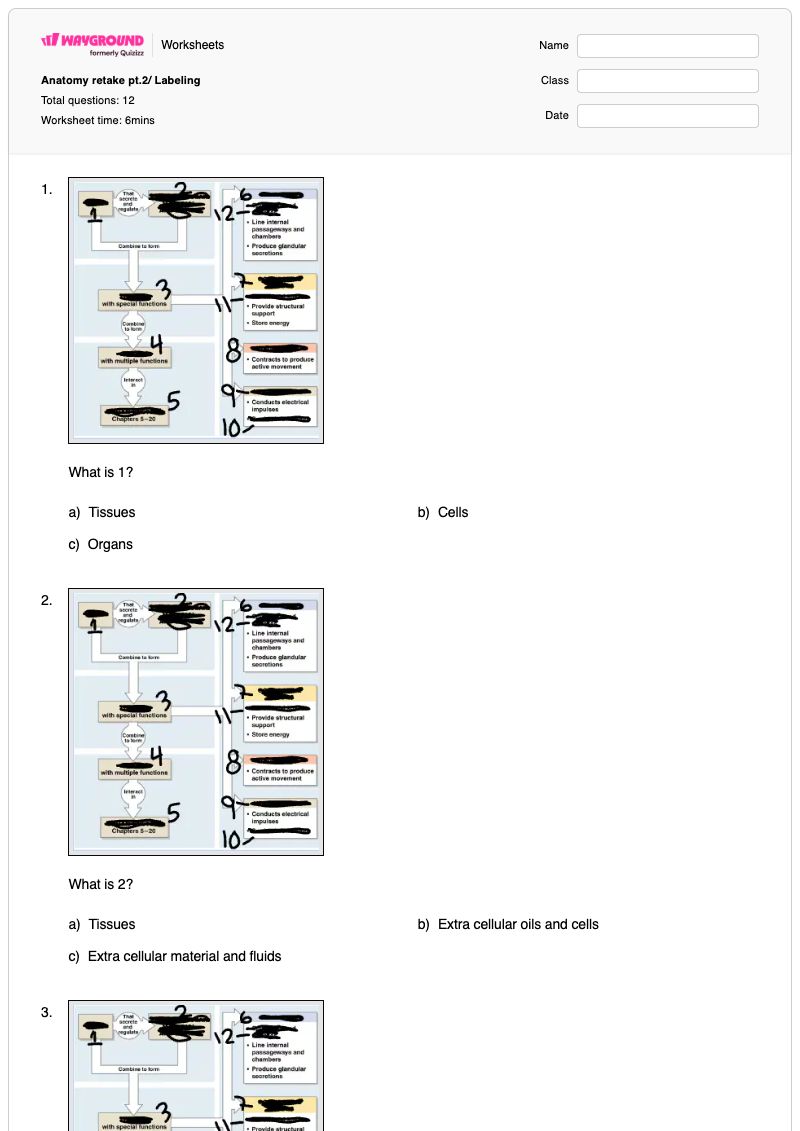
Anatomy Retake Pt. 2/Labeling is a Grade 13 physics worksheet that reviews levels of anatomical organization and tissue identification. Through 12 multiple-choice items based on numbered labels, students identify cells, extracellular material and fluids, tissues, organs, and organ systems. They then distinguish epithelia, connective tissue, muscle tissue, and neural tissue, including the functions associated with these tissue types: covering exposed surfaces, filling internal spaces, and carrying information. The sequence helps students connect foundational organizational levels with specific tissue categories and functions.
Use this worksheet as a retake, review activity, or check for understanding after instruction on anatomical organization and tissues. Students select the correct term for each numbered label or function, giving teachers a focused way to identify confusion between related categories such as tissues and organs or among the four tissue types. This free printable worksheet includes a complete answer key for efficient review and grading, and it is also available digitally through Wayground.
Worksheet settings
Font size
S
M
L
XL
Worksheets
Anatomy retake pt.2/ Labeling
Total questions: 12
Name
Class
Date
1.
What is 1?
a)
Tissues
b)
Cells
c)
Organs
2.
What is 2?
a)
Tissues
b)
Extra cellular oils and cells
c)
Extra cellular material and fluids
3.
What is 3?
a)
Tissues
b)
Cells
c)
Organs
4.
What is 4?
a)
Cells
b)
Muscles
c)
Organs
5.
What is 5?
a)
Extracellular system
b)
Epithelial system
c)
Organ system
6.
What is 6?
a)
Muscle tissue
b)
Connective tissue
c)
Neural tissue
d)
Epithelia
7.
What is 7?
a)
Connective tissue
b)
Epithelia
c)
Muscle Tissue
d)
Neural Tissue
8.
What is 8?
a)
Neural Tissue
b)
Connective tissue
c)
Muscle tissue
d)
Epithelia
9.
What is 9?
a)
Epithelia
b)
Connective tissue
c)
Muscle tissue
d)
Neural Tissue
10.
What is 10?
a)
Fills internal spaces
b)
Carries information
c)
Covers exposed surfaces
11.
What is 12?
a)
Fills internal spaces
b)
Covers exposed surfaces
c)
carries information
12.
What is 11?
a)
Fill internal spaces
b)
Carries information
c)
covers exposed surfaces
Answer Key
Anatomy retake pt.2/ Labeling
Total questions: 12
1.
b)
Cells
2.
c)
Extra cellular material and fluids
3.
a)
Tissues
4.
c)
Organs
5.
c)
Organ system
6.
d)
Epithelia
7.
a)
Connective tissue
8.
c)
Muscle tissue
9.
d)
Neural Tissue
10.
b)
Carries information
11.
b)
Covers exposed surfaces
12.
a)
Fill internal spaces
140 %
Browse by subjects
Browse by grades
Browse by format
FAQs
What does the Anatomy Retake Pt. 2/Labeling worksheet cover?
This worksheet covers the levels of anatomical organization—cells, extracellular material and fluids, tissues, organs, and organ systems—and the identification of epithelia, connective tissue, muscle tissue, and neural tissue. Its 12 multiple-choice labeling items also ask students to connect these tissue types with functions such as covering exposed surfaces, filling internal spaces, and carrying information.
How can I use this worksheet to teach anatomical organization and tissue types?
Introduce the numbered labels by having students explain how cells, tissues, organs, and organ systems relate to one another before they begin the multiple-choice items. Afterward, use the tissue questions to prompt comparisons among epithelia, connective, muscle, and neural tissue, asking students to justify why a listed function belongs with one tissue type rather than another.
What mistakes should I watch for when students complete this anatomy labeling worksheet?
Watch for students selecting tissues when a numbered label represents an organ, or choosing an organ when the item refers to an organ system. Students may also confuse the four tissue names or match the functions incorrectly—for example, assigning carrying information to a tissue other than neural tissue, or covering exposed surfaces to a tissue other than epithelia.
How do I assign and grade this anatomy labeling worksheet?
The worksheet is available as a printable PDF and as a digital quiz on Wayground, and it includes a complete answer key for all 12 multiple-choice items. For printable submissions, you can scan student work with the Wayground for Teachers app to support grading and review.
How can I differentiate this worksheet for my students?
For the numbered labeling and tissue-function items, use the worksheet’s Advanced Settings to adjust font spacing or choose a larger font size for clearer visual processing. You can also enable a dyslexia-friendly font or translate the worksheet into another language when those options better support access to the anatomy terms.
Where can I find more worksheets like this on Wayground?
Wayground offers a broad collection of free printable worksheets and practice problems across subjects, with downloadable PDFs and answer keys to help students build essential skills and concepts. Browse more resources at https://wayground.com/en-us/worksheets.

 Worksheets


