
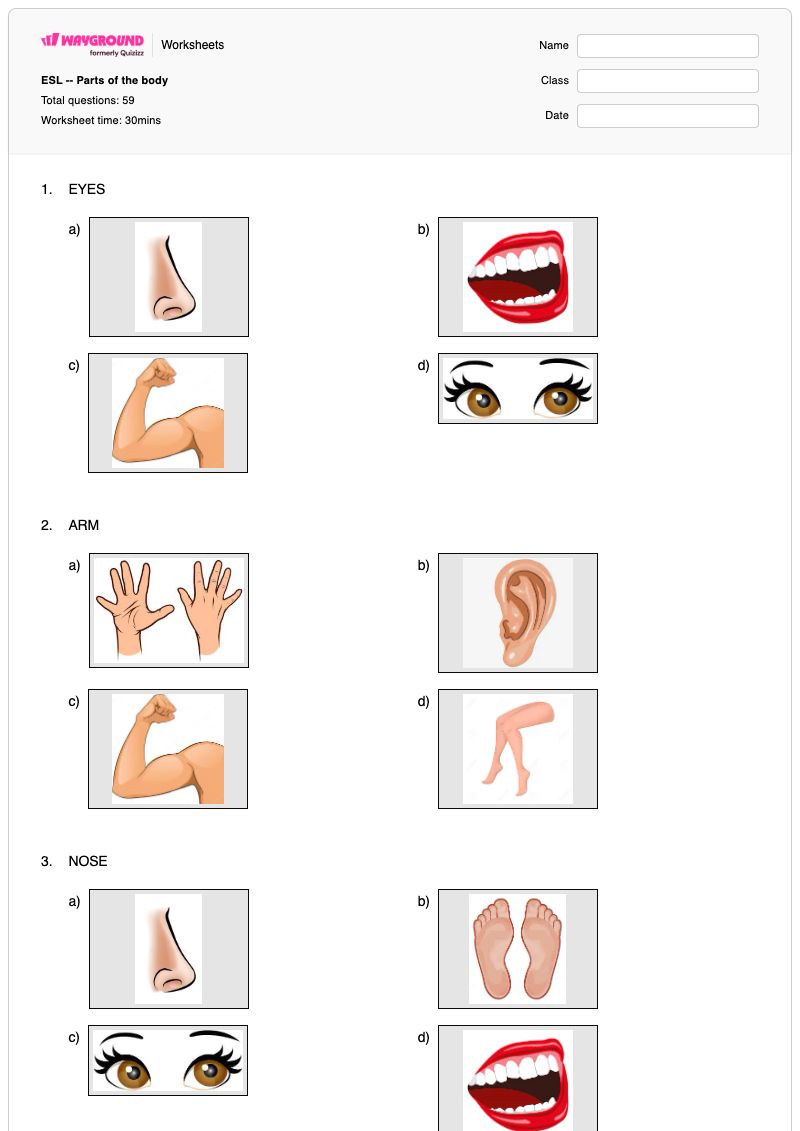

ESL -- Parts of the Body is a Kindergarten English worksheet that builds foundational body-part vocabulary for young English learners. Across 59 questions, students answer 47 multiple-choice items identifying words such as eyes, arm, nose, legs, mouth, ear, feet, hands, and face, then complete 12 short fill-in-the-blank prompts using vocabulary including elbow, finger, hand, head, and knee.
The worksheet moves from recognizing individual body-part words to applying them in simple sentences. Students practise choosing the correct word for prompts such as “This is a…” and “These are …,” reinforcing the difference between singular and plural forms while developing early English reading and vocabulary skills. It is useful for introducing or reviewing body-part words in an ESL lesson, independent practice, or a quick vocabulary check. This is a free printable worksheet with a complete answer key.
Worksheet settings
Font size
S
M
L
XL
Worksheets
ESL -- Parts of the body
Total questions: 59
Name
Class
Date
1.
EYES
a)
b)
c)
d)
2.
ARM
a)
b)
c)
d)
3.
NOSE
a)
b)
c)
d)
4.
LEGS
a)
b)
c)
d)
5.
MOUTH
a)
b)
c)
d)
6.
EAR
a)
b)
c)
d)
7.
FEET
a)
b)
c)
d)
8.
HANDS
a)
b)
c)
d)
9.
FACE
a)
b)
c)
d)
10.
This is an...
(a)
11.
These are ...
(a)
12.
This is a...
(a)
13.
This is a...
(a)
14.
This is a...
(a)
15.
This is a...
(a)
16.
This is a...
(a)
17.
This is a...
(a)
18.
This is a...
(a)
19.
This is a...
(a)
20.
This is a...
(a)
21.
These are...
(a)
22.
a)
Head
b)
Nose
c)
Hair
d)
Ear
23.
a)
Head
b)
Hair
c)
Nose
d)
Eye
24.
a)
Head
b)
Hair
c)
Eyes
d)
Nose
25.
a)
Head
b)
Hair
c)
Eyes
d)
Nose
26.
a)
Jaw
b)
Nose
c)
Hair
d)
Head
27.
a)
Hand
b)
Hair
c)
Head
d)
Eyes
28.
a)
Heel
b)
Head
c)
Hair
d)
Eyes
29.
a)
Hair
b)
Hair
c)
knee
d)
Eyes
30.
a)
Knee
b)
Haid
c)
Hair
d)
Toe
31.
a)
Arm
b)
Knee
c)
Hair
d)
Eyes
32.
We use our ………… to smell.
a)
eye
b)
hand
c)
nose
d)
ears
33.
We use our ………… to touch things.
a)
mouth
b)
hand
c)
nose
d)
fingers
34.
My mom always comb my ___________ everyday.
a)
nostrils
b)
hair
c)
nose
d)
fingers
35.
We use our ………… to hear.
a)
eye
b)
hand
c)
nose
d)
ears
36.
We use our ………… to see.
a)
eyes
b)
hand
c)
nose
d)
ears
37.
We use our ………… to walk.
a)
eyes
b)
hand
c)
legs
d)
nose
38.
We use our ………… to taste.
a)
lips
b)
tongue
c)
mouth
d)
teeth
39.
We use our ………… to bite.
a)
lips
b)
tongue
c)
mouth
d)
teeth
40.
We use trim our ………… to keep it clean.
a)
finger
b)
thumb
c)
fingernails
d)
teeth
41.
The fingers on my feet are called ________.
a)
feetnails
b)
toenail
c)
fingernails
d)
toes
42.
The hair inside our _______________ helps to clean the air that we breathe in.
a)
ear
b)
mouth
c)
nose
d)
eye
43.
The taste-buds on our ___________ help us to taste food.
a)
teeth
b)
lip
c)
gum
d)
tongue
44.
Our ______________ allow us to bite and chew our food.
a)
teeth
b)
fingers
c)
hands
d)
eyes
45.
If dirt gets into our ________________, tears will help to wash it out.
a)
ears
b)
eyes
c)
mouth
d)
nose
46.
Hair does not grow in the soles of our ___________________ .
a)
feet
b)
head
c)
face
d)
mouth
47.
The ___________________ of your hand is the inside part.
a)
wrist
b)
knuckle
c)
fingers
d)
palm
48.
If you touch something hot, your brain tells you to move your ______________ away.
a)
leg
b)
head
c)
face
d)
hand
49.
Your _______________ and brain work together to tell you the different sounds.
a)
eyes
b)
mouth
c)
ears
d)
skin
50.
The _____________ is the joint between the hand and the arm.
a)
waist
b)
elbow
c)
wrist
d)
finger
51.
Your _____________ is the place where your leg bends.
a)
thigh
b)
ankle
c)
knee
d)
hip
52.
Henry had an upset _____________ after eating so many lollipops.
a)
hip
b)
waist
c)
chest
d)
stomach
53.
Shirley blushes and her _____________ turned red.
a)
ears
b)
chin
c)
cheeks
d)
forehead
54.
Lin Mey twisted her ______________ when she wore her new high-heeled shoes.
a)
foot
b)
knee
c)
thigh
d)
ankle
55.
She helped him to his chair, with her arm around his __________ .
a)
neck
b)
chest
c)
shoulder
d)
abdomen
56.
Please trim my ___________ . It is too long.
a)
hair
b)
chest
c)
shoulder
d)
fingernail
57.
Although ___________ are very strong, they can be damaged by germs.
a)
lips
b)
teeth
c)
eyelids
d)
tongue
58.
When we breathe, we take air into our body through our ____________ .
a)
nostrils
b)
eyes
c)
mouth
d)
nose
59.
The patient's broken ___________ is cast in plaster.
a)
arm
b)
mouth
c)
eyelash
d)
forehead
Answer Key
ESL -- Parts of the body
Total questions: 59
1.
d)
2.
c)
3.
a)
4.
c)
5.
a)
6.
d)
7.
a)
8.
c)
9.
a)
10.
elbow, Elbow
11.
feet, Feet
12.
finger, Finger
13.
hand, Hand
14.
head, Head
15.
knee, Knee
16.
leg, Leg
17.
mouth, Mouth
18.
neck, Neck
19.
shoulder, Shoulder
20.
stomach, Stomach
21.
toes, Toes
22.
a)
Head
23.
d)
Eye
24.
b)
Hair
25.
d)
Nose
26.
a)
Jaw
27.
a)
Hand
28.
a)
Heel
29.
c)
knee
30.
d)
Toe
31.
a)
Arm
32.
c)
nose
33.
d)
fingers
34.
b)
hair
35.
d)
ears
36.
a)
eyes
37.
c)
legs
38.
b)
tongue
39.
d)
teeth
40.
c)
fingernails
41.
d)
toes
42.
c)
nose
43.
d)
tongue
44.
a)
teeth
45.
b)
eyes
46.
a)
feet
47.
d)
palm
48.
d)
hand
49.
c)
ears
50.
c)
wrist
51.
c)
knee
52.
d)
stomach
53.
c)
cheeks
54.
d)
ankle
55.
c)
shoulder
56.
a)
hair
57.
b)
teeth
58.
a)
nostrils
59.
a)
arm
140 %
Browse by subjects
Browse by grades
Browse by format
FAQs
What does the ESL Parts of the Body worksheet cover?
This Kindergarten English worksheet practises identifying body-part vocabulary through 47 multiple-choice questions and completing 12 fill-in-the-blank sentences. Students recognize words such as eyes, arm, nose, legs, mouth, ear, feet, hands, face, elbow, finger, hand, head, and knee, then apply them in prompts using “This is a…” or “These are …”.
How can I use this body-parts worksheet to teach ESL students?
Introduce the body-part words orally and have students point to each part before they begin the multiple-choice section. Afterward, use the fill-in-the-blank items to model why “This is a…” matches a singular word such as hand or knee, while “These are …” matches the plural word feet.
What mistakes should I watch for on this body-parts worksheet?
Watch for students choosing a similar-looking or familiar body-part word without checking the prompt, especially in the multiple-choice items. In the sentence-completion section, students may use a singular word after “These are,” choose the wrong form for “This is a…,” or overlook the expected capitalization shown in the answer choices.
How do I assign and grade the ESL Parts of the Body worksheet?
The worksheet is available as a printable PDF and as a digital quiz on Wayground, so you can use the 59 body-part vocabulary questions in either format. It includes a complete answer key, and printable submissions can be graded by scanning student work with the Wayground for Teachers app. The printable option can also support classrooms that are reducing screen time.
How can I differentiate this body-parts worksheet for my students?
Use the worksheet’s Advanced Settings to adjust font spacing and font size so the body-part labels and sentence-completion prompts are easier to follow. You can also enable a dyslexia-friendly font or translate the worksheet into another language when learners need additional language support.
Where can I find more worksheets like this on Wayground?
Wayground offers a comprehensive collection of free printable worksheets and practice problems across all subjects, including downloadable PDFs and answer keys. Browse more resources at https://wayground.com/en-us/worksheets.