This Grade 2 science worksheet gives students focused practice identifying insect body structures and explaining how different insects use their legs. The 10 multiple-choice questions cover the six legs and three main body parts shared by insects, including the head, thorax, and abdomen, as well as the functions of specialized legs in beetles, grasshoppers, honeybees, and praying mantises.
Students apply their knowledge to connect structure with function: they identify the thorax as the body section that supports movement, the abdomen as the section containing organs, and the head as the location of the eyes, mouth, and antennae. They also learn why the praying mantis is considered a farmer’s friend. This free printable worksheet is designed for Grade 2 science instruction, review, or formative assessment and includes a complete answer key for efficient checking.
Worksheet settings
Font size
S
M
L
XL
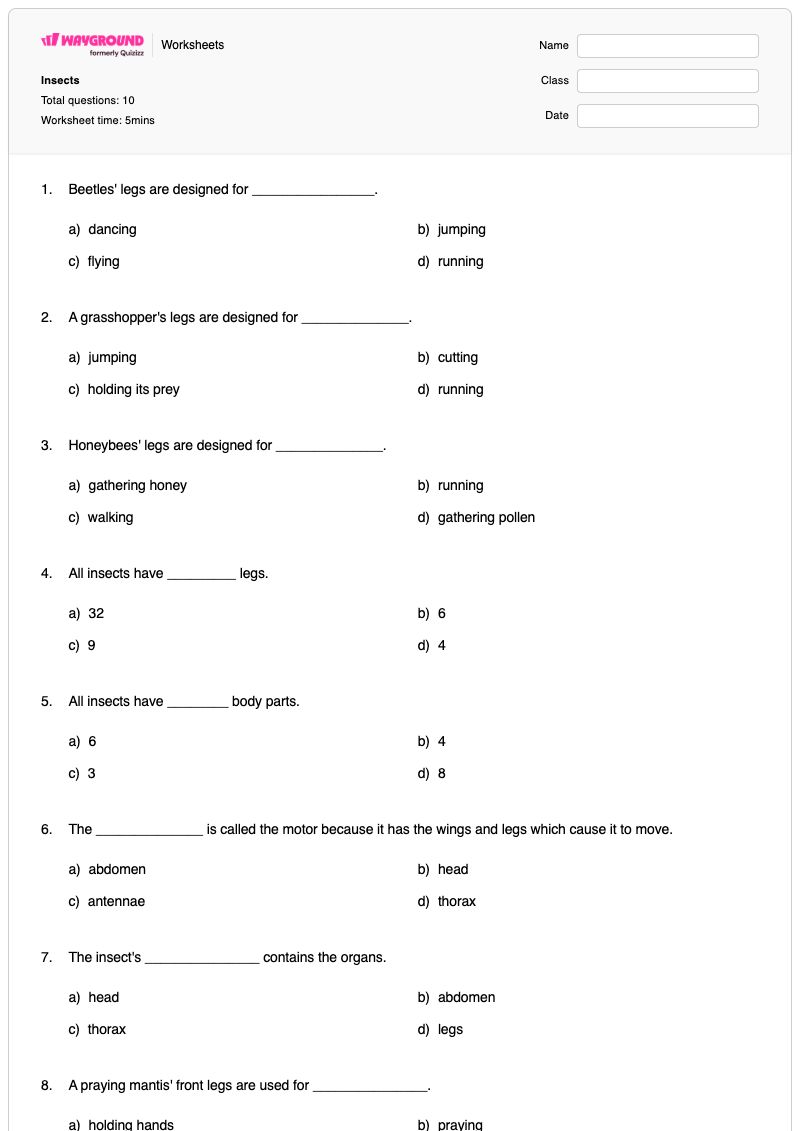
Worksheets
Insects
Total questions: 10
Name
Class
Date
1.
Beetles' legs are designed for ________________.
a)
dancing
b)
jumping
c)
flying
d)
running
2.
A grasshopper's legs are designed for ______________.
a)
jumping
b)
cutting
c)
holding its prey
d)
running
3.
Honeybees' legs are designed for ______________.
a)
gathering honey
b)
running
c)
walking
d)
gathering pollen
4.
All insects have _________ legs.
a)
32
b)
6
c)
9
d)
4
5.
All insects have ________ body parts.
a)
6
b)
4
c)
3
d)
8
6.
The ______________ is called the motor because it has the wings and legs which cause it to move.
a)
abdomen
b)
head
c)
antennae
d)
thorax
7.
The insect's _______________ contains the organs.
a)
head
b)
abdomen
c)
thorax
d)
legs
8.
A praying mantis' front legs are used for _______________.
a)
holding hands
b)
praying
c)
holding its prey
d)
walking
9.
Why is the praying mantis called the farmer's friend?
a)
It is a very polite insect.
b)
It cleans up after itself.
c)
It eats moths, caterpillars, grasshoppers, and other insects that eat crops.
d)
It eats corn, tomatoes, and peanuts in the field.
10.
The insect's __________ contains the eyes, mouth, and antenna.
a)
thorax
b)
abdomen
c)
head
d)
legs
Answer Key
Insects
Total questions: 10
1.
d)
running
2.
a)
jumping
3.
d)
gathering pollen
4.
b)
6
5.
c)
3
6.
d)
thorax
7.
b)
abdomen
8.
c)
holding its prey
9.
c)
It eats moths, caterpillars, grasshoppers, and other insects that eat crops.
10.
c)
head
140 %
Browse by subjects
Browse by grades
Browse by format
FAQs
What does this insects worksheet cover?
This Grade 2 science worksheet uses 10 multiple-choice questions to assess insect anatomy and adaptations. Students identify insects’ six legs and three body parts, match the head, thorax, and abdomen to their functions, and connect specialized legs with actions such as running, jumping, gathering pollen, or holding prey.
How can I use this worksheet to teach insect body parts and leg functions?
Introduce the worksheet with a labeled insect diagram, then have students locate the head, thorax, and abdomen before discussing how each part contributes to movement or survival. Use the leg-function questions as a comparison activity: ask students why a grasshopper’s legs differ in function from a honeybee’s or a praying mantis’s front legs, then let them complete the multiple-choice questions independently.
What mistakes should I watch for when students complete this insect worksheet?
Students may confuse the thorax and abdomen, selecting the abdomen as the body section that powers movement or the thorax as the section containing organs. They may also choose a general action such as walking instead of the specialized function named in the questions, such as a honeybee gathering pollen or a praying mantis holding prey. Watch for confusion between the head’s eyes, mouth, and antennae and the other insect body parts.
How do I assign and grade this insects worksheet?
You can assign this worksheet as a printable PDF or as a digital quiz on Wayground. It includes a complete answer key, and printable submissions can be graded by scanning student work with the Wayground for Teachers app. The printable format also supports classrooms that are reducing screen time while students review insect anatomy.
How can I differentiate this insect worksheet for my students?
Use the worksheet’s Advanced Settings to adjust font spacing or increase the font size, making the 10 multiple-choice items easier to read. You can also enable a dyslexia-friendly font or translate the insect anatomy questions into another language when that support is useful.
Where can I find more worksheets like this on Wayground?
Wayground offers a broad collection of free printable worksheets and practice problems across subjects, with downloadable PDFs and answer keys to help students build essential skills and concepts. Browse more resources at https://wayground.com/en-us/worksheets.

 Worksheets