Charles’s and Boyle’s Laws is a free printable science worksheet for students in Grades 6–12. Its 12 multiple-choice questions check whether students can identify the variables compared in each gas law, recall the required Kelvin temperature scale for Charles’s Law, select the correct formulas, and identify which variable remains constant.
The worksheet also reinforces the difference between direct and inverse proportionality. Students apply those relationships conceptually by predicting how temperature changes when volume changes at constant pressure and how pressure changes when volume changes in Boyle’s Law. The included answer key supports quick review, independent practice, or an introductory check of students’ understanding before more advanced gas-law calculations.
Worksheet settings
Font size
S
M
L
XL
Worksheets
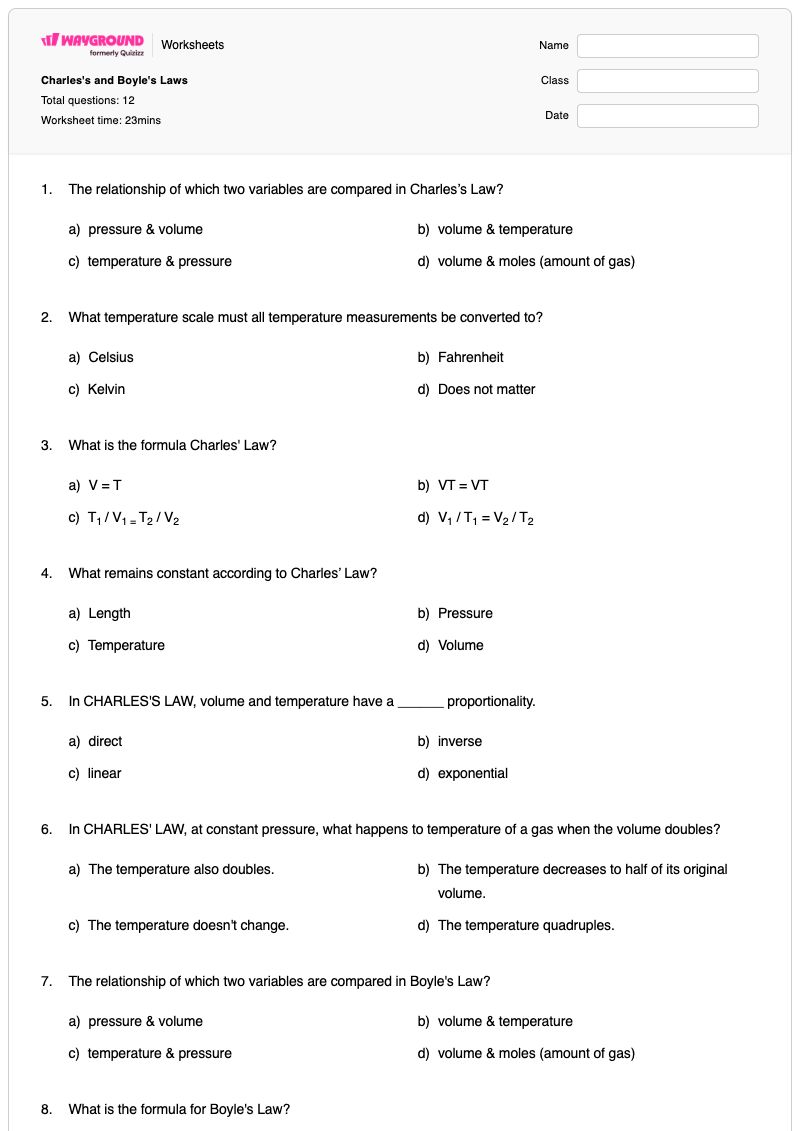
Charles's and Boyle's Laws
Total questions: 12
Name
Class
Date
1.
The relationship of which two variables are compared in Charles’s Law?
a)
pressure & volume
b)
volume & temperature
c)
temperature & pressure
d)
volume & moles (amount of gas)
2.
What temperature scale must all temperature measurements be converted to?
a)
Celsius
b)
Fahrenheit
c)
Kelvin
d)
Does not matter
3.
What is the formula Charles' Law?
a)
V = T
b)
VT = VT
c)
T1 / V1 = T2 / V2
d)
V1 / T1 = V2 / T2
4.
What remains constant according to Charles’ Law?
a)
Length
b)
Pressure
c)
Temperature
d)
Volume
5.
In CHARLES'S LAW, volume and temperature have a ______ proportionality.
a)
direct
b)
inverse
c)
linear
d)
exponential
6.
In CHARLES' LAW, at constant pressure, what happens to temperature of a gas when the volume doubles?
a)
The temperature also doubles.
b)
The temperature decreases to half of its original volume.
c)
The temperature doesn't change.
d)
The temperature quadruples.
7.
The relationship of which two variables are compared in Boyle's Law?
a)
pressure & volume
b)
volume & temperature
c)
temperature & pressure
d)
volume & moles (amount of gas)
8.
What is the formula for Boyle's Law?
a)
P1V1=P2V2
b)
P1V1/P2V2
c)
P1V2=P2V1
d)
P1/V1=P2/V2
9.
In BOYLE'S LAW, when Pressure increases then the Volume must...
a)
Increase
b)
Decrease
10.
In BOYLE'S LAW, when Volume increases then Pressure must...
a)
Increase
b)
Decrease
11.
In BOYLE'S LAW, what type of relationship do pressure and volume have?
a)
Direct
b)
Inverse
c)
No relationship
12.
Which container will have a lower pressure?
a)
left
b)
right
c)
they both have the same pressure
Answer Key
Charles's and Boyle's Laws
Total questions: 12
1.
b) volume & temperature
2.
c) Kelvin
3.
d) V1 / T1 = V2 / T2
4.
b)
Pressure
5.
a)
direct
6.
a)
The temperature also doubles.
7.
a) pressure & volume
8.
a) P1V1=P2V2
9.
b)
Decrease
10.
b)
Decrease
11.
b)
Inverse
12.
a)
left
140 %
Browse by subjects
Browse by grades
Browse by format
FAQs
What does this Charles’s and Boyle’s Laws worksheet help students learn?
This 12-question multiple-choice worksheet helps students distinguish Charles’s Law, which compares volume and temperature at constant pressure, from Boyle’s Law, which compares pressure and volume. Students identify the Kelvin requirement and correct formulas, then use direct and inverse relationships to predict how one gas variable changes when another changes.
How can I use this worksheet to teach Charles’s and Boyle’s Laws?
Introduce the worksheet by having students sort the two laws by variables, then discuss the constant in each relationship before they begin the multiple-choice questions. Ask students to justify their choices about doubling volume in Charles’s Law and increasing pressure or volume in Boyle’s Law, using the formulas and proportionality terms as evidence.
What mistakes should I watch for when students complete this gas-laws worksheet?
Watch for students choosing Celsius instead of Kelvin, reversing the Charles’s Law formula, or treating its volume–temperature relationship as inverse rather than direct. Students may also confuse Boyle’s pressure–volume relationship with a direct one, select the wrong formula, or miss that pressure and volume move in opposite directions.
How do I assign and grade this Charles’s and Boyle’s Laws worksheet?
Wayground provides this worksheet as a printable PDF and as a digital quiz, with a complete answer key for all 12 multiple-choice questions. You can grade printable submissions by scanning student work with the Wayground for Teachers app, or use the digital quiz to review responses in Wayground.
How can I differentiate this Charles’s and Boyle’s Laws worksheet for my students?
Use the worksheet’s Advanced Settings to adjust font spacing or choose a larger font size so the multiple-choice options and gas-law formulas are easier to read. You can also enable a dyslexia-friendly font or translate the worksheet into another language while keeping the Charles’s Law and Boyle’s Law questions intact.
Where can I find more worksheets like this on Wayground?
Wayground offers a broad collection of free printable worksheets and practice problems across subjects, including downloadable PDFs and answer keys to support essential skills and concepts. Browse more resources at https://wayground.com/en-us/worksheets.

 Worksheets