

Wayground
Captains of Industry/Robber Barons Review - Printable History Worksheets - Wayground

Captains of Industry/Robber Barons Review

18 questions

9th - 9th Grade

History

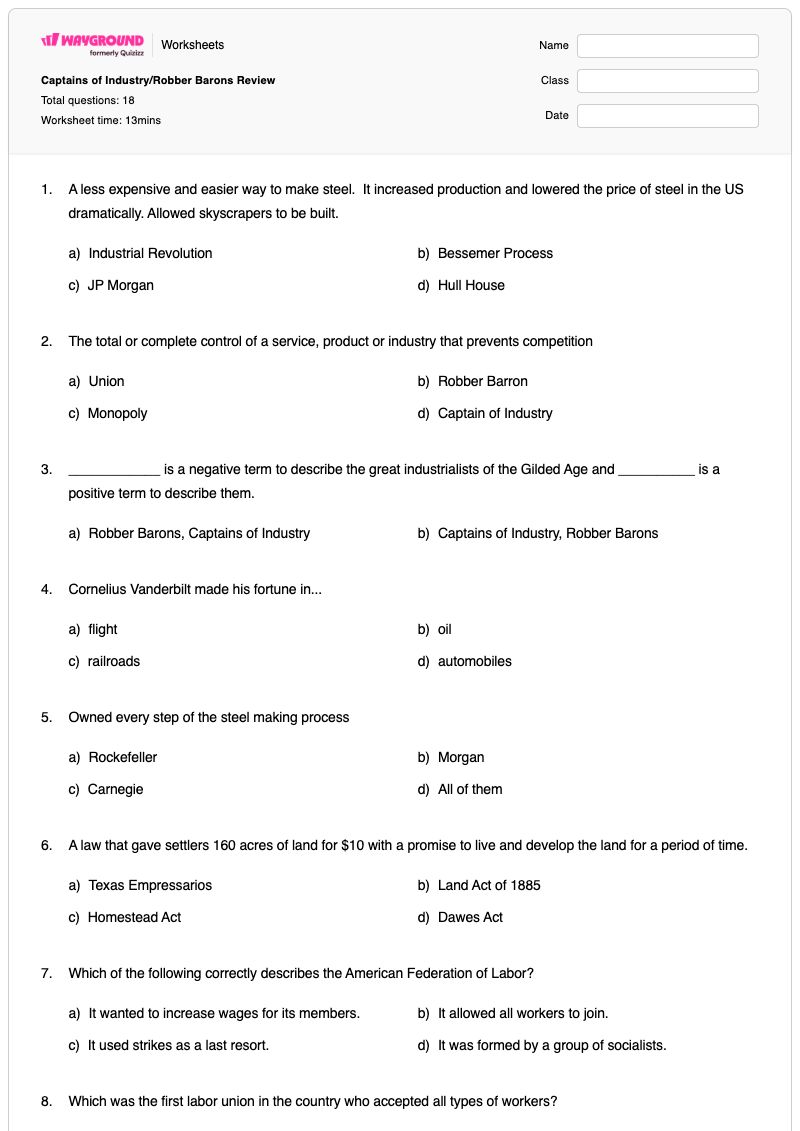
Captains of Industry/Robber Barons Review is a Grade 9 history worksheet that uses 18 multiple-choice questions to assess key ideas from the Gilded Age and American industrialization. Students identify the Bessemer Process, define monopolies, distinguish the negative label “Robber Barons” from the positive label “Captains of Industry,” and connect major figures such as Vanderbilt and Carnegie to their industries. The questions also review the Homestead Act, labor unions, and the American Federation of Labor. Students apply their knowledge of the Populist movement by identifying its goals, candidates, and historical context, including the campaign symbolism from The Wonderful Wizard of Oz. The review format helps teachers check whether students can match people, laws, organizations, economic ideas, and symbols with their historical meanings. This free printable worksheet includes an answer key and is suitable for review, independent practice, or a formative assessment in a Grade 9 American history unit.

Worksheet settings

Font size

S
M
L
XL
Worksheets

Captains of Industry/Robber Barons Review

Total questions: 18

Name
Class
Date
1.
A less expensive and easier way to make steel.  It increased production and lowered the price of steel in the US dramatically. Allowed skyscrapers to be built.
a)
Industrial Revolution
b)
Bessemer Process
c)
JP Morgan
d)
Hull House
2.
The total or complete control of a service, product or industry that prevents competition
a)
Union
b)
Robber Barron
c)
Monopoly
d)
Captain of Industry
3.
____________ is a negative term to describe the great industrialists of the Gilded Age and __________ is a positive term to describe them.
a)
Robber Barons, Captains of Industry
b)
Captains of Industry, Robber Barons
4.
Cornelius Vanderbilt made his fortune in...
a)
flight
b)
oil
c)
railroads
d)
automobiles
5.
Owned every step of the steel making process
a)
Rockefeller
b)
Morgan
c)
Carnegie
d)
All of them
6.

A law that gave settlers 160 acres of land for $10 with a promise to live and develop the land for a period of time.

a)

Texas Empressarios

b)

Land Act of 1885

c)

Homestead Act

d)

Dawes Act

7.
Which of the following correctly describes the American Federation of Labor?
a)
It wanted to increase wages for its members.
b)
It allowed all workers to join.
c)
It used strikes as a last resort.
d)
It was formed by a group of socialists.
8.

Which was the first labor union in the country who accepted all types of workers?

a)

American Federation of Labor

b)

Railroad Worker's Union

c)

American Labor Union

d)

Knights of Labor

9.

Why did the Populist party want unlimited coinage of silver?

a)

To increase the amount of money in circulation and raise farm prices

b)

To reduce economic inflation

c)

To raise campaign contribution limits

d)

To decrease the bargaining power of labor unions

10.
During the late 1800's, farmers formed the __________Party. 
a)
Populist
b)
Democratic
c)
Republican
d)
Whit
11.
Which candidate was the Populist party's candidate?
a)
Andrew Johnson
b)
Ulyssess Grant
c)
William Jennings Bryan
d)
William McKinley
12.
Represents the American farmer- thinks he lacks the brains, but he is quite smart and helps the journey to Oz
Needs a little political guidance to voice opinion and organize
a)
Scarecrow
b)
Tin Man
c)
Cowardly Lion
d)
Dorothy
13.
Represents the silver standard issue
•It will take the farmer home to a land of plenty as more currency is place in circulation
a)
Tornado
b)
"Silver" Slippers
c)
Yellow Brick Road
d)
OZ
14.
•Represents the industrial worker
•Once all flesh and blood, now just machines in an industrial age
•A worker that toils tirelessly day in and day out. 
a)
Cowardrly Lion
b)
Wicked Witch
c)
Wizard
d)
Tin Man
15.
Represents courage
•William Jennings Bryan (1896 Presidential Candidate vs. McKinley)- “Cross of Gold”
a)
Wizard
b)
Cowardly Lion
c)
Dorothy
d)
Good Witch
16.
•Represents the gold standard  
 - leads to the capital city or Washington, DC where the power lies
a)
Emerald City
b)
"Silver" Slippers
c)
Wicked Witch
d)
Yellow Brick Road
17.
•Represents Washington, DC- where all the problems are supposed to be solved  
- a city of power behind smoke and mirrors
a)
Emerald City
b)
OZ
c)
Kansas
d)
Good Witch
18.
This man gained his wealth and power from banking and finances during the Gilded Age
a)
John D Rockefeller
b)
Andrew Carnegie
c)
JP Morgan
d)
Cornelius Vanderbilt
Answer Key

Captains of Industry/Robber Barons Review

Total questions: 18

1.
b) Bessemer Process
2.
c) Monopoly
3.
a) Robber Barons, Captains of Industry
4.
c) railroads
5.
c) Carnegie
6.
c)

Homestead Act

7.
a) It wanted to increase wages for its members.
8.
d)

Knights of Labor

9.
a)

To increase the amount of money in circulation and raise farm prices

10.
a) Populist
11.
c) William Jennings Bryan
12.
a) Scarecrow
13.
b) "Silver" Slippers
14.
d) Tin Man
15.
b) Cowardly Lion
16.
d) Yellow Brick Road
17.
a) Emerald City
18.
c) JP Morgan

FAQs

What does the Captains of Industry/Robber Barons Review worksheet cover?

This Grade 9 history worksheet uses 18 multiple-choice questions to review Gilded Age industrialization, including the Bessemer Process, monopolies, the contrasting labels “Robber Barons” and “Captains of Industry,” and the industries associated with Vanderbilt and Carnegie. It also checks understanding of the Homestead Act, labor unions, Populist goals and candidates, and the Wizard of Oz symbols used to represent issues such as silver coinage and industrial labor.

How can I use this worksheet to teach Gilded Age industrialization and Populism?

Use the multiple-choice review after introducing the unit, or assign selected questions as retrieval practice before a class discussion. Ask students to explain why each answer fits—for example, how the Bessemer Process affected steel production, why the Populists supported unlimited silver coinage, and what the Scarecrow, Silver Slippers, Tin Man, and Cowardly Lion symbolize. Reviewing the distractors aloud can help students connect people, movements, policies, and symbols rather than memorize isolated terms.

What mistakes should I watch for when students complete this worksheet?

Students may confuse the Bessemer Process with a person or organization, or select “Captains of Industry” when a question asks for the negative term “Robber Barons.” They may also mix up Carnegie’s control of steel production with Vanderbilt’s railroad fortune, or confuse the Knights of Labor with the American Federation of Labor. For the Populist questions, check that students connect silver coinage with increasing money in circulation and raising farm prices, and match the Wizard of Oz symbols to the correct groups or issues.

How do I assign and grade this worksheet?

The Captains of Industry/Robber Barons Review is available as a printable PDF and as a digital quiz on Wayground. It includes a complete answer key for the 18 multiple-choice questions, and printable submissions can be graded by scanning student work with the Wayground for Teachers app. The PDF option also lets schools provide review practice while reducing screen time.

How can I differentiate this worksheet for my students?

In the worksheet’s Advanced Settings, adjust font spacing or font size to make the 18 multiple-choice items easier to read and navigate. You can also apply a dyslexia-friendly font or translate the worksheet into another language, helping students access the historical terms, names, and Wizard of Oz symbolism in the format that best supports their reading.

Where can I find more worksheets like this on Wayground?

Wayground offers a comprehensive collection of free printable worksheets and practice problems across all subjects, with downloadable PDFs and answer keys to help students master essential skills and concepts. Browse more resources at https://wayground.com/en-us/worksheets.