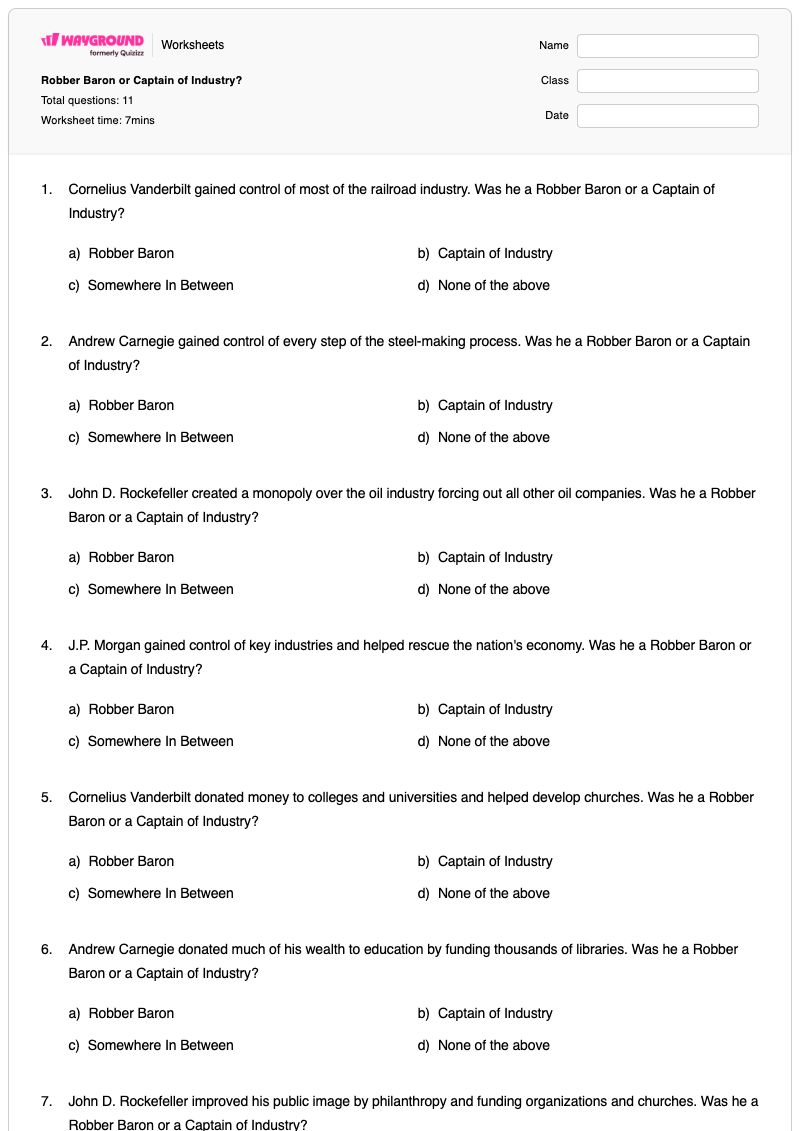
Robber Baron or Captain of Industry? is a Grade 12 history worksheet that asks students to evaluate the actions of Cornelius Vanderbilt, Andrew Carnegie, John D. Rockefeller, and J.P. Morgan during the rise of major American industries. Students classify each described action as reflecting a Robber Baron or a Captain of Industry, including industrial control, monopolies, philanthropy, labor practices, secret rebates, and treatment of competitors.
The 11 questions include 4 multiple-select items and 7 multiple-choice items. This format helps students distinguish between actions associated with wealth-building and philanthropy and actions involving economic control, worker treatment, or anticompetitive practices, rather than assigning one fixed label to each individual. This free printable worksheet includes a complete answer key and is designed for Grade 12 history review, guided practice, or formative assessment.
Worksheet settings
Font size
S
M
L
XL
Worksheets
Robber Baron or Captain of Industry?
Total questions: 11
Name
Class
Date
1.
Cornelius Vanderbilt gained control of most of the railroad industry. Was he a Robber Baron or a Captain of Industry?
a)
Robber Baron
b)
Captain of Industry
c)
Somewhere In Between
d)
None of the above
2.
Andrew Carnegie gained control of every step of the steel-making process. Was he a Robber Baron or a Captain of Industry?
a)
Robber Baron
b)
Captain of Industry
c)
Somewhere In Between
d)
None of the above
3.
John D. Rockefeller created a monopoly over the oil industry forcing out all other oil companies. Was he a Robber Baron or a Captain of Industry?
a)
Robber Baron
b)
Captain of Industry
c)
Somewhere In Between
d)
None of the above
4.
J.P. Morgan gained control of key industries and helped rescue the nation's economy. Was he a Robber Baron or a Captain of Industry?
a)
Robber Baron
b)
Captain of Industry
c)
Somewhere In Between
d)
None of the above
5.
Cornelius Vanderbilt donated money to colleges and universities and helped develop churches. Was he a Robber Baron or a Captain of Industry?
a)
Robber Baron
b)
Captain of Industry
c)
Somewhere In Between
d)
None of the above
6.
Andrew Carnegie donated much of his wealth to education by funding thousands of libraries. Was he a Robber Baron or a Captain of Industry?
a)
Robber Baron
b)
Captain of Industry
c)
Somewhere In Between
d)
None of the above
7.
John D. Rockefeller improved his public image by philanthropy and funding organizations and churches. Was he a Robber Baron or a Captain of Industry?
a)
Robber Baron
b)
Captain of Industry
c)
Somewhere In Between
d)
None of the above
8.
J.P. Morgan contributed various donations to libraries, hospitals, and schools. Was he a Robber Baron or a Captain of Industry?
a)
Robber Baron
b)
Captain of Industry
c)
Somewhere In Between
d)
None of the above
9.
Cornelius Vanderbilt offered rebates to customers and refused service for people traveling on competing railroad lines. Was he a Robber Baron or a Captain of Industry?
a)
Robber Baron
b)
Captain of Industry
c)
Somewhere In Between
d)
None of the above
10.
John D. Rockefeller forced railroad companies to give him secret rebates and lower his shipping costs. Was he a Robber Baron or a Captain of Industry?
a)
Robber Baron
b)
Captain of Industry
c)
Somewhere In Between
d)
None of the above
11.
Andrew Carnegie paid his workers low/inadequate wages, and fought hard to keep them from unionizing.
a)
Robber Baron
b)
Captain of Industry
Answer Key
Robber Baron or Captain of Industry?
Total questions: 11
1.
a)
Robber Baron
, b)
Captain of Industry
2.
a)
Robber Baron
, b)
Captain of Industry
3.
a)
Robber Baron
4.
b)
Captain of Industry
5.
b)
Captain of Industry
6.
b)
Captain of Industry
7.
b)
Captain of Industry
8.
b)
Captain of Industry
9.
a)
Robber Baron
10.
a)
Robber Baron
11.
a)
Robber Baron
140 %
Browse by subjects
Browse by grades
Browse by format
FAQs
What does the Robber Baron or Captain of Industry worksheet cover?
This Grade 12 history worksheet uses 11 multiple-choice and multiple-select questions to have students classify specific actions by Vanderbilt, Carnegie, Rockefeller, and Morgan as those of a Robber Baron or a Captain of Industry. Students evaluate evidence such as monopolies, control of industries, secret rebates, low wages, philanthropy, and support for education or public institutions. Because the labels can differ across actions by the same person, the worksheet builds evidence-based classification rather than simple memorization.
How can I use this worksheet to teach the difference between Robber Barons and Captains of Industry?
Introduce the two labels with a class chart that separates business practices, treatment of workers and competitors, and philanthropic contributions. Then have students complete the worksheet by underlining the action in each prompt before selecting a label, discussing why an industrialist may be classified differently in different questions. Use the multiple-select items on Vanderbilt, Carnegie, Rockefeller, and Morgan as discussion points because they require students to consider the described evidence carefully.
What mistakes should I watch for when students complete this worksheet?
Students may choose one permanent label for each industrialist instead of judging the specific action described in the question. They may also overlook that the Vanderbilt and Carnegie industrial-control items are multiple-select questions, or confuse philanthropy with practices such as monopolies, secret railroad rebates, low wages, and opposition to unions. Remind students to read the full prompt and check whether more than one answer is required.
How do I assign and grade this Robber Baron or Captain of Industry worksheet?
You can assign this 11-question worksheet as a printable PDF or as a digital quiz on Wayground. It includes a complete answer key for checking the four multiple-select and seven multiple-choice responses, and printable submissions can be graded by scanning student work with the Wayground for Teachers app. The printable option also supports classes that are reducing screen time.
How can I differentiate this worksheet for my students?
Use the worksheet’s Advanced Settings to adjust font spacing or select a larger font size so students can more easily read the action-based prompts and answer choices. You can also enable a dyslexia-friendly font or translate the worksheet into another language when appropriate. These options preserve the worksheet’s multiple-choice and multiple-select format while changing the presentation of its historical classification items.
Where can I find more worksheets like this on Wayground?
Wayground offers a comprehensive collection of free printable worksheets and practice problems across subjects, with downloadable PDFs and answer keys to help students master essential skills and concepts. Browse more resources at https://wayground.com/en-us/worksheets.

 Worksheets