
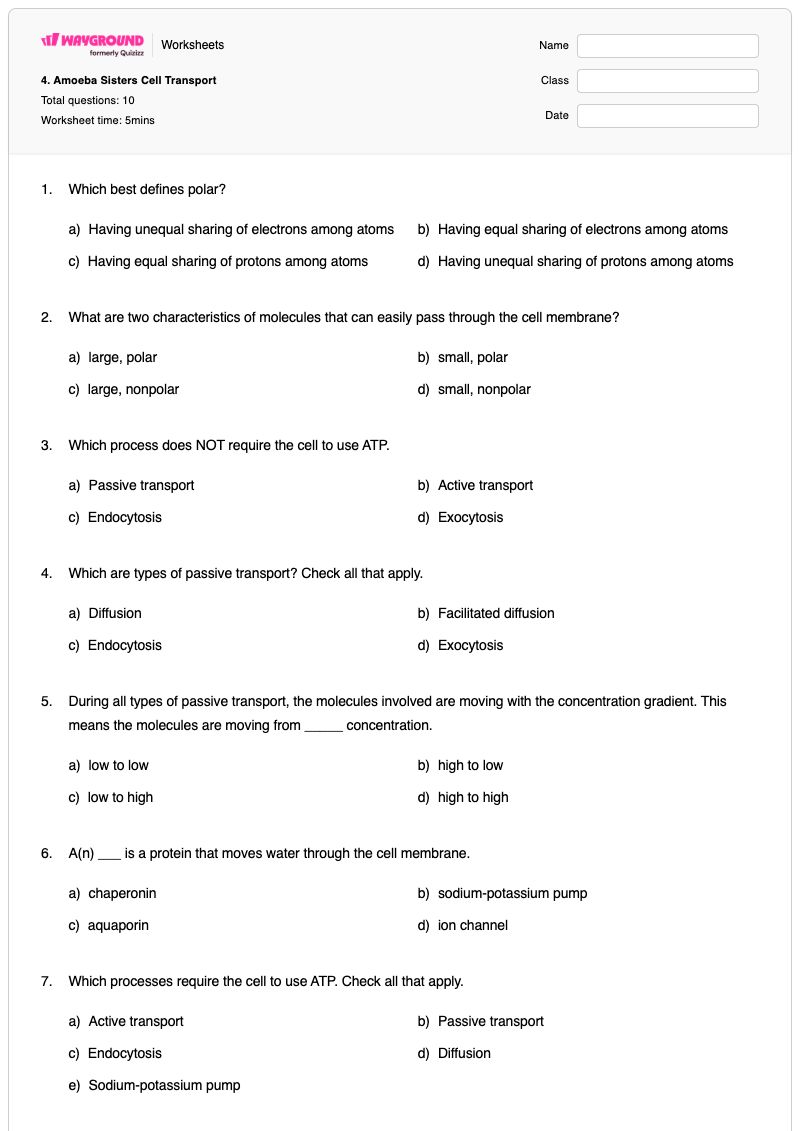

The 4. Amoeba Sisters Cell Transport worksheet helps Grade 9–10 biology students distinguish passive transport from active transport across the cell membrane. Through eight multiple-choice questions and two multiple-select questions, students identify polar and nonpolar molecules, interpret movement down a concentration gradient, and connect ATP use with active transport, endocytosis, exocytosis, and the sodium-potassium pump.
Students also identify aquaporins and transport proteins and determine which molecules can cross the membrane directly or use facilitated diffusion. The questions provide focused practice applying cell transport vocabulary and comparing processes rather than simply recalling definitions. This free printable worksheet includes a complete answer key and is suitable for biology instruction, review, or formative assessment.
Worksheet settings
Font size
S
M
L
XL
Worksheets
4. Amoeba Sisters Cell Transport
Total questions: 10
Name
Class
Date
1.
Which best defines polar?
a)
Having unequal sharing of electrons among atoms
b)
Having equal sharing of electrons among atoms
c)
Having equal sharing of protons among atoms
d)
Having unequal sharing of protons among atoms
2.
What are two characteristics of molecules that can easily pass through the cell membrane?
a)
large, polar
b)
small, polar
c)
large, nonpolar
d)
small, nonpolar
3.
Which process does NOT require the cell to use ATP.
a)
Passive transport
b)
Active transport
c)
Endocytosis
d)
Exocytosis
4.
Which are types of passive transport? Check all that apply.
a)
Diffusion
b)
Facilitated diffusion
c)
Endocytosis
d)
Exocytosis
5.
During all types of passive transport, the molecules involved are moving with the concentration gradient. This means the molecules are moving from _____ concentration.
a)
low to low
b)
high to low
c)
low to high
d)
high to high
6.
A(n) ___ is a protein that moves water through the cell membrane.
a)
chaperonin
b)
sodium-potassium pump
c)
aquaporin
d)
ion channel
7.
Which processes require the cell to use ATP. Check all that apply.
a)
Active transport
b)
Passive transport
c)
Endocytosis
d)
Diffusion
e)
Sodium-potassium pump
8.
This is a type of active transport when a cell releases a large particle from the cell.
a)
Diffusion
b)
Osmosis
c)
Exocytosis
d)
Endocytosis
9.
During facilitated diffusion, what helps move molecules through the cell membrane?
a)
Sodium-potassium pump
b)
Phagocytosis
c)
Transport protein
d)
Chaperonin protein
10.
What are two characteristics of molecules that use facilitated diffusion?
a)
large, polar
b)
small, polar
c)
large, nonpolar
d)
small, nonpolar
Answer Key
4. Amoeba Sisters Cell Transport
Total questions: 10
1.
a)
Having unequal sharing of electrons among atoms
2.
d)
small, nonpolar
3.
a)
Passive transport
4.
a)
Diffusion
, b)
Facilitated diffusion
5.
b)
high to low
6.
c)
aquaporin
7.
a)
Active transport
, c)
Endocytosis
, e)
Sodium-potassium pump
8.
c)
Exocytosis
9.
c)
Transport protein
10.
a)
large, polar
140 %
Browse by subjects
Browse by grades
Browse by format
FAQs
What does the Amoeba Sisters Cell Transport worksheet cover?
This Grade 9–10 biology worksheet covers how molecules move across the cell membrane through passive and active transport. Its eight multiple-choice and two multiple-select questions ask students to distinguish diffusion and facilitated diffusion from ATP-dependent processes, interpret movement from high to low concentration, and identify aquaporins, transport proteins, endocytosis, and exocytosis.
How can I use this worksheet to teach cell transport?
Introduce the worksheet by having students compare passive and active transport in terms of ATP use and movement along or against a concentration gradient. As students work through the questions, pause to discuss why small, nonpolar molecules can pass more easily, why large, polar molecules use facilitated diffusion, and how the multiple-select items separate diffusion and facilitated diffusion from ATP-dependent processes.
What mistakes should I watch for when students complete this cell transport worksheet?
Students may confuse passive transport with active transport by overlooking that passive transport moves molecules from high to low concentration without ATP. Watch for students selecting endocytosis or exocytosis as passive processes, treating aquaporins as general transport proteins, or choosing small nonpolar molecules for facilitated diffusion instead of large polar molecules.
How do I assign and grade this cell transport worksheet?
On Wayground, you can assign the Cell Transport worksheet as a printable PDF or as a digital quiz, and it includes a complete answer key for all eight multiple-choice and two multiple-select questions. Printable submissions can be graded by scanning student work with the Wayground for Teachers app.
How can I differentiate this cell transport worksheet for my students?
Use the worksheet’s Advanced Settings to adjust font spacing and font size so the transport-process questions and answer choices are easier to navigate. You can also enable a dyslexia-friendly font or translate the worksheet into another language when that better supports access to its cell membrane vocabulary.
Where can I find more worksheets like this on Wayground?
Wayground offers a comprehensive collection of free printable worksheets and practice problems across all subjects, with downloadable PDFs and answer keys to help students master essential skills and concepts. Browse more resources at https://wayground.com/en-us/worksheets.