

Wayground
Cell Transport Review - Printable Science Worksheets 9th - 9th Grade - Wayground

Cell Transport Review

Baiyinah Abdullah

By Baiyinah Abdullah

21 questions

9th - 9th Grade

Science

442 plays

Updated Sept 2026

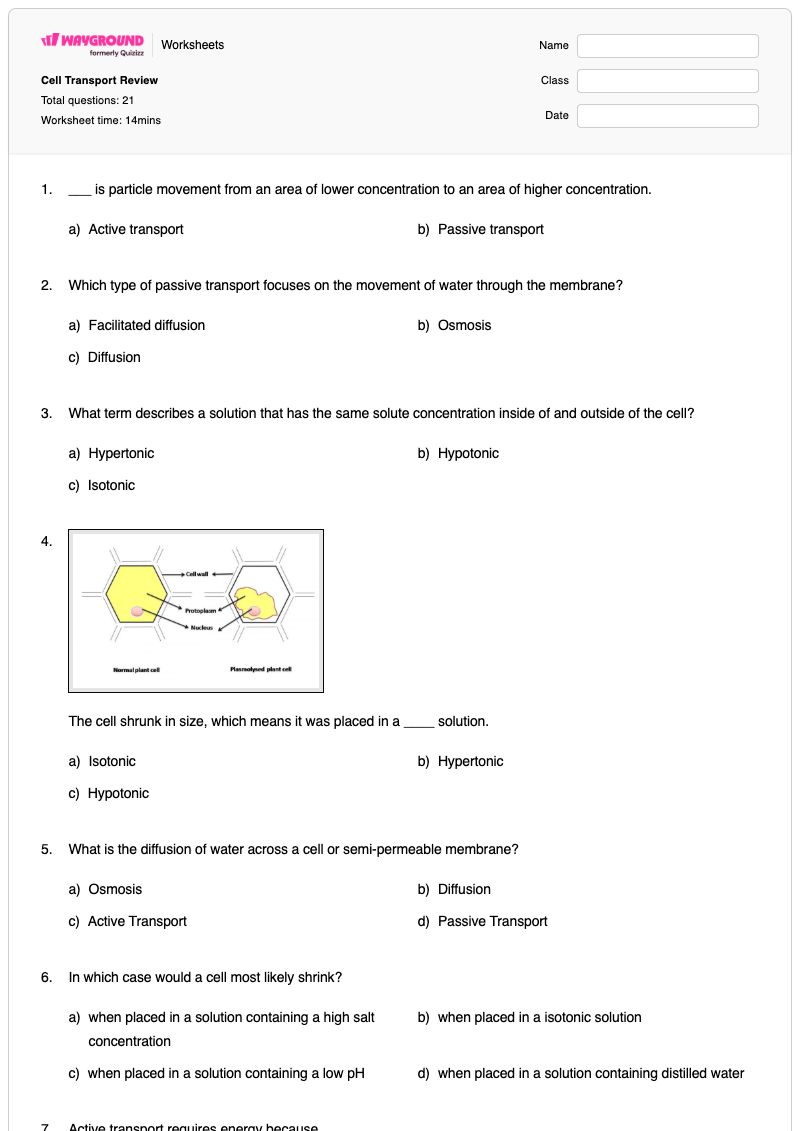
Cell Transport Review is a Grade 9 science worksheet that helps students distinguish active and passive transport by analyzing concentration gradients, energy requirements, membrane movement, and water movement through osmosis. Students also identify isotonic, hypertonic, and hypotonic solutions and connect solution conditions to cell changes such as shrinking or becoming firm. A lettuce-in-water scenario and a visual diffusion item require students to apply these ideas beyond simple definitions. The worksheet contains 21 questions: 19 multiple-choice items and 2 multiple-select items. It is useful for reviewing cell membrane function, comparing diffusion and osmosis, and checking whether students can classify transport processes from descriptions of particles moving with or against a concentration gradient. This free printable worksheet includes a complete answer key for efficient review, independent practice, or assessment.

Worksheet settings

Font size

S
M
L
XL
WaygroundWorksheets

Cell Transport Review

Total questions: 21

Name
Class
Date
1.

___ is particle movement from an area of lower concentration to an area of higher concentration.

a)

Active transport

b)

Passive transport

2.

Which type of passive transport focuses on the movement of water through the membrane?

a)

Facilitated diffusion

b)

Osmosis

c)

Diffusion

3.

What term describes a solution that has the same solute concentration inside of and outside of the cell?

a)

Hypertonic

b)

Hypotonic

c)

Isotonic

4.
The cell shrunk in size, which means it was placed in a ____ solution.

The cell shrunk in size, which means it was placed in a ____ solution.

a)

Isotonic

b)

Hypertonic

c)

Hypotonic

5.

What is the diffusion of water across a cell or semi-permeable membrane?

a)
Osmosis
b)
Diffusion
c)
Active Transport
d)
Passive Transport
6.
In which case would a cell most likely shrink?
a)
when placed in a solution containing a high salt concentration
b)
when placed in a isotonic solution
c)
when placed in a solution containing a low pH
d)
when placed in a solution containing distilled water
7.
Active transport requires energy because...
a)
The cell is moving something against a concentration gradient
b)
The cell is moving something with a concentration gradient
8.
A student noticed that placing wilted lettuce in a bowl of cool water caused the lettuce to become more crisp and firm. What is the best explanation for his observation?
a)
Water moved into the lettuce cells by active transport.
b)
Water moved into the lettuce cells by osmosis.
c)
Salt moved into the lettuce cells by diffusion.
d)
Water moved out of the lettuce cells by osmosis.
9.
What part of the cell regulates what can enter and leave the cell?

What part of the cell regulates what can enter and leave the cell?  

a)
Cell Membrane
b)
Nucleus
c)
Mitochondria
d)
Cytoplasm
10.
The picture below is an example of _________________.
a)
osmosis
b)
isotonic
c)
diffusion
d)
active transport
11.

Students are observing particles moving with the concentration gradient in a lab investigation. Which type of transport are they observing?

a)

using pumps to move things quickly

b)

passive transport

c)

osmosis

d)

endocytosis

12.

Students are observing particles moving against the concentration gradient in a lab investigation. Which type of transport are they observing?

a)

osmosis

b)

active Transport

c)

facilitated diffusion

d)

diffusion

13.

The cell membrane is responsible for allowing molecules to diffuse through a protein channel, from high concentration to low concentration. What type of transport is this?

a)

Passive Transport

b)

Active transport

14.

The cell membrane needs to use energy to move molecules quickly out of the cell through a pump. What type of transport is this?

a)

Passive transport

b)

Active transport

15.

The cell membrane is responsible for allowing molecules to diffuse into or out of the cell. What type of movement is diffusion?

a)

Passive transport

b)

Active transport

16.
This picture is a representation of what type of transport?

This picture is a representation of what type of transport?

a)

Osmosis because it is diffusing through a protein from an area of high concentration to low concentration.

b)

Facilitated diffusion because it is diffusing through a protein from an area of high concentration to low concentration.

c)

Facilitated diffusion because it is diffusing through a protein from an area of low concentration to high concentration.

d)

Simple diffusion because it is diffusing through a protein from an area of high concentration to low concentration.

17.
This picture describes the movement of molecules across the cell membrane. Choose 2 answers that correctly describes the…

This picture describes the movement of molecules across the cell membrane. Choose 2 answers that correctly describes the movement of the molecules.

a)

Molecules are moving up the concentration gradient.

b)

Molecules are moving from an area of low concentration to area of high concentration .

c)

Molecules are moving down the concentration gradient.

d)

Molecules are moving from an area of high concentration to area of low concentration.

18.
This a picture of an animal and plant cell placed in a solution. Describe the solution?

This a picture of an animal and plant cell placed in a solution. Describe the solution?

a)

Isotonic

b)

Hypotonic

c)

Hypertonic

19.
Question Image
a)

A

b)

B

c)

C

d)

D

20.
Question Image
a)

F

b)

G

c)

H

d)

J

21.
Question Image
a)

A

b)

B

c)

C

d)

D

WaygroundAnswer Key

Cell Transport Review

Total questions: 21

1.
a)

Active transport

2.
b)

Osmosis

3.
c)

Isotonic

4.
b)

Hypertonic

5.
a) Osmosis
6.
a) when placed in a solution containing a high salt concentration
7.
a) The cell is moving something against a concentration gradient
8.
b) Water moved into the lettuce cells by osmosis.
9.
a) Cell Membrane
10.
c) diffusion
11.
b)

passive transport

, c)

osmosis

12.
b)

active Transport

13.
a)

Passive Transport

14.
b)

Active transport

15.
a)

Passive transport

16.
b)

Facilitated diffusion because it is diffusing through a protein from an area of high concentration to low concentration.

17.
c)

Molecules are moving down the concentration gradient.

, d)

Molecules are moving from an area of high concentration to area of low concentration.

18.
b)

Hypotonic

19.
d)

D

20.
a)

F

21.
c)

C

FAQs

What does the Cell Transport Review worksheet cover?

This Grade 9 worksheet covers active transport, passive transport, diffusion, osmosis, and isotonic, hypertonic, and hypotonic solutions. Its 19 multiple-choice and 2 multiple-select questions ask students to classify transport from concentration-gradient descriptions, identify when energy is required, and predict cell changes such as shrinking or becoming firm.

How can I use this worksheet to teach cell transport?

Introduce the worksheet by having students compare movement with and against a concentration gradient, then connect those directions to passive and active transport. Use the osmosis, lettuce-in-water, and solution-concentration questions to discuss how water movement affects cells, and ask students to explain why a cell shrinks in a hypertonic solution. Review the multiple-select items as a class so students distinguish passive transport from osmosis rather than treating them as unrelated processes.

What mistakes should I watch for when students complete this cell transport worksheet?

Students may reverse movement with and against the concentration gradient, causing them to confuse active and passive transport or miss why active transport requires energy. They may also confuse osmosis with general diffusion, or mix up the effects of hypertonic, hypotonic, and isotonic solutions on cell size. In the multiple-select questions, watch for students choosing only one correct transport type when both passive transport and osmosis apply to the stated observation.

How do I assign and grade the Cell Transport Review worksheet?

Wayground provides this cell transport worksheet as a printable PDF and as a digital quiz, and it includes a complete answer key. You can grade printable student submissions by scanning their work with the Wayground for Teachers app. The printable version can also support instruction in schools that are reducing screen time.

How can I differentiate this cell transport worksheet for my students?

Use the worksheet’s Advanced Settings to adjust font spacing and font size so the transport definitions, solution descriptions, and answer choices are easier to follow. You can also enable a dyslexia-friendly font or translate the worksheet into another language when that better supports access to the cell transport vocabulary and questions.

Where can I find more worksheets like this on Wayground?

Wayground offers a broad collection of free printable worksheets and practice problems across subjects, with downloadable PDFs and answer keys to help students master essential skills and concepts. Browse more resources at https://wayground.com/en-us/worksheets.