
Wayground
STAAR Review- Cell Transport (pg 6) - Printable Science Worksheets 9th - 9th Grade - Wayground

STAAR Review- Cell Transport (pg 6)

Shaquille Breed

By Shaquille Breed

10 questions

9th - 9th Grade

Science

175 plays

Updated Sept 2026

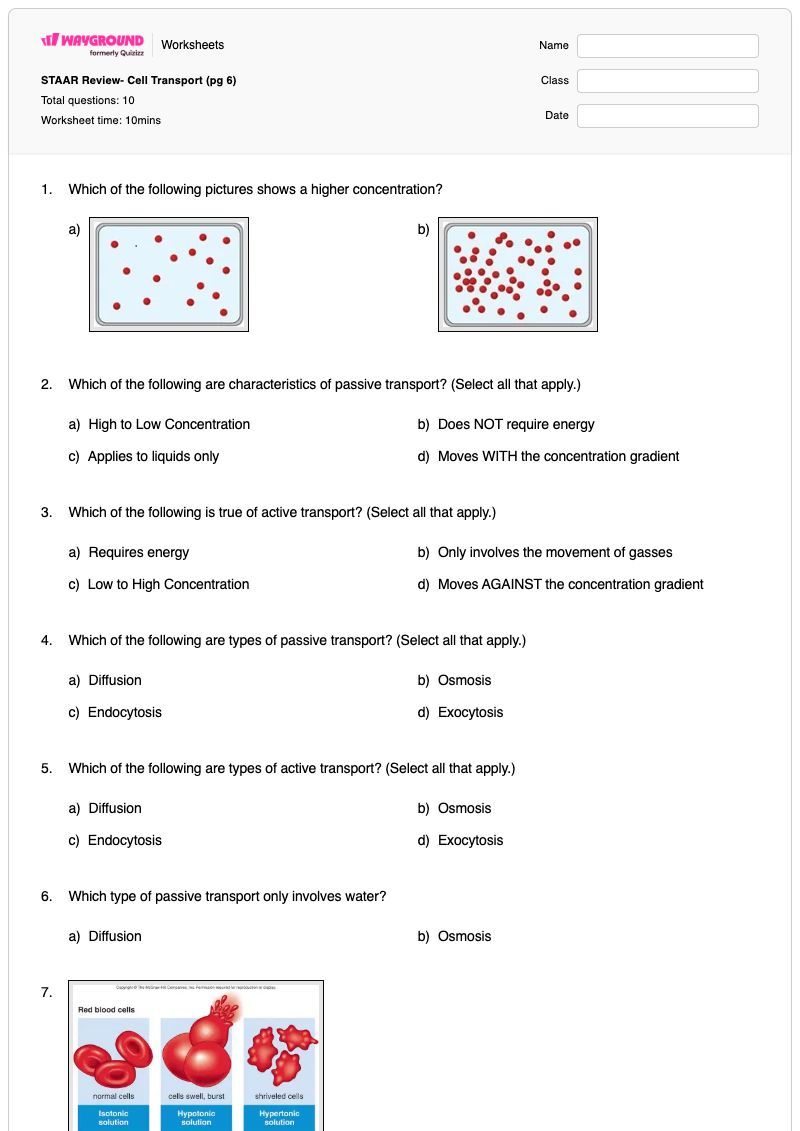
STAAR Review—Cell Transport (pg 6) is a free printable Grade 9 Biology worksheet with 10 questions: 6 multiple-choice items and 4 multiple-select items. It reviews how concentration affects particle movement, including passive transport, active transport, diffusion, osmosis, endocytosis, and exocytosis. Students also identify why water moves into a cell in a hypotonic solution and distinguish movement from high to low concentration from movement from low to high concentration. The worksheet helps students apply cell-transport vocabulary and connect each process to its energy requirement, direction of movement, and concentration gradient. The multiple-select questions require students to identify all accurate characteristics or examples, while the multiple-choice questions check definitions and reasoning about water and solute concentration. It is suitable for STAAR review, biology practice, or a short formative assessment, and includes a complete answer key for efficient checking.

Worksheet settings

Font size

S
M
L
XL
WaygroundWorksheets

STAAR Review- Cell Transport (pg 6)

Total questions: 10

Name
Class
Date
1.

Which of the following pictures shows a higher concentration?

a)
Which of the following pictures shows a higher concentration?
b)
Which of the following pictures shows a higher concentration?
2.

Which of the following are characteristics of passive transport? (Select all that apply.)

a)

High to Low Concentration

b)

Does NOT require energy

c)

Applies to liquids only

d)

Moves WITH the concentration gradient

3.

Which of the following is true of active transport? (Select all that apply.)

a)

Requires energy

b)

Only involves the movement of gasses

c)

Low to High Concentration

d)

Moves AGAINST the concentration gradient

4.

Which of the following are types of passive transport? (Select all that apply.)

a)

Diffusion

b)

Osmosis

c)

Endocytosis

d)

Exocytosis

5.

Which of the following are types of active transport? (Select all that apply.)

a)

Diffusion

b)

Osmosis

c)

Endocytosis

d)

Exocytosis

6.

Which type of passive transport only involves water?

a)

Diffusion

b)

Osmosis

7.
Why has water moved into the cell in the hypotonic solution?

Why has water moved into the cell in the hypotonic solution?

a)

The cell was deflated and needed to be inflated.

b)

The concentration of solvent was higher inside than outside the cell.

c)

The concentration of solute (salt) was higher outside the cell than inside.

d)

The concentration of solute (salt) was higher inside the cell than outside.

8.
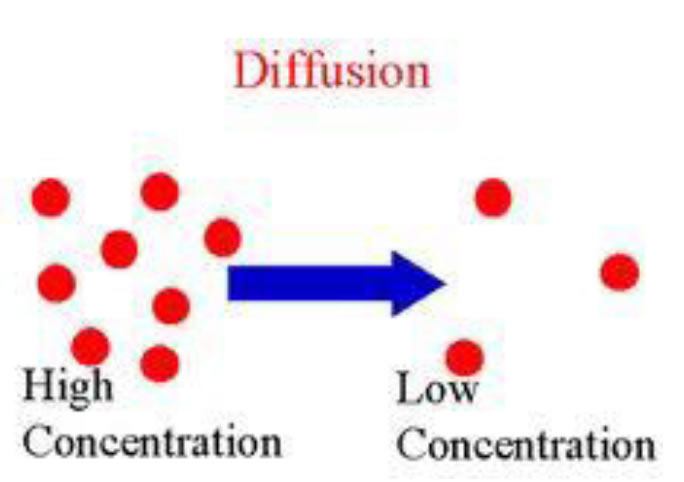
Movement of particles from high to low concentration.
Movement of particles from high to low concentration. 
a)
Passive Transport
b)
Active Transport
9.

Low to High movement of molecules is-

a)
Passive Transport
b)
Active Transport
10.
What is diffusion?

What is diffusion?

a)

When molecules move from a low concentration to a high concentration

b)

When molecules move from a high concentration to a low concentration.

c)

When there is no movement of molecules

d)

When molecules move everywhere regardless of concentration

WaygroundAnswer Key

STAAR Review- Cell Transport (pg 6)

Total questions: 10

1.
b)
2.
a)

High to Low Concentration

, b)

Does NOT require energy

, d)

Moves WITH the concentration gradient

3.
d)

Moves AGAINST the concentration gradient

, c)

Low to High Concentration

, a)

Requires energy

4.
a)

Diffusion

, b)

Osmosis

5.
c)

Endocytosis

, d)

Exocytosis

6.
b)

Osmosis

7.
d)

The concentration of solute (salt) was higher inside the cell than outside.

8.
a) Passive Transport
9.
b) Active Transport
10.
b)

When molecules move from a high concentration to a low concentration.

FAQs

What does this cell transport worksheet cover?

This Grade 9 Biology worksheet uses 6 multiple-choice and 4 multiple-select questions to review passive and active transport, concentration gradients, diffusion, osmosis, endocytosis, and exocytosis. Students build skill by classifying transport processes according to whether they move from high to low or low to high concentration, whether they require energy, and whether they involve water or vesicles.

How can I use this worksheet to teach passive and active transport?

Introduce the worksheet by modeling the meaning of high and low concentration, then have students compare movement with the concentration gradient in passive transport with movement against it in active transport. Use the multiple-select items to ask students to justify every selected characteristic, and discuss the hypotonic-solution question as an application of osmosis and solute concentration.

What mistakes should I watch for on this cell transport worksheet?

Students may reverse the direction of passive and active transport, selecting high-to-low movement for active transport or low-to-high movement for passive transport. They may also confuse diffusion with osmosis, overlook that osmosis involves water, or select endocytosis and exocytosis as passive transport. In the multiple-select questions, remind students that more than one option can be correct and that they must identify all correct characteristics.

How do I assign and grade this cell transport worksheet?

On Wayground, assign the worksheet as a printable PDF or use it as a digital quiz. It includes a complete answer key, and printable submissions can be graded by scanning student work with the Wayground for Teachers app. The PDF option can also support instruction when your school is reducing screen time.

How can I differentiate this cell transport worksheet for my students?

In the worksheet’s Advanced Settings, adjust font spacing or font size to make the concentration-gradient diagrams, definitions, and multiple-select options easier to read. You can also enable a dyslexia-friendly font or translate the worksheet into another language while keeping the cell-transport question format intact.

Where can I find more worksheets like this on Wayground?

Wayground offers a broad collection of free printable worksheets and practice problems across all subjects, with downloadable PDFs and answer keys to support essential skills and concepts. Browse more resources at https://wayground.com/en-us/worksheets.