

Wayground
7th Grade Chemistry Review - Printable Science Worksheets 7th Grade - Wayground

7th Grade Chemistry Review

Erin Strawn

Created by Erin Strawn

20 questions

7th Grade

Science

Updated Sept 2026

This Grade 7 Science worksheet provides a focused review of foundational chemistry concepts through 20 questions: 17 multiple-choice items and 3 multiple-select items. Students review how the periodic table is organized, distinguish chemical properties from physical properties, identify particle behavior in gases, liquids, and solids, and apply terms such as solubility and boiling point. They also identify compounds, recognize ways mixtures can be separated, read chemical symbols and formulas, distinguish subscripts from coefficients, and count atoms in formulas such as H₂O₂. Use this worksheet to check whether students can connect chemistry vocabulary with observable examples and symbolic representations. The multiple-select questions require students to choose two accurate descriptions of states of matter, while the formula questions reinforce element-symbol capitalization and basic formula interpretation. It is a free printable worksheet with a complete answer key, making it suitable for independent review, classroom practice, homework, or a short assessment after instruction.

Worksheet settings

Font size

S
M
L
XL
WaygroundWorksheets

7th Grade Chemistry Review

Total questions: 20

Name
Class
Date
1.
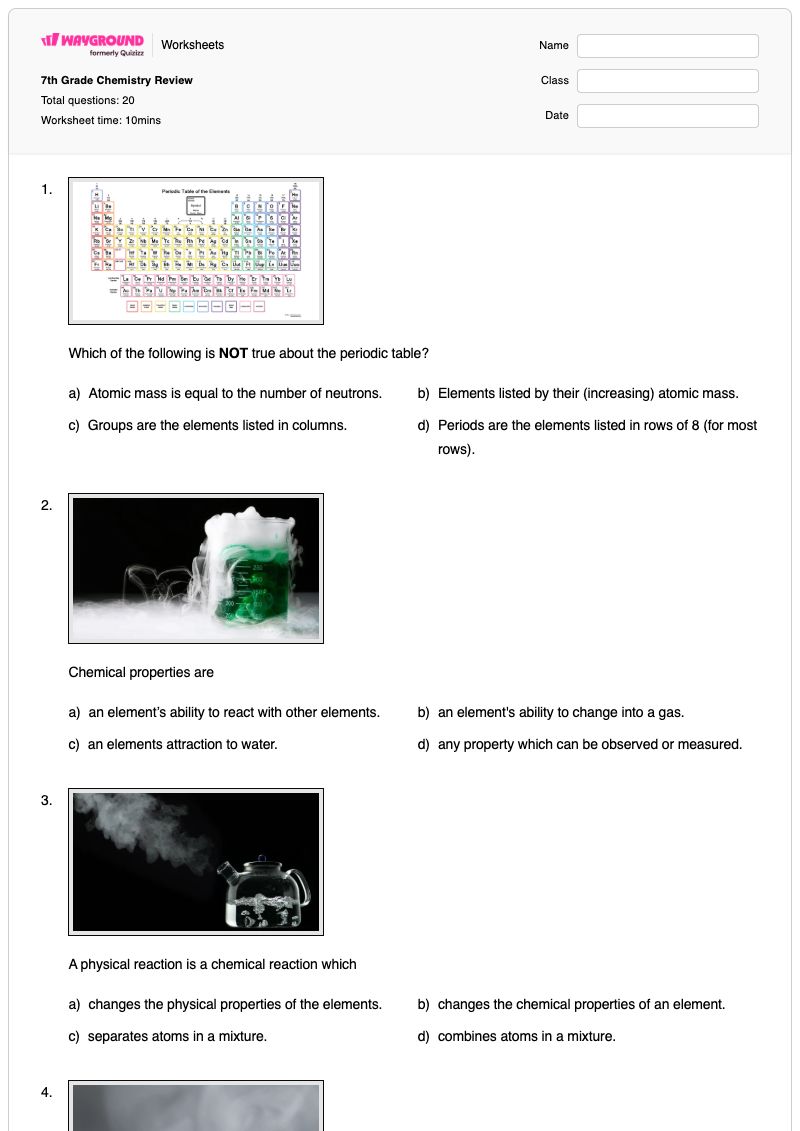
Which of the following is NOT true about the periodic table?

Which of the following is NOT true about the periodic table?

a)

Atomic mass is equal to the number of neutrons.

b)

Elements listed by their (increasing) atomic mass.

c)

Groups are the elements listed in columns.

d)

Periods are the elements listed in rows of 8 (for most rows).

2.
Chemical properties are

Chemical properties are

a)

an element’s ability to react with other elements.

b)

an element's ability to change into a gas.

c)

an elements attraction to water.

d)

any property which can be observed or measured.

3.
A physical reaction is a chemical reaction which

A physical reaction is a chemical reaction which

a)

changes the physical properties of the elements.

b)

changes the chemical properties of an element.

c)

separates atoms in a mixture.

d)

combines atoms in a mixture.

4.
Which of the following are true about gas molecules? Choose two .

Which of the following are true about gas molecules? Choose two.

a)

the particles move about quickly

b)

the particles are far apart

c)

the particles move slowly and vibrate in place

d)

the particles are close together

5.
Which of the following are true about the molecules in liquids? Choose two .

Which of the following are true about the molecules in liquids? Choose two.

a)

The particles slip easily over and around each other

b)

Will take the shape of its container

c)

The particles move slowly and vibrate in place

d)

The particles have a definite shape

6.
Which of the following are true about solids? Choose two .

Which of the following are true about solids? Choose two.

a)

The particles vibrate in place

b)

Have a definite shape

c)

The particles move quickly and freely

d)

The particles take the shape of their container

7.
Somethings ability to dissolve, or mix completely with a liquid, is

Somethings ability to dissolve, or mix completely with a liquid, is

a)

solubility.

b)

boiling point.

c)

freezing point.

d)

density.

8.
Which of the following is an example of something dissolving?

Which of the following is an example of something dissolving?

a)

Mixing sugar, lemon juice, and water for lemonade.

b)

Mixing sand and gravel for the substrate of a fish tank.

c)

Mixing oil and vinegar for salad dressing.

d)

Mixing cereals and nuts for a snack mix.

9.
Materials boil at different temperatures, the specific temperature a material has to reach in order to boil is called the…

Materials boil at different temperatures, the specific temperature a material has to reach in order to boil is called the materials

a)

boiling point.

b)

freezing point.

c)

melting point.

d)

solidification point.

10.
Which of the following is a compound containing more than one element?

Which of the following is a compound containing more than one element?

a)

NaCl

b)

Be

c)

S

d)

Ne

11.
Which of the following chemical formulas has a subscript? 1. H 2 O 2. 2HCl 3. NaCl

Which of the following chemical formulas has a subscript?

1. H2O

2. 2HCl

3. NaCl

a)

1 only

b)

2 only

c)

3 only

d)

1 and 2

12.
How many oxygen atoms are in an atom of hydrogen peroxide (H 2 O 2 ) ?

How many oxygen atoms are in an atom of hydrogen peroxide (H2O2) ?

a)

2

b)

4

c)

1

d)

8

13.
Which of the following are ways a mixture can be separated?

Which of the following are ways a mixture can be separated?

a)

all of these.

b)

sifting/straining

c)

evaporating

d)

dissolving

14.
Choose the correct chemical formula for the molecule

Choose the correct chemical formula for the molecule

a)

CO

b)

OC

c)

CMO

d)

CC

15.
Choose the correct chemical formula for the molecule

Choose the correct chemical formula for the molecule

a)

NaCl

b)

NACL

c)

NaCL

d)

ClNa

16.
How many atoms are in the following chemical formula? C 6 H 12 O 6

How many atoms are in the following chemical formula?

C6H12O6

a)

24

b)

3

c)

18

d)

12

17.
How many atoms are in the following chemical formula? 2CaCO 3

How many atoms are in the following chemical formula?

2CaCO3

a)

10

b)

8

c)

4

d)

5

18.
What is the atomic number of the atom?

What is the atomic number of the atom?

a)

6

b)

12

c)

18

d)

3

19.
What is the atomic number of the following atom?

What is the atomic number of the following atom?

a)

20

b)

40

c)

60

d)

10

20.
A thermometer is heated. The volume of the liquid inside of the thermometer increases, and the level of the liquid rises.…

A thermometer is heated. The volume of the liquid inside of the thermometer increases, and the level of the liquid rises. What happens to the mass of the liquid in the thermometer as the level of liquid rises?

a)

The mass stays the same.

b)

The mass increases.

c)

The mass decreases.

d)

It depends on the type of liquid.

WaygroundAnswer Key

7th Grade Chemistry Review

Total questions: 20

1.
a)

Atomic mass is equal to the number of neutrons.

2.
a)

an element’s ability to react with other elements.

3.
a)

changes the physical properties of the elements.

4.
a)

the particles move about quickly

, b)

the particles are far apart

5.
a)

The particles slip easily over and around each other

, b)

Will take the shape of its container

6.
a)

The particles vibrate in place

, b)

Have a definite shape

7.
a)

solubility.

8.
a)

Mixing sugar, lemon juice, and water for lemonade.

9.
a)

boiling point.

10.
a)

NaCl

11.
a)

1 only

12.
a)

2

13.
a)

all of these.

14.
a)

CO

15.
a)

NaCl

16.
a)

24

17.
a)

10

18.
a)

6

19.
a)

20

20.
a)

The mass stays the same.

FAQs

What does the 7th Grade Chemistry Review worksheet cover?

This worksheet reviews Grade 7 chemistry skills through 17 multiple-choice questions and 3 multiple-select questions. Students identify periodic-table organization, distinguish chemical and physical properties, describe particle behavior in solids, liquids, and gases, apply solubility and boiling-point vocabulary, and interpret compounds, mixtures, chemical symbols, subscripts, and atom counts in formulas.

How can I use this worksheet to teach these Grade 7 chemistry concepts?

Use the worksheet after instruction as a guided review: discuss the periodic-table and properties questions first, then have students explain how particle movement and spacing differ in each state of matter. For the formula items, model how capitalization, subscripts, and coefficients communicate chemical information before students complete the questions independently. Ask students to justify both selections in each multiple-select item rather than choosing answers by elimination.

What mistakes should I watch for when students complete this chemistry worksheet?

Watch for students equating atomic mass with the number of neutrons, confusing chemical properties with observable or measurable physical properties, or mixing up the particle descriptions for solids, liquids, and gases. In the multiple-select items, students may choose only one correct statement or select a state-of-matter description that belongs to another state. Formula questions may also reveal confusion between a subscript and a coefficient, incorrect element-symbol capitalization, or miscounting the oxygen atoms in H₂O₂.

How do I assign and grade this 7th Grade Chemistry Review worksheet?

The worksheet is available as a printable PDF and as a digital quiz on Wayground, and it includes a complete answer key for all 20 questions. Printable submissions can be graded by scanning student work with the Wayground for Teachers app, while the digital version can be completed and scored on the platform.

How can I differentiate this chemistry review worksheet for my students?

In the worksheet’s Advanced Settings, adjust font spacing or choose a larger font size to make the periodic-table, states-of-matter, and chemical-formula questions easier to read. You can also enable a dyslexia-friendly font or translate the worksheet into another language when those options support access to the chemistry vocabulary and multiple-select directions.

Where can I find more worksheets like this on Wayground?

Wayground offers a comprehensive collection of free printable worksheets and practice problems across all subjects, with downloadable PDFs and answer keys to help students master essential skills and concepts. Browse more resources at https://wayground.com/en-us/worksheets.