

Wayground
AP Biology Chemistry Review - Printable Science Worksheets 11th - 12th Grade - Wayground

AP Biology Chemistry Review

Lisa Short

Created by Lisa Short

20 questions

11th - 12th Grade

Science

Updated Nov 2025

AP Biology Chemistry Review is a free printable worksheet for Grade 11–12 biology students who need to strengthen core chemistry concepts used in biology. Its 20 multiple-choice questions ask students to identify polar, covalent, and ionic bonding; distinguish reactants from products; identify a solute in a solution; recognize organic compounds; and connect carbon and water properties to biological systems. The worksheet also checks understanding of water’s polarity, hydrogen bonding, cohesion, solvent behavior, specific heat, and role in plant water movement and temperature stability. Teachers can use the questions for review, guided discussion, independent practice, or an AP Biology preparation check. A complete answer key supports efficient feedback and helps reveal which chemistry foundations need additional instruction.

Worksheet settings

Font size

S
M
L
XL
WaygroundWorksheets

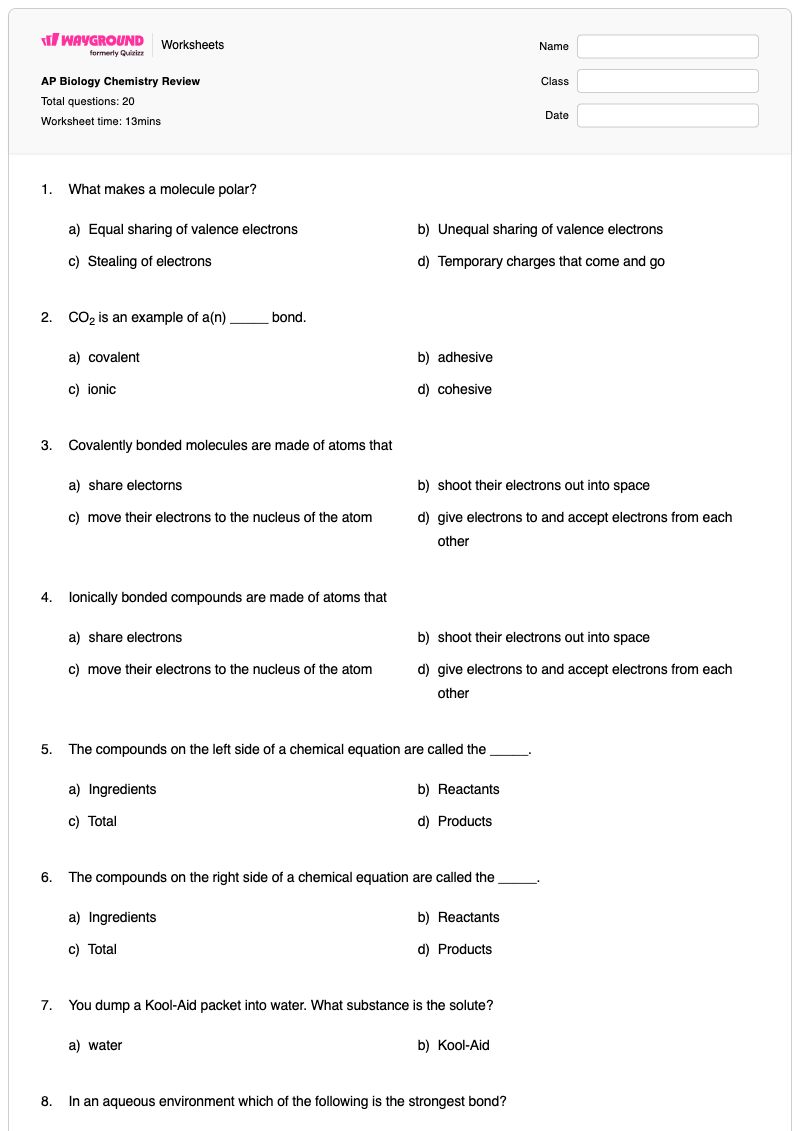
AP Biology Chemistry Review

Total questions: 20

Name
Class
Date
1.
What makes a molecule polar?
a)
Equal sharing of valence electrons
b)
Unequal sharing of valence electrons
c)
Stealing of electrons
d)
Temporary charges that come and go
2.
CO2 is an example of a(n) _____ bond.
a)
covalent
b)
adhesive
c)
ionic
d)
cohesive
3.
Covalently bonded molecules are made of atoms that
a)
share electorns
b)
shoot their electrons out into space
c)
move their electrons to the nucleus of the atom
d)
give electrons to and accept electrons from each other
4.
Ionically bonded compounds are made of atoms that 
a)
share electrons
b)
shoot their electrons out into space
c)
move their electrons to the nucleus of the atom
d)
give electrons to and accept electrons from each other
5.
The compounds on the left side of a chemical equation are called the _____.
a)
Ingredients
b)
Reactants
c)
Total
d)
Products
6.
The compounds on the right side of a chemical equation are called the _____.
a)
Ingredients
b)
Reactants
c)
Total
d)
Products
7.
You dump a Kool-Aid packet into water. What substance is the solute?
a)
water
b)
Kool-Aid
8.

In an aqueous environment which of the following is the strongest bond?

a)

covalent

b)

ionic attraction in solution

c)

van der Waals

d)

hydrogen

9.
Why is Carbon so important to living things?
a)
It forms molecules easily
b)
It can form many shapes
c)
It is in most organic molecule
d)
All of these
10.
Which of the following is an organic compound?
a)
H2O
b)
C6H12O6
c)
NH2
d)
OH
11.
Because water has a positively charged end and a negatively charged end, it can be described as
a)
amphipathic
b)
hydrophobic
c)
polar
d)
nonpolar
12.
Water molecules require a lot of energy to break the hydrogen bonds. This gives water a high
Water molecules require a lot of energy to break the hydrogen bonds.  This gives water a high
a)
density
b)
polarity
c)
solvency
d)
specific heat
13.
What property of water allows it to be such a versatile solvent that it is often called the "universal solvent?"
a)
Purity
b)
Polarity and cohesion
c)
High heat capacity
d)
Expansion upon freezing
14.
Which of the following properties of water enables molecules to cling together as they move from the roots to the leaves of plants?
a)
Water expands as it freezes.
b)
Water is an excellent solvent.
c)
Water exhibits cohesive behavior.
d)
Water moderates temperature.
15.
Large bodies of water do not quickly fluctuate, or change, in temperature. Why?
a)
Water is a solvent.
b)
Water has a high heat capacity.
c)
Water acts as a buffer.
d)
Water is non-polar.
16.
Some insects can stand on the surface of calm water. Their feet push the surface of the water down slightly, but they do not break the surface. Why?
a)
The insects are light enough so they do not break the hydrogen bonds holding the water molecules together
b)
The insects actually use their wings to hover slightly above the water’s surface and they only skim it with their feet.
c)
The insect’s feet are non-polar, so they are repelled by the polar water molecules and are pushed away from the water’s surface.
d)
The insects are small enough to see the individual water molecules, so they are able to step carefully from one molecule to the next
17.
Why does water move from the roots to the leaves of plants?
a)
Water is pushed by solutes.
b)
Capillary action pulls the water molecules like a chain.
c)
Water is pulled by gravity.
d)
Water’s cohesion causes it to “pull” towards the leaves.
18.
Why does ice float?
a)
As water freezes, it expands and its density decreases.
b)
As water freezes, it takes up more hydrogen from the atmosphere, causing it to have a greater buoyancy.
c)
As water freezes, air becomes trapped between the hydrogen bonds of water molecules.
d)
As water freezes, it takes up more oxygen from the atmosphere, causing it to have a greater buoyancy.
19.
What property of water helps to moderate earth's temperature?
a)
adhesion
b)
chohesion
c)
Specific heat capacity
d)
Latent heat of vaporization
20.
Pure water has a pH of

Pure water has a pH of

a)

6

b)

15

c)

3

d)

7

WaygroundAnswer Key

AP Biology Chemistry Review

Total questions: 20

1.
b) Unequal sharing of valence electrons
2.
a) covalent
3.
a) share electorns
4.
d) give electrons to and accept electrons from each other
5.
b) Reactants
6.
d) Products
7.
b) Kool-Aid
8.
a)

covalent

9.
d) All of these
10.
b) C6H12O6
11.
c) polar
12.
d) specific heat
13.
b) Polarity and cohesion
14.
c) Water exhibits cohesive behavior.
15.
b) Water has a high heat capacity.
16.
a) The insects are light enough so they do not break the hydrogen bonds holding the water molecules together
17.
b) Capillary action pulls the water molecules like a chain.
18.
a) As water freezes, it expands and its density decreases.
19.
c) Specific heat capacity
20.
d)

7

FAQs

What does the AP Biology Chemistry Review worksheet cover?

This 20-question multiple-choice worksheet reviews chemistry foundations used in biology, including polar, covalent, and ionic bonds; reactants and products; solutes; organic compounds; carbon; and water properties. Students build recognition and classification skills by selecting answers that connect molecular structure and chemical terminology to biological examples such as Kool-Aid in water, carbon compounds, and water movement in plants.

How can I use this worksheet to teach AP Biology chemistry concepts?

Introduce the worksheet by modeling how unequal electron sharing produces polarity and how electron sharing differs from electron transfer in covalent and ionic bonding. Then have students work through the items in sections—bonding, chemical equations and solutions, carbon, and water—and explain why each selected answer fits, especially for water’s cohesion, polarity, hydrogen bonding, and high heat capacity.

What mistakes should I watch for when students complete this chemistry review?

Students may confuse polarity with ionic bonding, or treat covalent bonds as electron transfer rather than electron sharing. Watch for reversals of reactants and products, confusion between a solute and the water solvent, and failure to distinguish water’s related properties—for example, choosing polarity instead of specific heat when explaining resistance to temperature change.

How do I assign and grade this AP Biology Chemistry Review worksheet?

The worksheet is available as a printable PDF and as a digital quiz on Wayground, so you can assign the multiple-choice review in the format that best fits your lesson. It includes a complete answer key, and printable submissions can be graded by scanning student work with the Wayground for Teachers app.

How can I differentiate this chemistry review worksheet for my students?

Use the worksheet’s Advanced Settings to adjust font spacing and font size for the multiple-choice items, or enable a dyslexia-friendly font to make the chemistry terminology easier to read. You can also translate the worksheet into another language while retaining its focus on bonding, solutions, carbon, and water-property questions.

Where can I find more worksheets like this on Wayground?

Wayground offers a broad collection of free printable worksheets and practice problems across subjects, with downloadable PDFs and answer keys to support mastery of essential skills and concepts. Browse more resources at https://wayground.com/en-us/worksheets.