

Wayground
AP Chem Ch. 14/15 BR #6 Acid/Base - Printable Science Worksheets 12th Grade - Wayground

AP Chem Ch. 14/15 BR #6 Acid/Base

Alison Klein

Created by Alison Klein

16 questions

12th Grade

Science

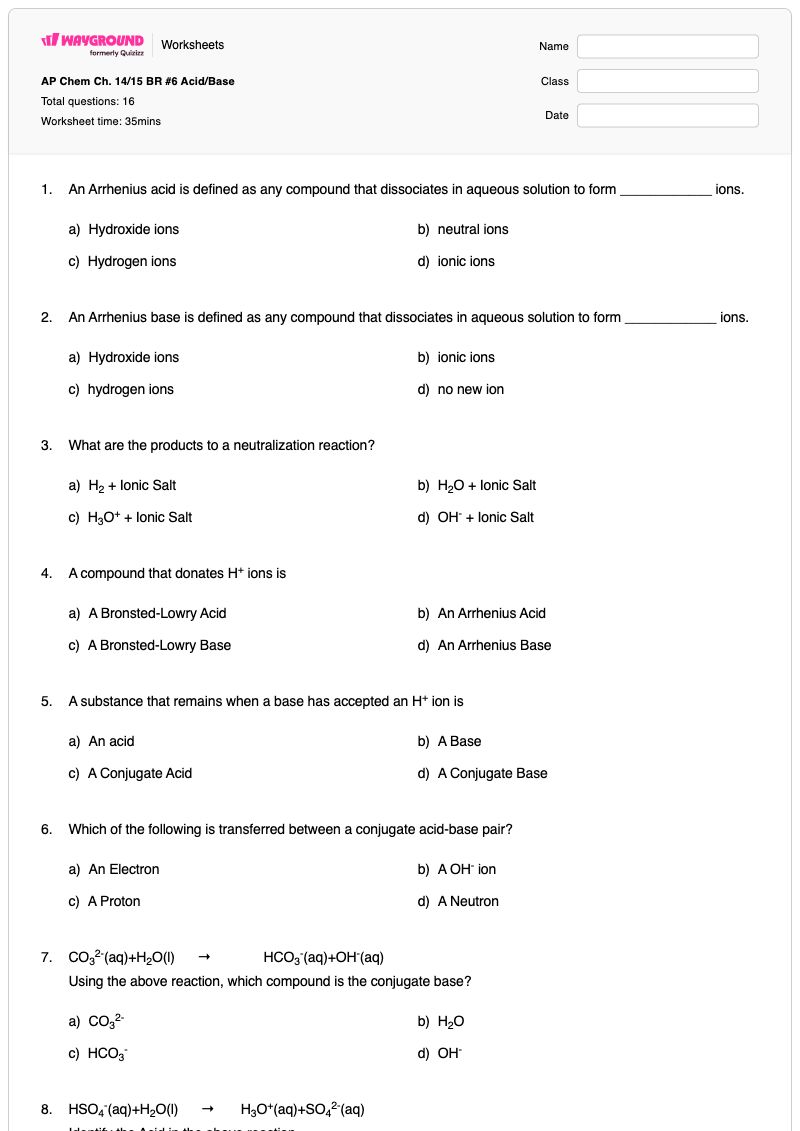
This Grade 12 chemistry worksheet gives students 16 multiple-choice questions on acid–base definitions and reactions. Students distinguish Arrhenius acids and bases by the ions formed in water, identify Brønsted–Lowry proton donors and acceptors, recognize neutralization products, and determine which substances are conjugate acids or conjugate bases. Several items use chemical equations and formulas, asking students to identify the acid, base, conjugate species, or proton-transfer relationship in context. The worksheet also checks whether a substance could act as a Brønsted–Lowry acid and whether a reactant is behaving as an acid or base. It is a free printable worksheet with a complete answer key, suitable for Grade 12 chemistry review, independent practice, or a focused check of acid–base reasoning.

Worksheet settings

Font size

S
M
L
XL
WaygroundWorksheets

AP Chem Ch. 14/15 BR #6 Acid/Base

Total questions: 16

Name
Class
Date

1.

An Arrhenius acid is defined as any compound that dissociates in aqueous solution to form ____________ ions.

a)

Hydroxide ions

b)

neutral ions

c)

Hydrogen ions

d)

ionic ions

2.

An Arrhenius base is defined as any compound that dissociates in aqueous solution to form ____________ ions.

a)

Hydroxide ions

b)

ionic ions

c)

hydrogen ions

d)

no new ion

3.
What are the products to a neutralization reaction?
a)
H2 + Ionic Salt
b)
H2O + Ionic Salt
c)
H3O+ + Ionic Salt
d)
OH- + Ionic Salt
4.
A compound that donates H+ ions is 
a)
A Bronsted-Lowry Acid
b)
An Arrhenius Acid
c)
A Bronsted-Lowry Base
d)
An Arrhenius Base
5.
A substance that remains when a base has accepted an H+ ion is
a)
An acid
b)
A Base
c)
A Conjugate Acid
d)
A Conjugate Base
6.
Which of the following is transferred between a conjugate acid-base pair?
a)
An Electron
b)
A OH- ion
c)
A Proton
d)
A Neutron
7.
CO32-(aq)+H2O(l)      →              HCO3-(aq)+OH-(aq)
Using the above reaction, which compound is the conjugate base?
a)
CO32-
b)
H2O
c)
HCO3-
d)
OH-
8.
HSO4-(aq)+H2O(l)      →       H3O+(aq)+SO42-(aq)
Identify the Acid in the above reaction.
a)
HSO4-
b)
H2O
c)
H3O+
d)
SO42-
9.
What is the conjugate base in the following reaction?
a)
HCO3- 
b)
HCl
c)
 H2CO3 
d)
Cl-
10.
What is the conjugate acid in the following equation?
a)
PO43- 
b)
HNO3 
c)
NO3- 
d)
HPO42-
11.

A Bronsted-Lowry acid is a substance that...

a)

accepts H+ ions

b)

donates OH- ions

c)

increases the concentration of OH- ions

d)

donates H+ ions

12.

Which of the following could NOT act as a Bronsted-

Lowry acid?

a)

HCN

b)

H2SO4

c)

NH4+

d)

CN-

13.

A Bronsted-Lowry base is defined as a

substance that __________.

a)

increases [H+ ] when dissolved in H2O

b)

decreases [H+ ] when dissolved in H2O

c)

increases [OH-] when dissolved in H2O

d)

acts as a proton acceptor

14.

Which of the following compounds could never

act as a Bronsted-Lowry acid?

a)

SO4 2-

b)

HSO4-

c)

H2SO4

d)

NH4+

15.
For the following reaction, identify whether the circled reactant is behaving as an acid or a base.

For the following reaction, identify whether the

circled reactant is behaving as an acid or a base.

a)

Acid

b)

Base

c)

Neither

d)

Both

16.
For the following reaction, identify whether the circled reactant is behaving as an acid or a base.

For the following reaction, identify whether the

circled reactant is behaving as an acid or a base.

a)

Acid

b)

Base

c)

Neither

d)

Both

WaygroundAnswer Key

AP Chem Ch. 14/15 BR #6 Acid/Base

Total questions: 16

1.
c)

Hydrogen ions

2.
a)

Hydroxide ions

3.
b) H2O + Ionic Salt
4.
a) A Bronsted-Lowry Acid
5.
c) A Conjugate Acid
6.
c) A Proton
7.
d) OH-
8.
a) HSO4-
9.
d) Cl-
10.
d) HPO42-
11.
d)

donates H+ ions

12.
d)

CN-

13.
d)

acts as a proton acceptor

14.
a)

SO4 2-

15.
a)

Acid

16.
b)

Base

FAQs

What does the AP Chem Ch. 14/15 BR #6 Acid/Base worksheet cover?

This worksheet uses 16 multiple-choice questions to assess Arrhenius acid and base definitions, Brønsted–Lowry proton transfer, neutralization products, and conjugate acid–base pairs. Students apply these ideas to both direct-definition items and chemical equations, identifying species such as acids, bases, conjugate acids, and conjugate bases.

How can I use this worksheet to teach acid–base definitions and conjugate pairs?

Introduce the Arrhenius definitions first, then contrast them with the Brønsted–Lowry model of proton donation and acceptance. Before students complete the equation-based multiple-choice items, have them mark the proton donor, proton acceptor, and the species formed after proton transfer; use the neutralization question to connect acid–base reactions with water and ionic salt formation.

What mistakes should I watch for when students complete this acid–base worksheet?

Students may confuse an Arrhenius acid, which forms hydrogen ions in aqueous solution, with a Brønsted–Lowry acid, which donates a proton. In the reaction-identification items, watch for students labeling the original acid or base instead of its conjugate partner, reversing conjugate acid and conjugate base, or choosing a hydroxide ion, electron, or neutron instead of the proton transferred between a conjugate pair.

How do I assign and grade this acid–base worksheet?

The worksheet is available as a printable PDF and as a digital quiz on Wayground, and it includes a complete answer key for all 16 multiple-choice questions. For printable submissions, you can scan student work with the Wayground for Teachers app to streamline grading while reviewing errors in definitions, reaction roles, and conjugate-pair identification.

How can I differentiate this acid–base worksheet for my students?

In the worksheet’s Advanced Settings, adjust font spacing and font size to make the 16 multiple-choice items and chemical formulas easier to read. You can also enable a dyslexia-friendly font or translate the worksheet into another language, which can support access to the acid–base definitions and reaction-identification questions.

Where can I find more worksheets like this on Wayground?

Wayground offers a comprehensive collection of free printable worksheets and practice problems across subjects, with downloadable PDFs and answer keys to help students master essential skills and concepts. Browse more resources at https://wayground.com/en-us/worksheets.
