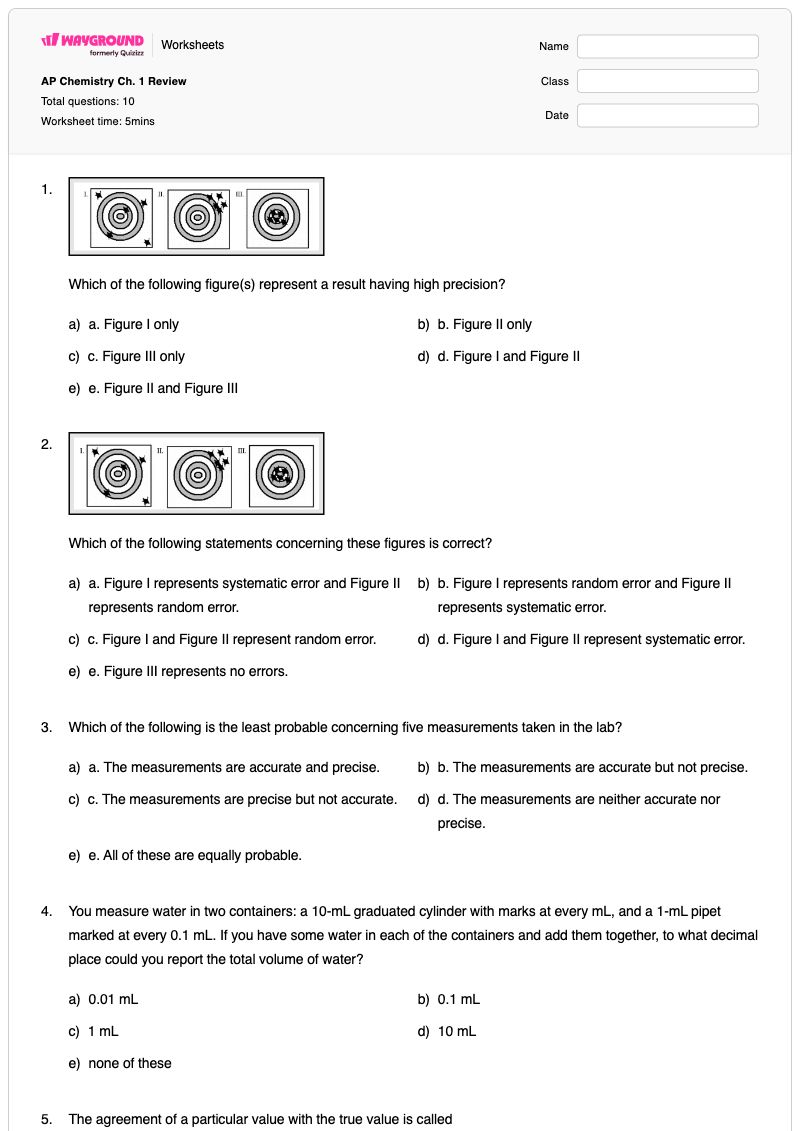
AP Chemistry Ch. 1 Review is a Grade 12 chemistry worksheet focused on interpreting experimental measurements and reporting them correctly. Students analyze figures for precision, distinguish accuracy from precision, identify random and systematic error, evaluate sources of uncertainty, and determine the appropriate decimal place for measured volumes. The worksheet also reinforces significant-figure rules through calculator notation, addition of measured volumes, and perimeter calculations, then applies density to predict whether gasoline floats or sinks in water.
This free printable worksheet includes 10 questions: 9 multiple-choice items and 1 fill-in-the-blank item. It is designed for AP Chemistry review, independent practice, homework, or a short formative assessment after instruction on measurement and data reporting. A complete answer key helps teachers quickly check student understanding of precision, accuracy, uncertainty, significant figures, and density-based reasoning.
Worksheet settings
Font size
S
M
L
XL
Worksheets
AP Chemistry Ch. 1 Review
Total questions: 10
Name
Class
Date
1.
Which of the following figure(s) represent a result having high precision?
a)
a. Figure I only
b)
b. Figure II only
c)
c. Figure III only
d)
d. Figure I and Figure II
e)
e. Figure II and Figure III
2.
Which of the following statements concerning these figures is correct?
a)
a. Figure I represents systematic error and Figure II represents random error.
b)
b. Figure I represents random error and Figure II represents systematic error.
c)
c. Figure I and Figure II represent random error.
d)
d. Figure I and Figure II represent systematic error.
e)
e. Figure III represents no errors.
3.
Which of the following is the least probable concerning five measurements taken in the lab?
a)
a. The measurements are accurate and precise.
b)
b. The measurements are accurate but not precise.
c)
c. The measurements are precise but not accurate.
d)
d. The measurements are neither accurate nor precise.
e)
e. All of these are equally probable.
4.
You measure water in two containers: a 10-mL graduated cylinder with marks at every mL, and a 1-mL pipet marked at every 0.1 mL. If you have some water in each of the containers and add them together, to what decimal place could you report the total volume of water?
a)
0.01 mL
b)
0.1 mL
c)
1 mL
d)
10 mL
e)
none of these
5.
The agreement of a particular value with the true value is called
a)
accuracy
b)
error
c)
precision
d)
significance
e)
certainty
6.
The amount of uncertainty in a measured quantity is determined by:
a)
both the skill of the observer and the limitations of the measuring instrument
b)
neither the skill of the observer nor the limitations of the measuring instrument
c)
the limitations of the measuring instrument only
d)
the skill of the observer only
e)
none of these
7.
A scientist obtains the number 0.045006700 on a calculator. If this number actually has four (4) significant figures, how should it be written?
(a)
8.
The beakers shown below have different precisions as shown. Suppose you pour the water from these three beakers into one container. What would be the volume in the container reported to the correct number of significant figures?
a)
78.817 mL
b)
78.82 mL
c)
78.8 mL
d)
80 mL
e)
79 mL
9.
You are asked to determine the perimeter of the cover of your textbook. You measure the length as 36.71 cm and the width as 24.83 cm. How many significant figures should you report for the perimeter?
a)
1
b)
2
c)
3
d)
4
10.
The density of gasoline is 0.7025 g/mL at 20°C. When gasoline is added to water:
a)
It will float on top.
b)
It will sink to the bottom.
c)
It will mix so, you can't see it.
d)
The mixture will improve the running of the motor.
e)
None of these things will happen.
Answer Key
AP Chemistry Ch. 1 Review
Total questions: 10
1.
e)
e. Figure II and Figure III
2.
b)
b. Figure I represents random error and Figure II represents systematic error.
3.
a)
a. The measurements are accurate and precise.
4.
b)
0.1 mL
5.
a)
accuracy
6.
a)
both the skill of the observer and the limitations of the measuring instrument
7.
0.04501
8.
e)
79 mL
9.
d)
4
10.
a)
It will float on top.
140 %
Browse by subjects
Browse by grades
Browse by format
FAQs
What does the AP Chemistry Ch. 1 Review worksheet cover?
This Grade 12 worksheet uses 9 multiple-choice questions and 1 fill-in-the-blank question to assess measurement accuracy, precision, random and systematic error, uncertainty, decimal-place reporting, and significant figures. Students interpret measurement diagrams, choose reporting precision for combined volumes, round a calculator value to four significant figures, and apply density to predict that gasoline floats on water. Completing these items builds the skill of evaluating experimental data and communicating measurements with appropriate precision.
How can I use this worksheet to teach accuracy, precision, and significant figures?
Introduce the worksheet by having students compare the figures and explain how the data pattern shows precision, random error, or systematic error. Then work through the measurement-reporting items, asking students to identify the least precise measurement before deciding the decimal place or significant figures for a sum or perimeter. Use the gasoline-density question as a closing application in which students connect a numerical property to a physical prediction.
What mistakes should I watch for when students complete this chemistry review worksheet?
Students may treat accuracy and precision as interchangeable, or confuse random error with systematic error when interpreting the figures. In the volume and beaker questions, watch for reporting extra decimal places instead of following the least precise measurement. Students may also keep trailing digits in 0.045006700 instead of writing four significant figures, or choose a gasoline outcome without comparing its density with water.
How do I assign and grade this AP Chemistry review worksheet?
The worksheet is available as a printable PDF and as a digital quiz on Wayground, with a complete answer key for all 10 items. For printable submissions, you can grade student work by scanning it with the Wayground for Teachers app. The PDF option also supports classrooms that are reducing screen time while students practise measurement and significant-figure reasoning.
How can I differentiate this worksheet for my students?
Use the worksheet’s Advanced Settings to adjust font spacing and font size so the measurement diagrams, answer choices, and significant-figure calculations are easier to read. You can also apply a dyslexia-friendly font or translate the worksheet into another language when that supports access to the chemistry vocabulary and directions.
Where can I find more worksheets like this on Wayground?
Wayground offers a comprehensive collection of free printable worksheets and practice problems across subjects, including downloadable PDFs and answer keys to help students master essential skills and concepts. Browse more resources at https://wayground.com/en-us/worksheets.


 Worksheets

