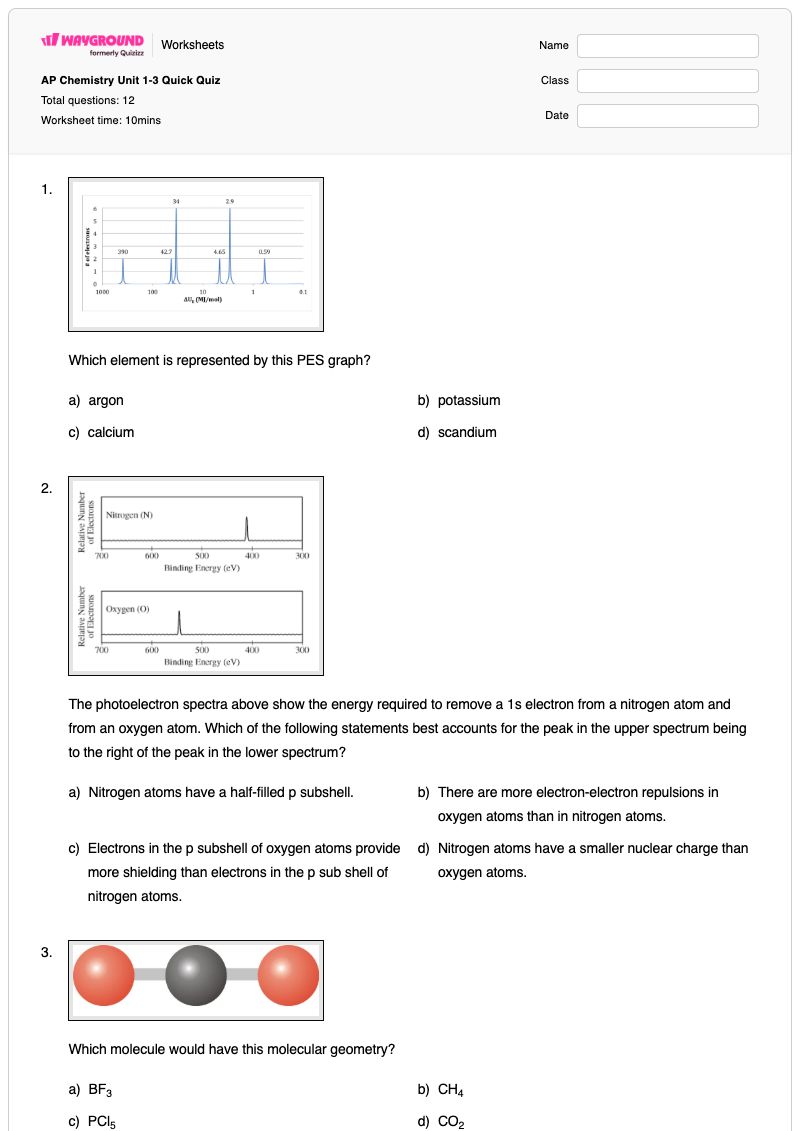
AP Chemistry Unit 1-3 Quick Quiz is a 12-question multiple-choice review for Grades 10–12 Chemistry students. It asks students to interpret photoelectron spectra, explain how nuclear charge affects electron binding energy, identify molecular geometry, and determine the numbers of sigma and pi bonds in molecular structures. Students also classify intermolecular forces, compare substance strength using boiling points, and connect conductivity and physical properties to ionic, metallic, covalent, and hydrogen-bonded interactions.
This free printable worksheet with an answer key supports formative assessment, unit review, or preparation for an AP Chemistry-style check of understanding. The final questions extend the review to particle motion as temperature changes, requiring students to connect macroscopic observations such as melting, boiling, and electrical conductivity with particle-level behavior. Its four-option multiple-choice format helps teachers quickly identify misconceptions across several foundational chemistry concepts.
Worksheet settings
Font size
S
M
L
XL
Worksheets
AP Chemistry Unit 1-3 Quick Quiz
Total questions: 12
Name
Class
Date
1.
Which element is represented by this PES graph?
a)
argon
b)
potassium
c)
calcium
d)
scandium
2.
The photoelectron spectra above show the energy required to remove a 1s electron from a nitrogen atom and from an oxygen atom. Which of the following statements best accounts for the peak in the upper spectrum being to the right of the peak in the lower spectrum?
a)
Nitrogen atoms have a half-filled p subshell.
b)
There are more electron-electron repulsions in oxygen atoms than in nitrogen atoms.
c)
Electrons in the p subshell of oxygen atoms provide more shielding than electrons in the p sub shell of nitrogen atoms.
d)
Nitrogen atoms have a smaller nuclear charge than oxygen atoms.
3.
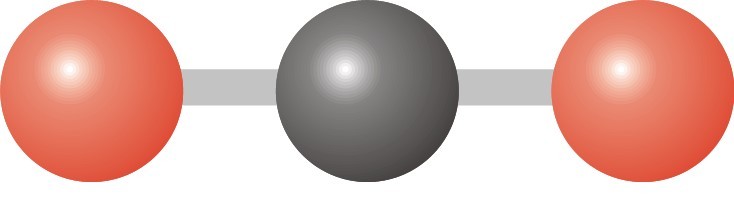
Which molecule would have this molecular geometry?
a)
BF3
b)
CH4
c)
PCl5
d)
CO2
4.
Who could this be?
a)
CO2
b)
NH3
c)
H2S
d)
CH4
5.
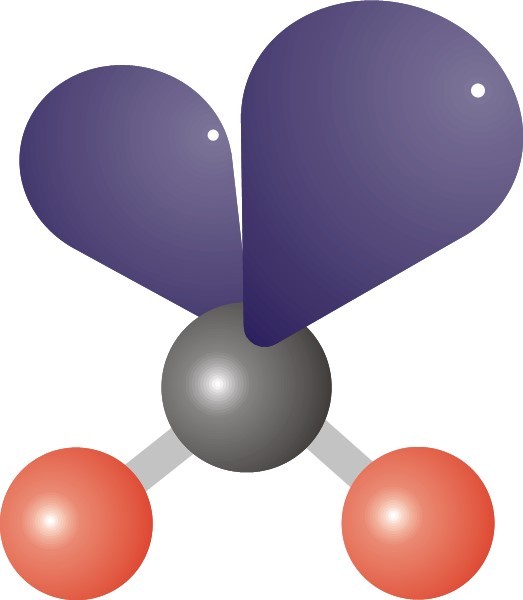
How many pi bonds does this have?
a)
1
b)
2
c)
3
d)
4
6.
How many sigma and pi bonds does this have?
a)
1 sigma and 1 pi
b)
2 sigma and 1 pi
c)
1 sigma and 2 pi
d)
2 sigma and 2 pi
7.
Which substance would have the weakest intermolecular forces of attraction?
a)
CH4
b)
NaCl
c)
H2O
d)
MgF2
8.
Intermolecular force present in HCl?
a)
dipole dipole
b)
dispersion
c)
H-bond
d)
ionic
9.
Which substance has the weakest intermolecular forces?
a)
Substance A, boiling point of 75 °C
b)
Substance B, boiling point of 105 °C
c)
Substance C, boiling point of 25 °C
d)
Substance d, boiling point of 45 °C
10.
A sample of a hard, solid binary compound at room temperature did not conduct electricity as a pure solid but became highly conductive when dissolved in water. Which of the following types of interactions is most likely found between the particles in the substance?
a)
Ionic bonds
b)
Metallic bonds
c)
Covalent bonds
d)
Hydrogen bonds
11.
Which of the following could be the identity of a white crystalline solid that exhibits the following properties?
-It melts at 320°C.
-It does not conduct electricity as a solid.
-It conducts electricity in an aqueous solution.
a)
C6H12O6(s)
b)
NaOH(s)
c)
SiO2(s)
d)
Cu(s)
12.
When the temperature of matter increases the particles...
a)
speed up and move closer
b)
speed up and move farther apart
c)
slow down and move closer together
d)
slow down and move farther apart
Answer Key
AP Chemistry Unit 1-3 Quick Quiz
Total questions: 12
1.
c)
calcium
2.
d)
Nitrogen atoms have a smaller nuclear charge than oxygen atoms.
3.
d) CO2
4.
c) H2S
5.
b) 2
6.
b) 2 sigma and 1 pi
7.
a)
CH4
8.
a) dipole dipole
9.
c)
Substance C, boiling point of 25 °C
10.
a)
Ionic bonds
11.
b)
NaOH(s)
12.
b) speed up and move farther apart
140 %
Browse by subjects
Browse by grades
Browse by format
FAQs
What does the AP Chemistry Unit 1-3 Quick Quiz cover?
This worksheet uses 12 multiple-choice questions to review specific Unit 1–3 skills: interpreting photoelectron spectra, explaining nuclear-charge effects, identifying molecular geometry, counting sigma and pi bonds, classifying intermolecular forces, and linking conductivity or boiling point to particle interactions. It also checks whether students can predict how particles respond when temperature increases. Completing the questions gives students practice applying these ideas to graphs, molecular representations, formulas, and property descriptions rather than recalling isolated definitions.
How can I use this worksheet to teach the AP Chemistry Unit 1-3 concepts?
Use the quiz after students have learned electron structure, VSEPR-based molecular geometry, bonding, and intermolecular forces. Have students explain the evidence behind selected answers—for example, why nuclear charge changes a PES peak, why a molecular drawing contains a particular number of sigma and pi bonds, or why a substance with a lower boiling point has weaker intermolecular forces. Review the conductivity and temperature items as a class to connect observable properties with particle-level explanations.
What mistakes should I watch for when students complete this chemistry quiz?
Students may attribute a PES difference to shielding or a half-filled subshell when the relevant comparison is nuclear charge. They may confuse molecular geometry with a molecule’s formula, count a double or triple bond incorrectly when separating sigma and pi bonds, or treat all attractions as hydrogen bonds. Other common errors include choosing an ionic compound from a formula without considering solid-versus-aqueous conductivity, and overlooking that lower boiling point indicates weaker intermolecular forces in the comparison item.
How do I assign and grade this AP Chemistry Unit 1-3 worksheet?
The worksheet is available as a printable PDF and as a digital quiz on Wayground, so you can use the same 12 multiple-choice questions for paper review or online practice. It includes a complete answer key for checking responses across the PES, molecular structure, bonding, intermolecular-force, and particle-motion items. Printable submissions can be graded by scanning student work with the Wayground for Teachers app.
How can I differentiate this AP Chemistry quiz for my students?
Use the worksheet’s Advanced Settings to adjust font spacing and font size so the four-option questions, chemical formulas, and property descriptions are easier to read. You can also apply a dyslexia-friendly font or translate the worksheet into another language when appropriate. These options create an alternate version of this chemistry quiz while keeping its multiple-choice content unchanged.
Where can I find more worksheets like this on Wayground?
Wayground offers a comprehensive collection of free printable worksheets and practice problems across all subjects, with downloadable PDFs and answer keys to help students master essential skills and concepts. Browse more resources at https://wayground.com/en-us/worksheets.


 Worksheets