
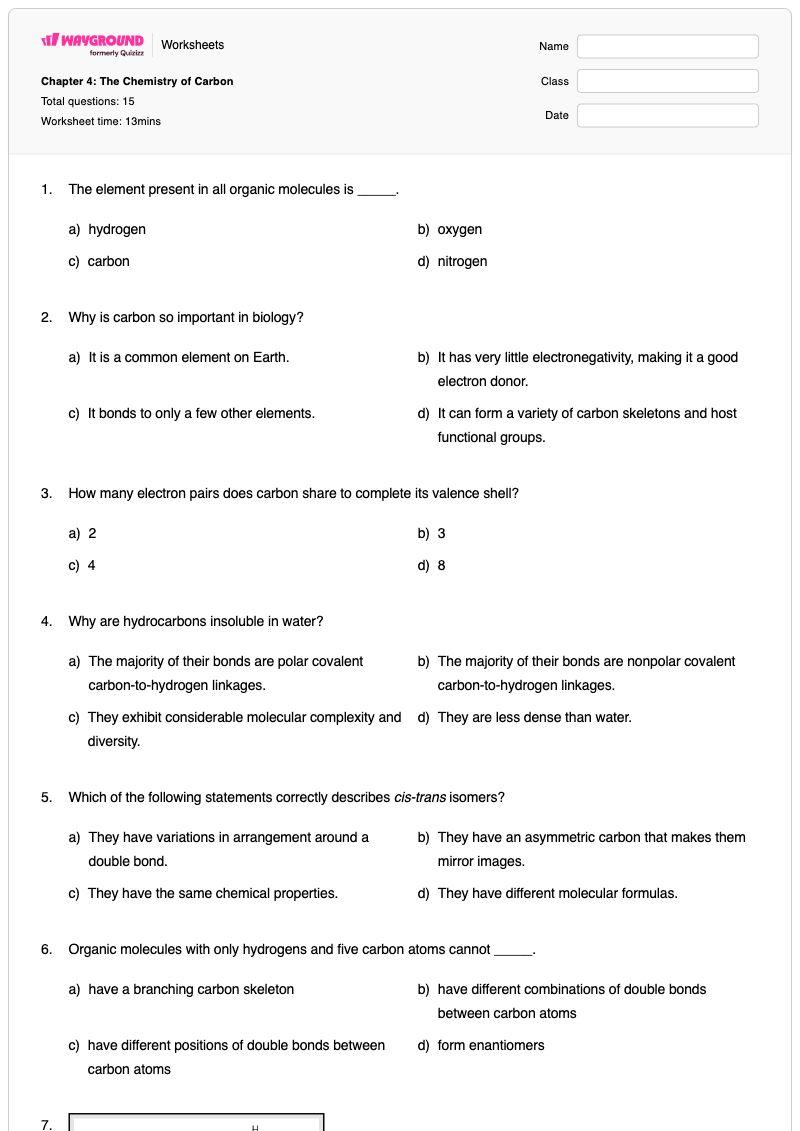

Chapter 4: The Chemistry of Carbon is a Grade 11–12 science worksheet that uses 15 multiple-choice questions to check students’ understanding of carbon’s role in organic molecules. Students identify carbon’s bonding capacity, explain why carbon forms diverse skeletons and functional groups, connect nonpolar hydrocarbon bonds to water insolubility, and distinguish structural isomers, cis-trans isomers, and enantiomers. The questions also use molecular diagrams to assess visual interpretation of organic structures.
The worksheet further focuses on recognizing and naming functional groups, identifying carboxyl groups and ketones, determining which groups behave as organic acids, and evaluating whether a covalently bonded molecule is possible. It works well for Grade 11–12 biology or chemistry review, independent practice, or a formative check after instruction on carbon chemistry. This free printable worksheet includes a complete answer key for efficient checking and feedback.
Worksheet settings
Font size
S
M
L
XL
Worksheets
Chapter 4: The Chemistry of Carbon
Total questions: 15
Name
Class
Date
1.
The element present in all organic molecules is _____.
a)
hydrogen
b)
oxygen
c)
carbon
d)
nitrogen
2.
Why is carbon so important in biology?
a)
It is a common element on Earth.
b)
It has very little electronegativity, making it a good electron donor.
c)
It bonds to only a few other elements.
d)
It can form a variety of carbon skeletons and host functional groups.
3.
How many electron pairs does carbon share to complete its valence shell?
a)
2
b)
3
c)
4
d)
8
4.
Why are hydrocarbons insoluble in water?
a)
The majority of their bonds are polar covalent carbon-to-hydrogen linkages.
b)
The majority of their bonds are nonpolar covalent carbon-to-hydrogen linkages.
c)
They exhibit considerable molecular complexity and diversity.
d)
They are less dense than water.
5.
Which of the following statements correctly describes cis-trans isomers?
a)
They have variations in arrangement around a double bond.
b)
They have an asymmetric carbon that makes them mirror images.
c)
They have the same chemical properties.
d)
They have different molecular formulas.
6.
Organic molecules with only hydrogens and five carbon atoms cannot _____.
a)
have a branching carbon skeleton
b)
have different combinations of double bonds between carbon atoms
c)
have different positions of double bonds between carbon atoms
d)
form enantiomers
7.
The two molecules shown in the figure below are best described as _____.
a)
enantiomers
b)
structural isomers
c)
cis-trans isomers
d)
chain length isomers
8.
The figure shows the structures of glucose and fructose. These two molecules differ in the _____.
a)
number of carbon, hydrogen, and oxygen atoms
b)
types of carbon, hydrogen, and oxygen atoms
c)
arrangement of carbon, hydrogen, and oxygen atoms
d)
number of oxygen atoms joined to carbon atoms by double covalent bonds
9.
The two molecules shown in the figure are best described as ______.
a)
enantiomers
b)
radioactive isotopes
c)
structural isomers
d)
cis-trans isomers
10.
Which of the pairs of molecular structures shown depict enantiomers (enantiomeric forms) of the same molecule?
a)
b)
c)
d)
11.
Which of the functional groups below acts most like an acid in water?
a)
amino
b)
carbonyl
c)
carboxyl
d)
hydroxyl
12.
What is the name of the functional group shown in the figure?
a)
carbonyl
b)
ketone
c)
aldehyde
d)
carboxyl
13.
Which of the structures illustrated is an impossible covalently bonded molecule?
a)
A
b)
B
c)
C
d)
D
14.
Which molecule shown has a carbonyl functional group in the form of a ketone?
a)
A
b)
B
c)
C
d)
D
15.
Which molecule shown above can increase the concentration of hydrogen ions in a solution and is, therefore, an organic acid?
a)
A
b)
B
c)
C
d)
D
Answer Key
Chapter 4: The Chemistry of Carbon
Total questions: 15
1.
c)
carbon
2.
d)
It can form a variety of carbon skeletons and host functional groups.
3.
c)
4
4.
b)
The majority of their bonds are nonpolar covalent carbon-to-hydrogen linkages.
5.
a)
They have variations in arrangement around a double bond.
6.
d)
form enantiomers
7.
b)
structural isomers
8.
c)
arrangement of carbon, hydrogen, and oxygen atoms
9.
d)
cis-trans isomers
10.
c)
11.
c)
carboxyl
12.
d)
carboxyl
13.
b)
B
14.
b)
B
15.
c)
C
140 %
Browse by subjects
Browse by grades
Browse by format
FAQs
What does this Chapter 4 carbon chemistry worksheet cover?
This Grade 11–12 worksheet contains 15 multiple-choice questions on carbon bonding, hydrocarbon properties, molecular isomers, and functional groups. Students apply these ideas by interpreting molecular structures, distinguishing structural, cis-trans, and enantiomeric relationships, and identifying groups such as carboxyl and ketone.
How can I use this worksheet to teach the chemistry of carbon?
Introduce carbon’s four shared electron pairs and its ability to form varied skeletons before assigning the questions on bonding and hydrocarbon solubility. Then have students justify their choices in the structure-based items, especially when distinguishing structural isomers, cis-trans isomers, and enantiomers or identifying functional groups. Use the final questions to connect molecular structure with acidity and ketone formation.
What mistakes should I watch for when students complete this carbon chemistry worksheet?
Students may confuse structural isomers, which differ in atom arrangement, with cis-trans isomers, which differ around a double bond, or with enantiomers, which are mirror-image forms. They may also mistake a carboxyl group for a carbonyl group or ketone, overlook carbon’s four bonding capacity when judging whether a molecule is possible, or choose an organic acid without connecting it to increased hydrogen-ion concentration.
How do I assign and grade this carbon chemistry worksheet?
The worksheet is available as a printable PDF and as a digital quiz on Wayground, and it includes a complete answer key for all 15 multiple-choice questions. For printable submissions, scan student work with the Wayground for Teachers app to grade responses efficiently. The PDF option can also support schools that are reducing screen time.
How can I differentiate this carbon chemistry worksheet for my students?
Use the worksheet’s Advanced Settings to adjust font spacing and font size so the 15 multiple-choice items and molecular-structure prompts are easier to read. You can also enable a dyslexia-friendly font or translate the worksheet into another language when appropriate for your learners.
Where can I find more free worksheets like this on Wayground?
Wayground offers a comprehensive collection of free printable worksheets and practice problems across subjects, with downloadable PDFs and answer keys to help students master essential skills and concepts. Browse more resources at https://wayground.com/en-us/worksheets.