

Wayground
Chemical Bonds - Printable Science Worksheets 10th Grade - Wayground

Chemical Bonds

Matthew Johnson

Created by Matthew Johnson

11 questions

10th Grade

Science

Chemical Bonds is a Grade 10 chemistry worksheet that builds foundational understanding of how and why atoms form compounds. Students identify the meaning of “inter,” distinguish intramolecular forces, chemical bonds, intermolecular forces, and ionic bonds, and connect bond type to electronegativity difference. The worksheet also covers equal electron sharing in nonpolar covalent bonds, electron transfer in ionic bonds, the octet rule, and the role of chemical formulas. This free printable worksheet includes 11 varied items: 8 multiple-choice questions, 1 matching task, 1 dropdown item, and 1 drag-and-drop activity. Students apply their understanding by interpreting H₂O to count atoms, identifying what a chemical formula communicates, and explaining that compounds form to reach greater stability and lower energy. A complete answer key is included for efficient review, grading, or independent practice.

Worksheet settings

Font size

S
M
L
XL
WaygroundWorksheets

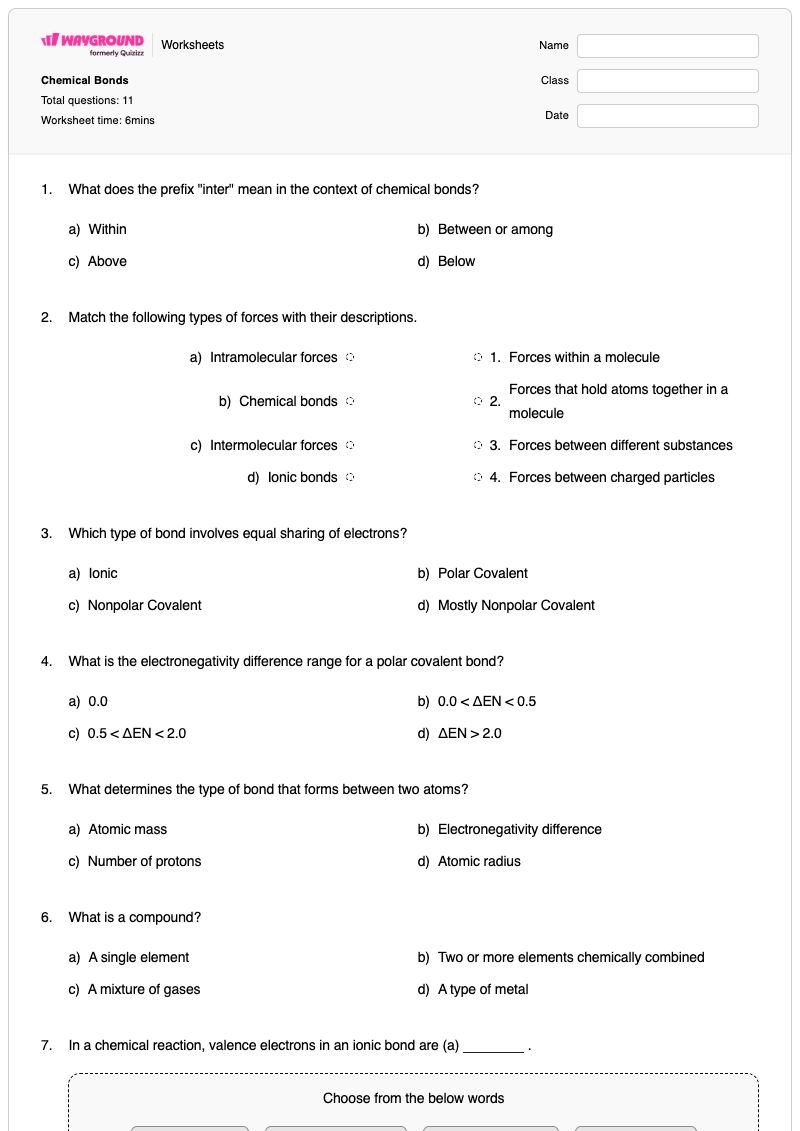
Chemical Bonds

Total questions: 11

Name
Class
Date
1.

What does the prefix "inter" mean in the context of chemical bonds?

a)

Within

b)

Between or among

c)

Above

d)

Below

2.

Match the following types of forces with their descriptions.

Intramolecular forces

Forces within a molecule

Chemical bonds

Forces that hold atoms together in a molecule

Intermolecular forces

Forces between different substances

Ionic bonds

Forces between charged particles

3.

Which type of bond involves equal sharing of electrons?

a)

Ionic

b)

Polar Covalent

c)

Nonpolar Covalent

d)

Mostly Nonpolar Covalent

4.

What is the electronegativity difference range for a polar covalent bond?

a)

0.0

b)

0.0 < ΔEN < 0.5

c)

0.5 < ΔEN < 2.0

d)

ΔEN > 2.0

5.

What determines the type of bond that forms between two atoms?

a)

Atomic mass

b)

Electronegativity difference

c)

Number of protons

d)

Atomic radius

6.

What is a compound?

a)

A single element

b)

Two or more elements chemically combined

c)

A mixture of gases

d)

A type of metal

7.

In a chemical reaction, valence electrons in an ionic bond are (a)   .

Choose from the below words
They are shared
They are transferred
They are destroyed
They are created
8.

What does a chemical formula indicate?

a)

The color of a compound

b)

The taste of a compound

c)

The elements and the number of each element in a compound

d)

The temperature at which a compound melts

9.

How many atoms of hydrogen are in a molecule of water (H₂O)?

a)

1

b)

2

c)

3

d)

4

10.

Elements form compounds to (a)  

Choose from the below words
To increase energy
To become unstable
To be stable and achieve low energy
To change color
11.

According to the octet rule, what do atoms do to achieve 8 valence electrons?

a)

Gain, lose, or share electrons

b)

Gain protons

c)

Lose neutrons

d)

Share protons

WaygroundAnswer Key

Chemical Bonds

Total questions: 11

1.
b)

Between or among

2.

Intramolecular forces

 - 

Forces within a molecule

, 

Chemical bonds

 - 

Forces that hold atoms together in a molecule

, 

Intermolecular forces

 - 

Forces between different substances

, 

Ionic bonds

 - 

Forces between charged particles

3.
c)

Nonpolar Covalent

4.
c)

0.5 < ΔEN < 2.0

5.
b)

Electronegativity difference

6.
b)

Two or more elements chemically combined

7.
They are transferred
8.
c)

The elements and the number of each element in a compound

9.
b)

2

10.
To be stable and achieve low energy
11.
a)

Gain, lose, or share electrons

FAQs

What does the Chemical Bonds worksheet cover?

This Grade 10 chemistry worksheet uses multiple-choice, matching, dropdown, and drag-and-drop questions to assess how students classify chemical bonds and explain electron behavior. Students distinguish intramolecular and intermolecular forces, connect bond type to electronegativity difference, identify electron sharing versus transfer, apply the octet rule, and interpret a formula such as H₂O.

How can I use this worksheet to teach chemical bonds?

Introduce the worksheet by reviewing the vocabulary in the matching item, especially the distinction between intramolecular forces, chemical bonds, and intermolecular forces. Then have students use electronegativity difference to reason about bond type before completing the items on electron sharing, electron transfer, the octet rule, and compound stability. Use the formula questions, including H₂O, as a final check that students can connect bonding ideas to chemical representations.

What mistakes should I watch for when students complete this Chemical Bonds worksheet?

Students may confuse “inter” with “within,” or mix up intermolecular forces with the bonds holding atoms together. Watch for students selecting polar covalent when electrons are shared equally, choosing sharing instead of transfer for ionic bonds, or treating electronegativity difference as atomic mass or atomic radius. They may also misread the subscript in H₂O, overlook that chemical formulas show both elements and quantities, or confuse gaining, losing, or sharing electrons under the octet rule.

How do I assign and grade this Chemical Bonds worksheet?

You can assign Chemical Bonds as a printable PDF or as a digital quiz on Wayground, and it includes a complete answer key for checking all 11 items. For printable submissions, scan student work with the Wayground for Teachers app to support faster grading.

How can I differentiate this Chemical Bonds worksheet for my students?

In the worksheet’s Advanced Settings, adjust font spacing and font size to make the bond definitions, answer choices, and chemical formula items easier to read. You can also enable a dyslexia-friendly font or translate the worksheet into another language when appropriate for your learners.

Where can I find more worksheets like this on Wayground?

Wayground offers a broad collection of free printable worksheets and practice problems across subjects, with downloadable PDFs and answer keys to help students master essential skills and concepts. Browse more resources at https://wayground.com/en-us/worksheets.