

Chemistry Final Exam Review 3 is a free printable worksheet for Grades 9–12 that uses 18 multiple-choice questions to review foundational chemistry knowledge. Students identify phase changes such as freezing, sublimation, and condensation; distinguish physical changes from chemical properties; classify examples as homogeneous mixtures, heterogeneous mixtures, compounds, or elements; and recognize the tightly packed structure of solids.
The review also checks essential science-laboratory safety procedures through questions about horseplay, cleanup, handwashing, equipment storage, broken glass, chemical odors, and reporting injuries. It works well for end-of-unit review, exam preparation, or a quick check of students’ ability to apply chemistry vocabulary and safe lab practices. A complete answer key is included with this free printable worksheet.
Worksheet settings
Font size
S
M
L
XL
Worksheets
Chemistry Final Exam Review 3
Total questions: 18
Name
Class
Date
1.
States of Matter: Melting, Freezing, Evaporating, and Sublimating are all...
a)
physical changes.
b)
chemical changes.
2.
States of Matter: Liquid turning into a solid is called...
a)
melting
b)
freezing
c)
evaporation
d)
condensation
e)
sublimation
3.
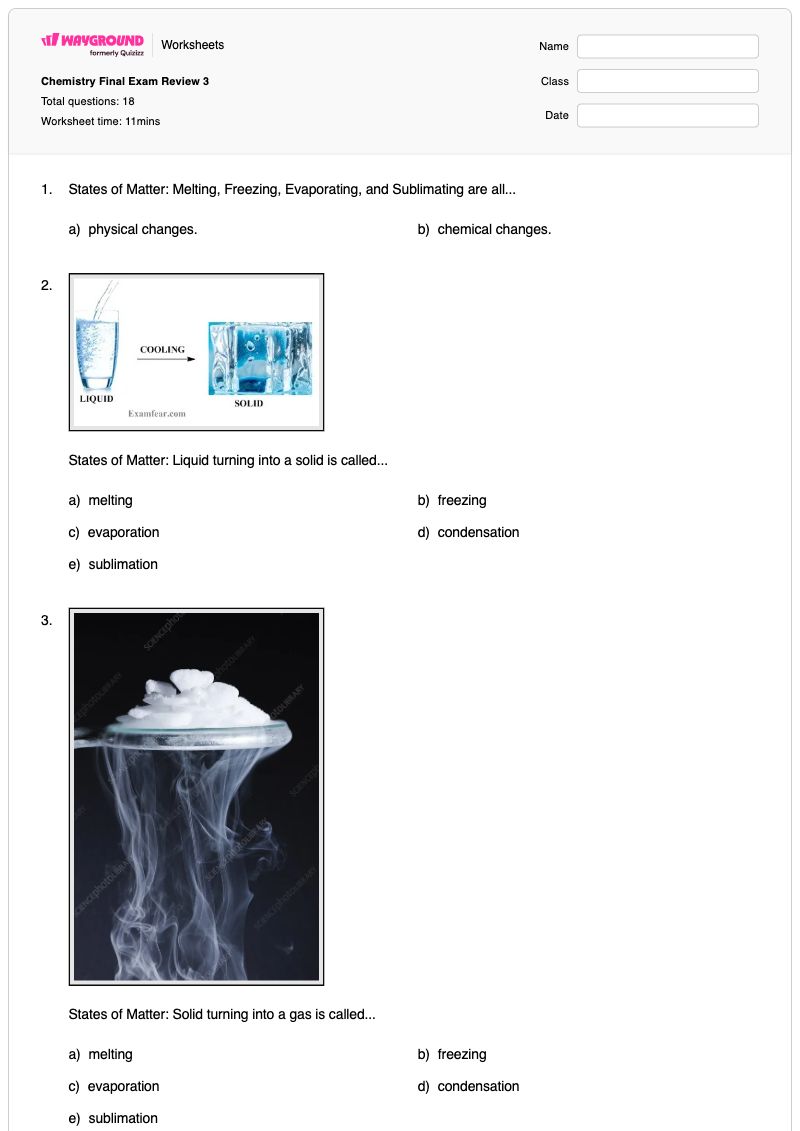
States of Matter: Solid turning into a gas is called...
a)
melting
b)
freezing
c)
evaporation
d)
condensation
e)
sublimation
4.
States of Matter: Gas turning into a liquid is called...
a)
melting
b)
freezing
c)
evaporation
d)
condensation
e)
sublimation
5.
States of Matter: Which of the following has a tightly packed structure?
a)
solid
b)
liquid
c)
gas
6.
Which of these is an example of a Homogeneous mixture:
a)
Tea with sugar
b)
oil and water
c)
NaCl
d)
H2O
7.
Which of these is an example of a Heterogeneous mixture:
a)
Tea with sugar
b)
oil and water
c)
NaCl
d)
H2O
8.
Which of these is an example of a Compound:
a)
Tea with sugar
b)
oil and water
c)
Gold
d)
H2O
9.
Which of these is an example of a Element:
a)
Tea with sugar
b)
oil and water
c)
Gold
d)
H2O
10.
Which of the following are examples of Physical Changes?
a)
shape, length, mass
b)
reactivity, flammability, corrosive
c)
freezing, melting, boiling
11.
Horseplay, practical jokes, or pranks in the classroom are
a)
not dangerous.
b)
okay if you are working alone.
c)
always against the rules.
d)
okay.
12.
Before you leave the science room, you should
a)
wash your hands with soap and water.
b)
return all equipmernt to the proper storage area.
c)
clean your work area and equipment.
d)
all of the above.
13.
It is okay to pick up broken glass with your bare hands as long as the glass is placed in the trash can.
a)
True
b)
False
14.
It's fine to smell chemicals directly from their containers.
a)
True
b)
False
15.
You have been injured in the laboratory (cut, burn, etc.). First you should
a)
apply first aid yourself
b)
tell your science teacher immediately
c)
see a doctor after school
d)
visit the school nurse after class
16.
What is the proper way to smell a chemical mixture in an experiment?
a)
waft
b)
blow your nose then take a big wiff
c)
take a big sniff
d)
snort
17.
Flammable materials should never be used near:
a)
A. An open door
b)
B. An open flame
c)
C.Another student
d)
D. A sink
18.
Goggles are worn in the lab
a)
to avoid eye strain
b)
to improve your vision
c)
only if you do not have your own glasses
d)
any time chemicals, heat, or glassware are used
Answer Key
Chemistry Final Exam Review 3
Total questions: 18
1.
a)
physical changes.
2.
b)
freezing
3.
e)
sublimation
4.
d)
condensation
5.
a)
solid
6.
a)
Tea with sugar
7.
b)
oil and water
8.
d)
H2O
9.
c)
Gold
10.
c)
freezing, melting, boiling
11.
c)
always against the rules.
12.
d)
all of the above.
13.
b)
False
14.
b) False
15.
b)
tell your science teacher immediately
16.
a) waft
17.
b)
B. An open flame
18.
d)
any time chemicals, heat, or glassware are used
140 %
Browse by subjects
Browse by grades
Browse by format
FAQs
What does Chemistry Final Exam Review 3 cover?
This 18-question multiple-choice worksheet reviews phase changes, including freezing, sublimation, and condensation; classifications of matter, including elements, compounds, and homogeneous and heterogeneous mixtures; and physical changes. It also asks students to apply laboratory safety rules, so completing it reinforces both chemistry vocabulary and safe decision-making in the science room.
How can I use this worksheet to teach phase changes and classifications of matter?
Introduce the review by having students create a reference chart for solid, liquid, and gas transitions, then compare elements, compounds, and mixtures using the examples named in the questions. Students can complete the multiple-choice items independently and explain why alternatives such as oil and water, NaCl, or H2O fit different classifications. Finish with a class discussion connecting freezing, melting, and boiling to physical changes.
What mistakes should I watch for when students complete this chemistry review?
Students may confuse the direction of phase changes, especially freezing with melting, sublimation with evaporation, or condensation with another gas-to-liquid process. They may also treat a compound such as H2O as an element, or confuse a homogeneous mixture such as tea with sugar with a heterogeneous mixture such as oil and water. On the safety items, watch for choices that minimize hazards, such as handling broken glass with bare hands or smelling chemicals directly.
How do I assign and grade Chemistry Final Exam Review 3?
You can assign this worksheet as a printable PDF or as a digital quiz on Wayground, and it includes a complete answer key for all 18 multiple-choice questions. Printable submissions can be graded by scanning student work with the Wayground for Teachers app. The PDF option can also support schools that want to reduce screen time during review.
How does this review check students’ laboratory safety knowledge?
The multiple-choice safety questions ask students to recognize that horseplay is against classroom rules, complete cleanup and handwashing before leaving, handle broken glass safely, avoid directly smelling chemicals, and report injuries to the science teacher immediately. These items require students to select the correct action in common lab situations rather than only recall chemistry definitions.
Where can I find more free worksheets like this on Wayground?
Wayground offers a comprehensive collection of free printable worksheets and practice problems across subjects, with downloadable PDFs and answer keys to help students master essential skills and concepts. Browse more resources at https://wayground.com/en-us/worksheets.