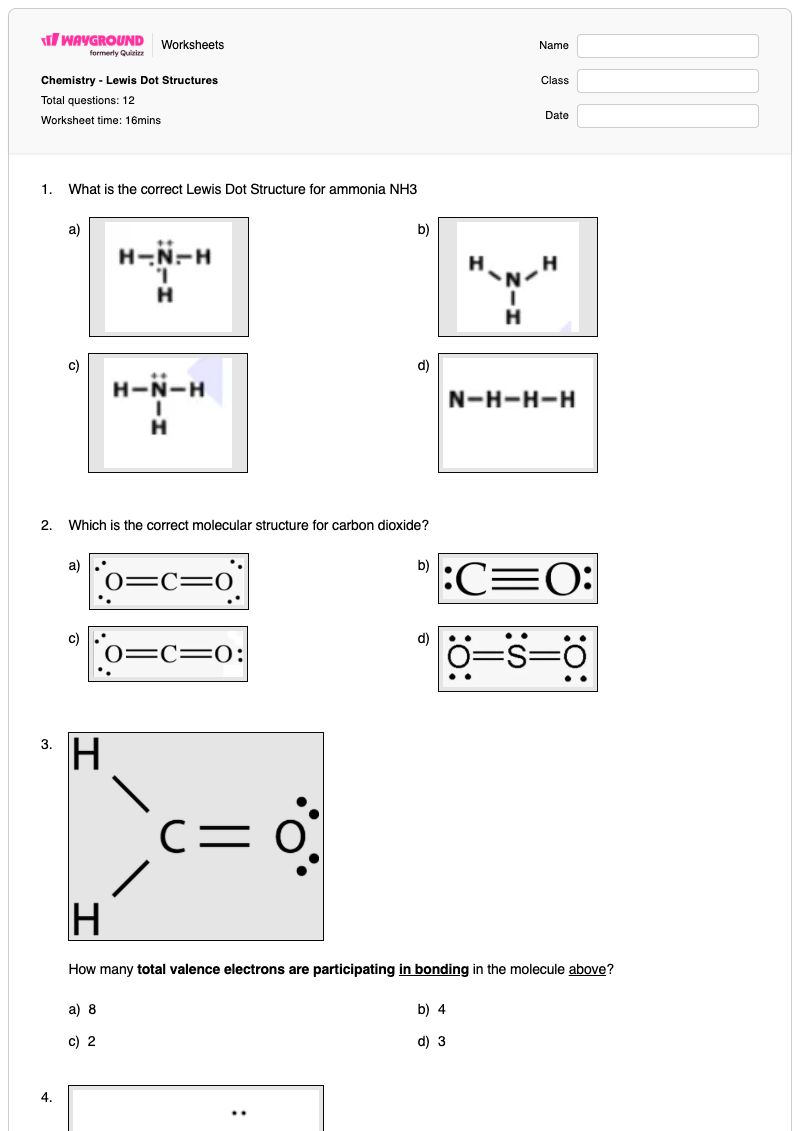
Chemistry – Lewis Dot Structures is a free printable worksheet for students in Grades 10–12 studying chemical bonds. Across 12 questions, including 10 multiple-choice and 2 multiple-select items, students identify correct Lewis dot structures for ammonia, carbon dioxide, and fluorine; count valence electrons and lone pairs; and determine single, double, and triple bonds in compounds such as CCl₄, carbonate, HCN, CHCl₃, and CH₂O.
The worksheet also asks students to recognize elements that can have fewer than eight valence electrons, including hydrogen, beryllium, and boron. These questions help learners connect electron-dot diagrams with molecular structure, bond type, lone-pair counts, and octet-rule exceptions. It is suitable for guided practice, independent review, or a quick assessment of Lewis structure fundamentals. The worksheet is available as a free printable PDF and includes a complete answer key for efficient checking.
Worksheet settings
Font size
S
M
L
XL
Worksheets
Chemistry - Lewis Dot Structures
Total questions: 12
Name
Class
Date
1.
What is the correct Lewis Dot Structure for ammonia NH3
a)
b)
c)
d)
2.
Which is the correct molecular structure for carbon dioxide?
a)
b)
c)
d)
3.
How many total valence electrons are participating in bonding in the molecule above?
a)
8
b)
4
c)
2
d)
3
4.
Which of the following is the correct Lewis dot structure for the molecule fluorine (F2)?
a)
A
b)
B
c)
C
d)
D
5.
CO2 has how many lone pairs?
a)
0
b)
1
c)
2
d)
3
e)
4
6.
NH3 has how many lone pairs?
a)
0
b)
1
c)
2
d)
3
7.
CCl4 has how many double bonds?
a)
0
b)
1
c)
2
d)
3
8.
Carbonate (CO32-) has how many double bonds?
a)
0
b)
1
c)
2
d)
3
9.
In HCN (Carbon is usually the central atom) what kind of bond is between the C and N
a)
Single
b)
Double
c)
Triple
10.
CHCl3 has how many double bonds?
a)
0
b)
1
c)
2
d)
3
11.
CH2O has which of the following?
a)
Multiple double bonds
b)
Multiple single bonds
c)
One double bond
d)
One single bond
e)
A lone pair
12.
Which of the following elements are an exception to the octet rule and require less than 8 valence electrons?
a)
H
b)
Li
c)
Be
d)
B
e)
C
Answer Key
Chemistry - Lewis Dot Structures
Total questions: 12
1.
c)
2.
a)
3.
a)
8
4.
b) B
5.
a)
0
6.
b)
1
7.
a)
0
8.
b)
1
9.
c)
Triple
10.
a)
0
11.
b)
Multiple single bonds
, c)
One double bond
12.
d)
B
, c)
Be
, a)
H
140 %
Browse by subjects
Browse by grades
Browse by format
FAQs
What does this Lewis Dot Structures worksheet help students learn?
This Grade 10–12 chemistry worksheet builds students’ ability to interpret and select Lewis dot structures rather than only recall the definition of a chemical bond. Its 10 multiple-choice and 2 multiple-select questions require students to count valence electrons and lone pairs, identify single, double, and triple bonds, and recognize octet-rule exceptions in examples such as NH₃, CO₂, carbonate, HCN, and CH₂O.
How can I use this worksheet to teach Lewis dot structures?
Introduce the worksheet by modeling how to identify the central atom, count valence electrons, and place shared and unshared electrons in a structure such as NH₃ or CO₂. Then have students complete the structure-identification items before moving to questions about lone pairs, bond order, and octet exceptions. Use the carbonate, HCN, and CH₂O items as discussion prompts to explain why a molecule may contain a double or triple bond and why multi-select answers can include both multiple single bonds and one double bond.
What mistakes should I watch for when students complete this Lewis structure worksheet?
Students may confuse a lone pair with a bonding pair, leading to incorrect counts for CO₂ and NH₃, or treat every connection in a structure as a double bond when identifying CCl₄ and CHCl₃. They may also miss that HCN contains a triple bond, overlook the double bond in carbonate or CH₂O, or select only one option on the multi-select questions. Check whether students apply the octet rule too rigidly instead of recognizing H, Be, and B as elements that can have fewer than eight valence electrons.
How do I assign and grade this Lewis Dot Structures worksheet?
You can assign the worksheet as a printable PDF or as a digital quiz on Wayground, with the 12 questions covering Lewis structures, bond order, lone pairs, and octet-rule exceptions. It includes a complete answer key, and printable submissions can be graded by scanning student work with the Wayground for Teachers app. The printable format also supports classrooms that are reducing screen time.
How can I differentiate this Lewis Dot Structures worksheet for my students?
Under the worksheet’s Advanced Settings, adjust font spacing or increase the font size to make the Lewis-structure diagrams, answer choices, and multi-select items easier to read. You can also enable a dyslexia-friendly font or translate the worksheet’s instructions and question text into another language while keeping formulas such as NH₃, CO₂, and HCN visible.
Where can I find more worksheets like this on Wayground?
Wayground offers a comprehensive collection of free printable worksheets and practice problems across subjects, with downloadable PDFs and answer keys to support essential skills and concepts. Browse more resources at https://wayground.com/en-us/worksheets.


 Worksheets


