

Wayground
Chemistry Reference Table Scavenger Hunt - Printable Science Worksheets 10th Grade - Wayground

Chemistry Reference Table Scavenger Hunt

Malika Richards

Created by Malika Richards

43 questions

10th Grade

Science

Updated May 2026

Chemistry Reference Table Scavenger Hunt is a free printable Grade 10 chemistry worksheet that builds students’ ability to locate and use reference information. Across 43 questions—7 multiple-choice items and 36 fill-in-the-blank prompts—students identify chemical formulas and ions, apply solubility and reaction-energy concepts, and retrieve values for temperature, phase changes, vapor pressure, specific heat, and gas solubility. The worksheet also asks students to use reference data in short calculations, such as determining the heat required to convert water to steam, while recalling chemistry conventions such as the milli- prefix and the molecular formula for ammonia. It provides varied practice with both recognition and precise written responses, helping teachers check whether students can read tables accurately and record values with the correct symbols, units, and notation. A complete answer key is included for efficient review and grading.

Worksheet settings

Font size

S
M
L
XL
WaygroundWorksheets

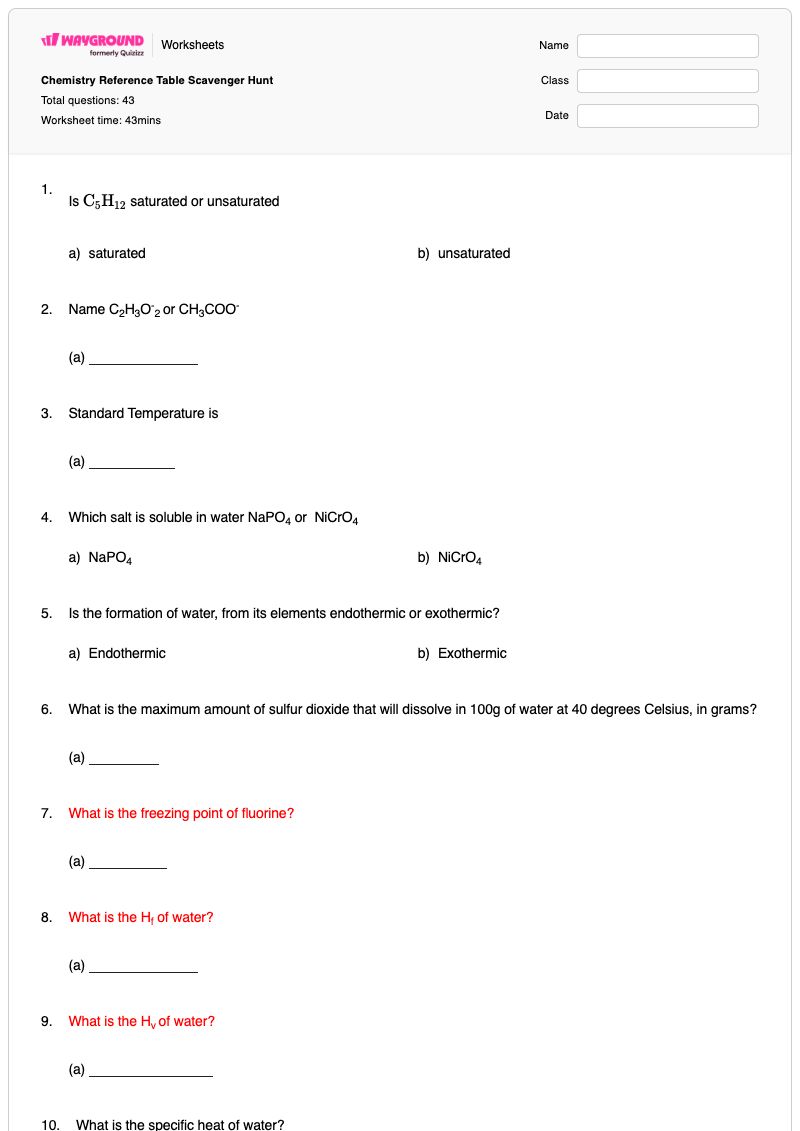
Chemistry Reference Table Scavenger Hunt

Total questions: 43

Name
Class
Date
1.

Is C5H12C_5H_{12} saturated or unsaturated

a)

saturated

b)

unsaturated

2.

Name C2H3O-2 or CH3COO-

(a)  

3.

Standard Temperature is

(a)  

4.

Which salt is soluble in water NaPO4 or  NiCrO4

a)

NaPO4

b)

NiCrO4

5.

Is the formation of water, from its elements endothermic or exothermic?

a)

Endothermic

b)

Exothermic

6.

What is the maximum amount of sulfur dioxide that will dissolve in 100g of water at 40 degrees Celsius, in grams?

(a)  

7.

What is the freezing point of fluorine?

(a)  

8.

What is the Hf of water?

(a)  

9.

What is the Hv of water?

(a)  

10.

What is the specific heat of water?

(a)  

11.

What is the vapor pressure of water at 750C?

(a)  

12.

How much heat does it take to convert 20g of water to steam at 1000C?

(a)  

13.

What is the prefix for 1/1000 of a meter?

(a)  

14.

What is the molecular formula of ammonia?

(a)  

15.

What is the formula for the permanganate ion?

(a)  

16.

Identify the class of organic compounds this molecule belongs too CH3COCH2CH3

(a)  

17.

What is the half-life of Pu-239?

(a)  

18.

Name this following:  H2CO3

(a)  

19.

What is the atomic mass of silver?

(a)  

20.

How much heat is released when LiBr dissolves in water?

(a)  

21.

What is the electronegativity of chlorine?

(a)  

22.

What is the decay mode of Au-198?

(a)  

23.

What is the ionization energy of Rb?

(a)  

24.

Which atom is more likely to lose electrons, Al or Zn?

a)

Al

b)

Zn

25.

Is the C-F bond nonpolar covalent, polar covalent or ionic?

a)

non polar

b)

polar

c)

ionic

26.

Write the electron configuration of potassium?

(a)  

27.

At what temperature will water boil, when the atmospheric pressure is 55 kPa?

(a)  

28.

What is the trend of atomic radii across period 3?

a)

increases

b)

decreases

29.

What is the density of tin?

(a)  

30.

Give the parts per million of solute for a solution containing 0.25g of sodium chloride in 200g of water.

(a)  

31.

If the accepted value for the mass of an object is 10.3g and a student found that the mass was 10.1g, what is the student’s percent error?

(a)  

32.

If a peanut is burned in a calorimeter containing 50g of water, and the water temperature changes from 450C to 570C, how many joules of energy were released by the peanut?

(a)  

33.

What is the approximate percent composition of Na in NaCl?

(a)  

34.

Convert 43°C to Kelvin

(a)  

35.

A sample of helium gas has a volume of 900. milliliters and a pressure of 2.50 atm at 298 K. What is the new pressure when the temperature is changed to 336 K and the volume is decreased to 450. milliliters?

(a)  

36.

How many carbons make up heptane?

(a)  

37.

What color will methyl orange turn in a basic solution?

(a)  

38.

What is SI unit for energy?

(a)  

39.

What is the concentration of NaOH if 14.0ml require 28.0 ml of 2.0 M HCl to reach the end point?

(a)  

40.

What is the concentration of NaOH made by dissolving 20g of NaOH in enough water to make 0.500 L of solution? (FM of NaOH = 40g)

(a)  

41.

What is the oxidation number of Au in Au2O3?

(a)  

42.

What is the name of the element that has the symbol "Rh"?

(a)  

43.

Which element is more reactive, potassium or tin?

a)

tin

b)

potassium

WaygroundAnswer Key

Chemistry Reference Table Scavenger Hunt

Total questions: 43

1.
a)

saturated

2.
acetate, Acetate
3.
273 K
4.
a)

NaPO4

5.
b)

Exothermic

6.
5 g
7.
53 K
8.
334 J/g
9.
2260 j/g
10.
4.18 j/g*K
11.
38 kPa
12.
45200 J
13.
milli
14.
NH3
15.
MnO4-
16.
ketone
17.
24100 years
18.
carbonic acid
19.
107.868 grams/mole, 107.868 g/mol, 107.868 amu, 107.868 u
20.
-48.83 kJ
21.
3.2
22.
beta
23.
403 kJ/mol
24.
a)

Al

25.
b)

polar

26.
2-8-8-1
27.
84°C, 84 degrees Celcius, 84 C
28.
b)

decreases

29.
7.287 g/cm3, 7.287
30.
1248.4 ppm
31.
1.94%, 1.94 %, 1.94 percent
32.
2508 J
33.
40%, 40 percent, 40 %
34.
316 K
35.
5.64 atm, 5.64 atm
36.
7, seven
37.
yellow
38.
joule, J, joules
39.
4 mol/L, 4 moles/ liter, 4 mol/ liter
40.
1 mol/L, 1 mole/ liter
41.
+3, positive 3, positive three
42.
rhodium
43.
b)

potassium

FAQs

What does the Chemistry Reference Table Scavenger Hunt worksheet cover?

This Grade 10 chemistry worksheet contains 43 reference-table questions: 7 multiple-choice items and 36 fill-in-the-blank prompts. Students retrieve and apply information such as ion and molecular formulas, solubility, temperature values, phase-change constants, vapor pressure, specific heat, reaction energy, and heat calculations.

How can I use this worksheet to teach students to use chemistry reference tables?

First model how to locate a value, formula, or classification in a chemistry reference table and how to copy its notation and units accurately. Then have students complete the multiple-choice items as guided practice before moving to the fill-in-the-blank questions, including the water-to-steam heat calculation, and discuss which table entry supports each answer.

What mistakes should I watch for when students complete this chemistry worksheet?

Watch for students confusing chemical formulas and ion names, such as acetate and permanganate, or omitting charges and subscripts. They may also mix up related reference values—such as heat of fusion, heat of vaporization, and specific heat—or give an incorrect unit or numerical value for questions involving vapor pressure, temperature, solubility, or heat.

How do I assign and grade this Chemistry Reference Table Scavenger Hunt worksheet?

Wayground provides this worksheet as a printable PDF and as a digital quiz, and it includes a complete answer key for the 7 multiple-choice and 36 fill-in-the-blank questions. For printable submissions, you can scan student work with the Wayground for Teachers app to support grading and review.

How can I differentiate this chemistry reference-table worksheet for my students?

Use the worksheet’s Advanced Settings to adjust font spacing or increase the font size so chemical formulas, units, and fill-in-the-blank prompts are easier to read. You can also enable a dyslexia-friendly font or translate the worksheet into another language when those options support access to the reference-table practice.

Where can I find more worksheets like this on Wayground?

Wayground offers a broad collection of free printable worksheets and practice problems across subjects, with downloadable PDFs and answer keys to help students master essential skills and concepts. Browse more resources at https://wayground.com/en-us/worksheets.