

Wayground
Chemistry Unit 2, lessons 4-5 - Printable Science Worksheets 10th Grade - Wayground

Chemistry Unit 2, lessons 4-5

L RS

Created by L RS

22 questions

10th Grade

Science

Updated Feb 2026

Chemistry Unit 2, Lessons 4–5 is a Grade 10 chemistry worksheet that reinforces how atomic structure explains charge and matter. Students identify ions, distinguish cations from anions, determine whether atoms are neutral, connect atomic number to protons and neutral-atom electrons, and identify how protons, neutrons, and electrons affect an element’s identity, mass, and charge. The worksheet also introduces Coulomb’s Law, electron transfer during charging, and the roles of charged particles in attraction.

Worksheet settings

Font size

S
M
L
XL
WaygroundWorksheets

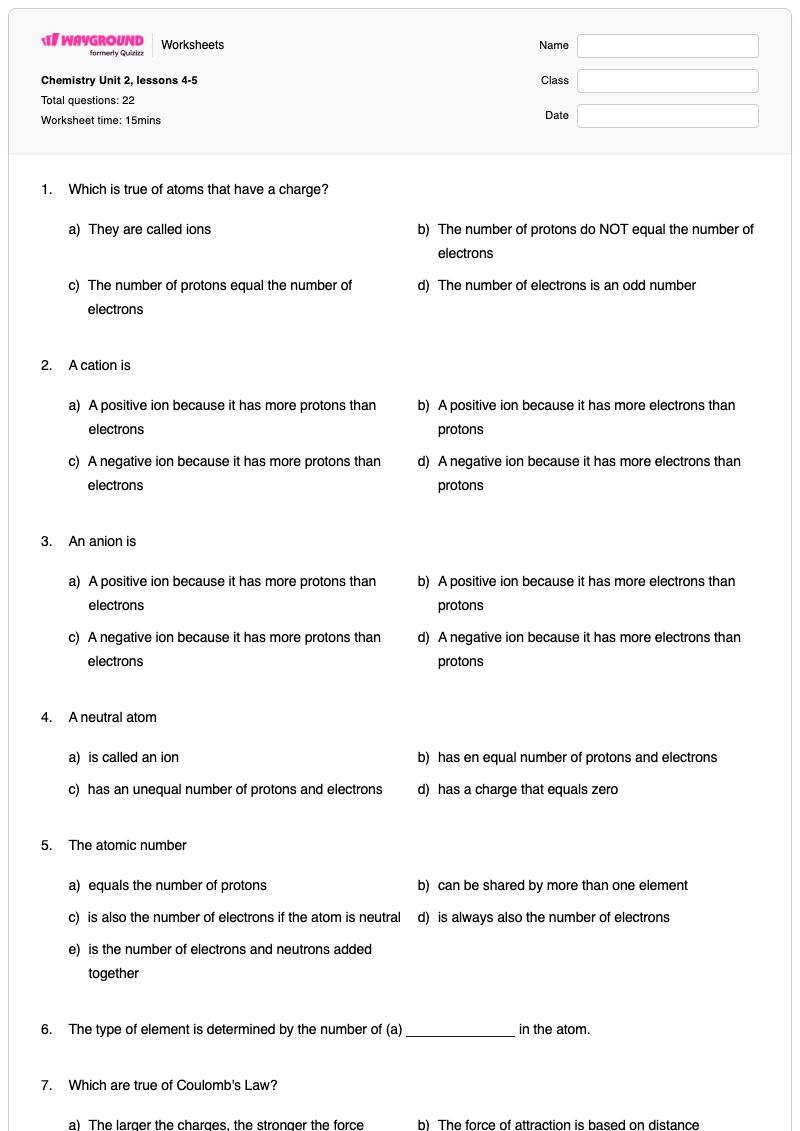
Chemistry Unit 2, lessons 4-5

Total questions: 22

Name
Class
Date
1.

Which is true of atoms that have a charge?

a)

They are called ions

b)

The number of protons do NOT equal the number of electrons

c)

The number of protons equal the number of electrons

d)

The number of electrons is an odd number

2.

A cation is

a)

A positive ion because it has more protons than electrons

b)

A positive ion because it has more electrons than protons

c)

A negative ion because it has more protons than electrons

d)

A negative ion because it has more electrons than protons

3.

An anion is

a)

A positive ion because it has more protons than electrons

b)

A positive ion because it has more electrons than protons

c)

A negative ion because it has more protons than electrons

d)

A negative ion because it has more electrons than protons

4.

A neutral atom

a)

is called an ion

b)

has en equal number of protons and electrons

c)

has an unequal number of protons and electrons

d)

has a charge that equals zero

5.

The atomic number

a)

equals the number of protons

b)

can be shared by more than one element

c)

is also the number of electrons if the atom is neutral

d)

is always also the number of electrons

e)

is the number of electrons and neutrons added together

6.

The type of element is determined by the number of (a)   in the atom.

7.

Which are true of Coulomb's Law?

a)

The larger the charges, the stronger the force

b)

The force of attraction is based on distance

c)

Distance does not influence the force of attraction

d)

The smaller the charges, the stronger the force

e)

Objects with a charge cannot attract a neutral object

8.

How does rubbing a neutral object (such as a balloon on clothes) create a charge?

a)

It transfers electrons

b)

It transfers protons and electrons

c)

It transfers neutrons

d)

It transfers protons

9.

Which is true of protons?

a)

If you change the number of protons, you change the element

b)

They attract electrons

c)

They are located in the nucleus

d)

They attract neutrons

e)

They are positively charged

10.

Which is true of neutrons?

a)

They have no charge

b)

They are located in the nucleus

c)

If you change the number of neutrons you change the element

d)

If you change the number of neutrons you change the mass

e)

They attract electrons

11.

Which is true of electrons?

a)

They have a negative charge

b)

They are located in the nucleus

c)

They are attracted to protons

d)

If you change the number of electrons, you change the element

e)

If you change the number of electrons, you change the mass

12.

Which is true of electrolytes?

a)

They are made of water and an ionic salt.

b)

They can be found in our blood and other body fluids

c)

They are poisonous

d)

They carry a charge/electric current

e)

Our bodies do not need them

13.

What is the difference between a solute and a solvent?

a)

A solvent is a substances that dissolves other substances; a solute is the substance being dissolved.

b)

A solute is a substances that dissolves other substances; a solvent is the substance being dissolved.

c)

A solvent always contains water; a solute does not.

d)

A solute always contains water; a solvent does not.

14.

Let's talk about the 2 in H20. Which are true?

a)

The 2 is a subscript.

b)

The 2 is a coefficient.

c)

The 2 tells how many atoms of hydrogen are in water.

d)

The 2 tells how many atoms of oxygen are in water.

15.
Which are (with one exception) the elements to the left of the stairstep?

Which are (with one exception) the elements to the left of the stairstep?

a)

Metals

b)

Non-metals

c)

Ions

d)

Solid elements

16.
Which are the elements to the right of the stairstep?

Which are the elements to the right of the stairstep?

a)

Metals

b)

Nonmetals

c)

Ions

d)

Solids

17.

Metals form

a)

cations, positively charged ions.

b)

cations, negatively charged ions.

c)

anions, positively charged ions.

d)

anions, negatively charged ions.

18.

Nonmetals form

a)

cations, positively charged ions.

b)

cations, negatively charged ions.

c)

anions, positively charged ions.

d)

anions, negatively charged ions.

19.

Electrolytes

a)

are neutral overall, because the positive charge is the same as the negative charge

b)

have a positive charge, because they conduct electricity

c)

have a positive charge, because they have more protons than neutrons

d)

can have either a positive or negative charge

20.

What do electrolytes do in the body?

a)

Balance water

b)

Balance the pH level

c)

Move nutrients into cells

d)

Move wastes out of the cells

e)

Make sure that the organs work properly

21.

Aqueous solutions made of a metal and nonmetal are (a)   ; one example is salt.

22.

Aqueous solutions that form molecules when dissolved, are made with nonmetals with nonmetals, and do not conduct electricity are (a)   .

WaygroundAnswer Key

Chemistry Unit 2, lessons 4-5

Total questions: 22

1.
a)

They are called ions

, b)

The number of protons do NOT equal the number of electrons

2.
a)

A positive ion because it has more protons than electrons

3.
d)

A negative ion because it has more electrons than protons

4.
b)

has en equal number of protons and electrons

, d)

has a charge that equals zero

5.
a)

equals the number of protons

, c)

is also the number of electrons if the atom is neutral

6.
protons
7.
a)

The larger the charges, the stronger the force

, b)

The force of attraction is based on distance

8.
a)

It transfers electrons

9.
a)

If you change the number of protons, you change the element

, b)

They attract electrons

, c)

They are located in the nucleus

, e)

They are positively charged

10.
a)

They have no charge

, b)

They are located in the nucleus

, d)

If you change the number of neutrons you change the mass

11.
a)

They have a negative charge

, c)

They are attracted to protons

12.
a)

They are made of water and an ionic salt.

, b)

They can be found in our blood and other body fluids

, d)

They carry a charge/electric current

13.
a)

A solvent is a substances that dissolves other substances; a solute is the substance being dissolved.

14.
a)

The 2 is a subscript.

, c)

The 2 tells how many atoms of hydrogen are in water.

15.
a)

Metals

16.
b)

Nonmetals

17.
a)

cations, positively charged ions.

18.
d)

anions, negatively charged ions.

19.
a)

are neutral overall, because the positive charge is the same as the negative charge

20.
a)

Balance water

, b)

Balance the pH level

, c)

Move nutrients into cells

, d)

Move wastes out of the cells

, e)

Make sure that the organs work properly

21.
ionic
22.
covalent

FAQs

What does this Chemistry Unit 2, Lessons 4–5 worksheet cover?

This 22-question Grade 10 chemistry worksheet uses multiple-select, multiple-choice, and fill-in-the-blank items to assess atomic structure and charge. Students distinguish cations, anions, and neutral atoms; relate atomic number to protons and electrons; identify the properties of subatomic particles; apply basic Coulomb’s Law ideas; and interpret electrolytes, solute-versus-solvent roles, chemical-formula subscripts, and the location of metals on the periodic table.

How can I use this worksheet to teach ions and atomic structure?

Introduce the worksheet by having students compare the numbers and charges of protons and electrons, then use the cation, anion, and neutral-atom items to check that reasoning. Follow with a class discussion about what changes an element, what changes its mass, and how electron transfer—such as rubbing a balloon on clothing—creates charge. Use the multiple-select questions to ask students to justify each selected statement rather than guessing from one correct option.

What mistakes should I watch for when students complete this chemistry worksheet?

Students may confuse cations and anions by reversing which particle is gained or lost, or assume that changing electrons changes the element instead of its charge. Watch for errors that treat neutrons as charged, place protons or neutrons outside the nucleus, or claim that changing neutron number changes an element rather than its mass. In the formula item, students may mistake the subscript 2 for a coefficient or apply it to oxygen instead of hydrogen.

How do I assign and grade this Chemistry Unit 2, Lessons 4–5 worksheet?

The worksheet is available as a printable PDF and as a digital quiz on Wayground, with a complete answer key for all 22 items. You can grade printable submissions by scanning student work with the Wayground for Teachers app, or review responses through the digital quiz.

How can I differentiate this atomic structure worksheet for my students?

Use the worksheet’s Advanced Settings to adjust font spacing and font size so the multiple-select choices, definitions, and fill-in-the-blank prompts are easier to navigate. You can also select a dyslexia-friendly font or translate the worksheet into another language while keeping its atomic structure and charge questions intact.

Where can I find more worksheets like this on Wayground?

Wayground offers a comprehensive collection of free printable worksheets and practice problems across all subjects, including downloadable PDFs and answer keys to support essential skills and concepts. Browse more resources at https://wayground.com/en-us/worksheets.