

Wayground
Chemistry Unit 4 wksht 1 - Printable Science Worksheets 10th Grade - Wayground

Chemistry Unit 4 wksht 1

Mitchell Davenport

Created by Mitchell Davenport

15 questions

10th Grade

Science

Chemistry Unit 4 wksht 1 is a Grade 10 chemistry worksheet that develops students’ ability to classify matter and select appropriate separation techniques. Across 15 open-ended questions, students identify pictured techniques, decide which techniques could separate sand and salt or salt and water, and explain why a technique would not separate salt and sugar. They also analyze container diagrams to distinguish mixtures from pure substances and identify samples containing only elements or only compounds. The worksheet extends classification by asking students to determine which substances in a referenced container set are gases or solids. These written-response prompts require students to apply definitions, interpret particle representations, and justify their reasoning rather than simply select an option. It is a free printable worksheet with a complete answer key, suitable for Grade 10 chemistry instruction, guided practice, review, or formative assessment of matter classification and physical separation concepts.

Worksheet settings

Font size

S
M
L
XL
WaygroundWorksheets

Chemistry Unit 4 wksht 1

Total questions: 15

Name
Class
Date
1.
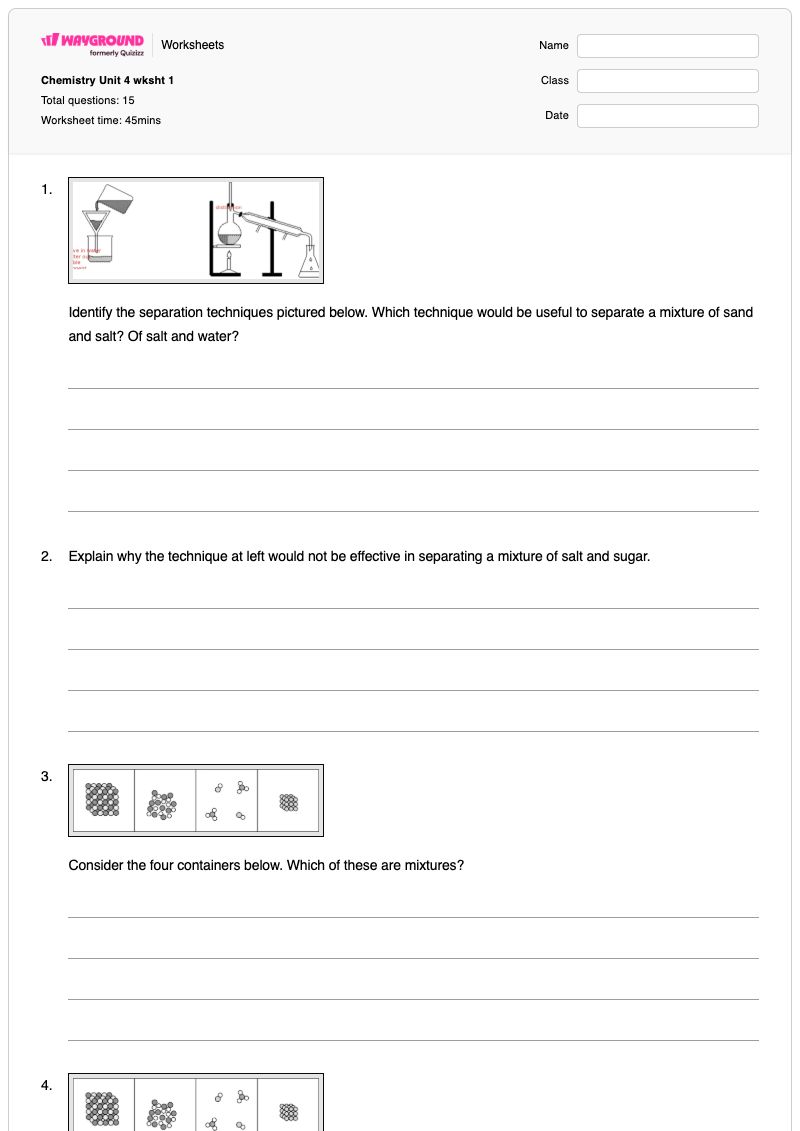
Identify the separation techniques pictured below. Which technique would be useful to separate a mixture of sand and salt?…

Identify the separation techniques pictured below. Which technique would be useful to separate a mixture of sand and salt? Of salt and water?

4 lines
2.

Explain why the technique at left would not be effective in separating a mixture of salt and sugar.

4 lines
3.
Consider the four containers below. Which of these are mixtures?

Consider the four containers below. Which of these are mixtures?

4 lines
4.
Consider the four containers below. Which of these are pure substances?

Consider the four containers below. Which of these are pure substances?

4 lines
5.
Consider the four containers below. Which contain only elements?

Consider the four containers below. Which contain only elements?

4 lines
6.
Consider the four containers below. Which of these are mixtures?

Consider the four containers below. Which of these are mixtures?

4 lines
7.
Consider the four containers below. Which of these are pure substances?

Consider the four containers below. Which of these are pure substances?

4 lines
8.
Consider the four containers below. Which contain only compounds?

Consider the four containers below. Which contain only compounds?

4 lines
9.
Consider the four containers below. Which contain only elements?

Consider the four containers below. Which contain only elements?

4 lines
10.
Consider the four containers below. Which of these are mixtures?

Consider the four containers below. Which of these are mixtures?

4 lines
11.
Consider the four containers below. Which of these are pure substances?

Consider the four containers below. Which of these are pure substances?

4 lines
12.
Consider the four containers below. Which contain only compounds?

Consider the four containers below. Which contain only compounds?

4 lines
13.
Consider the four containers below. Which contain only elements?

Consider the four containers below. Which contain only elements?

4 lines
14.
Which of the containers in #7 contain a gas?

Which of the containers in #7 contain a gas?

4 lines
15.
Which of the containers in #7 contain a solid?

Which of the containers in #7 contain a solid?

4 lines
WaygroundAnswer Key

Chemistry Unit 4 wksht 1

Total questions: 15

1.
n/a
2.
n/a
3.
n/a
4.
n/a
5.
n/a
6.
n/a
7.
n/a
8.
n/a
9.
n/a
10.
n/a
11.
n/a
12.
n/a
13.
n/a
14.
n/a
15.
n/a

FAQs

What does this worksheet cover?

This Grade 10 chemistry worksheet uses 15 open-ended prompts to assess separation techniques and the classification of matter. Students identify pictured techniques, evaluate methods for separating sand and salt or salt and water, explain why a method cannot separate salt and sugar, and classify container diagrams as mixtures, pure substances, elements, or compounds, including identifying gases and solids.

How can I use this worksheet to teach matter classification and separation techniques?

Introduce the worksheet by reviewing how mixtures differ from pure substances and how elements differ from compounds, then connect each separation technique to the properties that make separation possible. Have students explain their reasoning for the sand-and-salt, salt-and-water, and salt-and-sugar prompts before using the container diagrams for independent classification and discussion.

What mistakes should I watch for when students complete this worksheet?

Students may confuse a pure substance with a sample containing only one visible particle type, or treat a compound as an element because it appears uniform. They may also choose a separation technique without considering the substances’ properties, and confuse a sample’s physical state—such as solid or gas—with its classification as a mixture, element, or compound.

How do I assign and grade this worksheet?

This worksheet is available as a printable PDF and as a digital quiz on Wayground, and it includes a complete answer key for checking the 15 open-ended responses. For printable submissions, teachers can scan student work with the Wayground for Teachers app to support grading and review.

How can I differentiate this worksheet for my students?

Use the worksheet’s Advanced Settings to adjust font spacing or font size so the open-ended classification prompts and container diagrams are easier to read and annotate. You can also enable a dyslexia-friendly font or translate the worksheet into another language when that supports access to the separation-technique and matter-classification tasks.

Where can I find more worksheets like this on Wayground?

Wayground offers a comprehensive collection of free printable worksheets and practice problems across subjects, with downloadable PDFs and answer keys to help students master essential skills and concepts. Browse more resources at https://wayground.com/en-us/worksheets.