
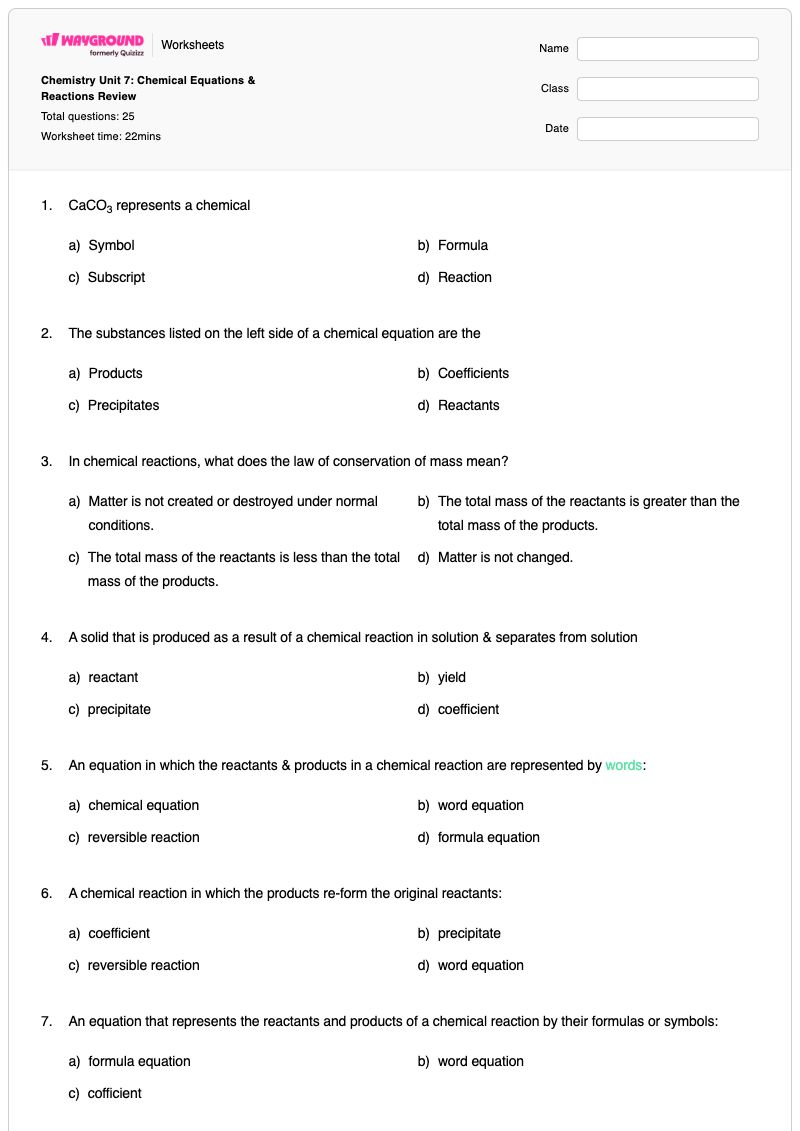

Chemistry Unit 7: Chemical Equations & Reactions Review
Created by Misty Turbeville
25 questions
10th Grade
Science
Updated Apr 2026
Chemistry Unit 7: Chemical Equations & Reactions Review is a Grade 10 chemistry worksheet with 25 multiple-choice questions covering essential chemical reaction concepts. Students review how to identify formulas, reactants, products, coefficients, subscripts, precipitates, word equations, formula equations, reversible reactions, and diatomic elements. The worksheet also addresses conservation of mass and evidence of chemical change, including distinguishing a change of state from other reaction indicators.
Students apply this vocabulary and reasoning to classify decomposition, single-replacement, double-replacement, and synthesis reactions from chemical equations. They also practise identifying the coefficients needed to balance an equation, such as phosphorus and oxygen forming phosphorus oxide. This free printable worksheet includes a complete answer key, making it useful for Grade 10 chemistry review, independent practice, homework, or preparation for an assessment.
Worksheet settings
Font size
S
M
L
XL
Worksheets
Chemistry Unit 7: Chemical Equations & Reactions Review
Total questions: 25
Name
Class
Date
1.
CaCO3 represents a chemical
a)
Symbol
b)
Formula
c)
Subscript
d)
Reaction
2.
The substances listed on the left side of a chemical equation are the
a)
Products
b)
Coefficients
c)
Precipitates
d)
Reactants
3.
In chemical reactions, what does the law of conservation of mass mean?
a)
Matter is not created or destroyed under normal conditions.
b)
The total mass of the reactants is greater than the total mass of the products.
c)
The total mass of the reactants is less than the total mass of the products.
d)
Matter is not changed.
4.
A solid that is produced as a result of a chemical reaction in solution & separates from solution
a)
reactant
b)
yield
c)
precipitate
d)
coefficient
5.
An equation in which the reactants & products in a chemical reaction are represented by words:
a)
chemical equation
b)
word equation
c)
reversible reaction
d)
formula equation
6.
A chemical reaction in which the products re-form the original reactants:
a)
coefficient
b)
precipitate
c)
reversible reaction
d)
word equation
7.
An equation that represents the reactants and products of a chemical reaction by their formulas or symbols:
a)
formula equation
b)
word equation
c)
cofficient
8.
A small whole number that appears in front of a formula in a chemical equation
a)
coefficient
b)
precipitate
c)
subscript
9.
Which is NOT an indicator of a chemical change?
a)
Color Change
b)
Precipitate formed
c)
Production of Gas (Bubbles)
d)
Change of state
10.
H2, F2, O2, I2, Cl2, Br2, N2 are all
a)
polyatomic ions
b)
diatomic elements
c)
noble gases
d)
transition metals
11.
What kind of reaction is this: 2H2O2→2 H2O + O2
a)
Synthesis
b)
Decomposition
c)
Single Replacement
d)
Combustion
12.
What kind of reaction is this: Fe + CuSO4 -> Cu + FeSO4
a)
Double Replacement
b)
Decompostion
c)
Single Replacement
d)
Combustion
13.
The reaction below is an example of? AgNO3 + NaCl → AgCl + NaNO3
a)
Single Replacement
b)
Double Replacement
c)
Decomposition
d)
Combustion
14.
What kind of reaction is this: 4Fe + 3O2 → 2Fe2O3
a)
Synthesis
b)
Decomposition
c)
Single Replacement
d)
Double Replacement
15.
Balance this equation- __P4 + __O2 --> __P2O3
a)
it is already balanced
b)
2, 1, 3
c)
1, 2, 3
d)
1, 3, 2
16.
What type of chemical reaction is this one?
C2H2 + O2 --> CO2 + H2O
a)
Decomposition
b)
Combustion
c)
Synthesis
d)
Single Replacement
17.
One of the signs of a chemical reaction taking place is:
a)
Bubbles are produced
b)
Reactants are not combining
c)
Products are not forming
d)
Color is not changing
18.
You know a chemical reaction has occurred if
a)
there is a precipitate.
b)
there is a color change.
c)
there is a temperature change.
d)
All of these answers are evidence.
19.
What are the blue numbers called?
a)
oxidation numbers
b)
subscripts
c)
group numbers
d)
product numbers
20.
Identify the Reactants in this equation.
a)
A
b)
B
21.
The arrow in a chemical equation means _______________.
a)
Equals
b)
Yields
22.
Balance this equation _N2 + _H2 --> _NH3
a)
1,2,3
b)
1,3,2
c)
1,1,2
d)
2,1,1
23.
What is the left part of a chemical equation called? 2H2 + O2 --> 2H2O
a)
Reactants
b)
Products
c)
Yields
d)
Chemical Equation
24.
What is the right part of a chemical equation called... 2H2 + O2--> 2H2O
a)
Reactants
b)
Products
c)
Yields
d)
Chemical Equation
25.
Is the following equation balanced?... Al + O2 --> 2Al2O3
a)
Yes!
b)
No!
Answer Key
Chemistry Unit 7: Chemical Equations & Reactions Review
Total questions: 25
1.
b) Formula
2.
d) Reactants
3.
a)
Matter is not created or destroyed under normal conditions.
4.
c)
precipitate
5.
b)
word equation
6.
c)
reversible reaction
7.
a)
formula equation
8.
a)
coefficient
9.
d)
Change of state
10.
b)
diatomic elements
11.
b) Decomposition
12.
c) Single Replacement
13.
b) Double Replacement
14.
a) Synthesis
15.
d) 1, 3, 2
16.
b)
Combustion
17.
a) Bubbles are produced
18.
d)
All of these answers are evidence.
19.
b)
subscripts
20.
a)
A
21.
b)
Yields
22.
b) 1,3,2
23.
a) Reactants
24.
b) Products
25.
b) No!
140 %
Browse by subjects
Browse by grades
Browse by format
FAQs
What does this chemical equations and reactions worksheet cover?
This Grade 10 worksheet uses 25 multiple-choice questions to assess chemical-equation vocabulary, conservation of mass, indicators of chemical change, diatomic elements, reaction classification, and balancing equations. Students identify terms such as reactants, products, coefficients, precipitates, word equations, and formula equations, then classify equations as synthesis, decomposition, single replacement, or double replacement and select balancing coefficients.
How can I use this worksheet to teach chemical equations and reaction types?
Introduce the vocabulary first by having students label the reactants, products, subscripts, and coefficients in a sample equation. Then use the worksheet’s equation-based items to ask students to explain the pattern that identifies each reaction type before completing the balancing question; review why changing coefficients preserves the formulas while balancing the atoms.
What mistakes should I watch for on this chemical reactions review worksheet?
Students may confuse a coefficient in front of a formula with a subscript within a formula, or switch the reactants and products based on their positions in the equation. They may also misclassify decomposition, synthesis, single-replacement, and double-replacement equations, treat a change of state as evidence of chemical change, or choose balancing numbers without checking each element on both sides.
How do I assign and grade this chemistry worksheet?
The Chemical Equations & Reactions Review worksheet is available as a printable PDF and as a digital quiz on Wayground, with a complete answer key for all 25 multiple-choice questions. Printable submissions can be graded by scanning student work with the Wayground for Teachers app.
How can I differentiate this chemical equations worksheet for my students?
Use the worksheet’s Advanced Settings to increase font size or spacing so chemical formulas, subscripts, and multiple-choice options are easier to read. You can also enable a dyslexia-friendly font or translate the worksheet into another language while students work with the reaction vocabulary and equation-classification items.
Where can I find more worksheets like this on Wayground?
Wayground offers a comprehensive collection of free printable worksheets and practice problems across all subjects, with downloadable PDFs and answer keys to support mastery of essential skills and concepts. Browse more resources at https://wayground.com/en-us/worksheets.