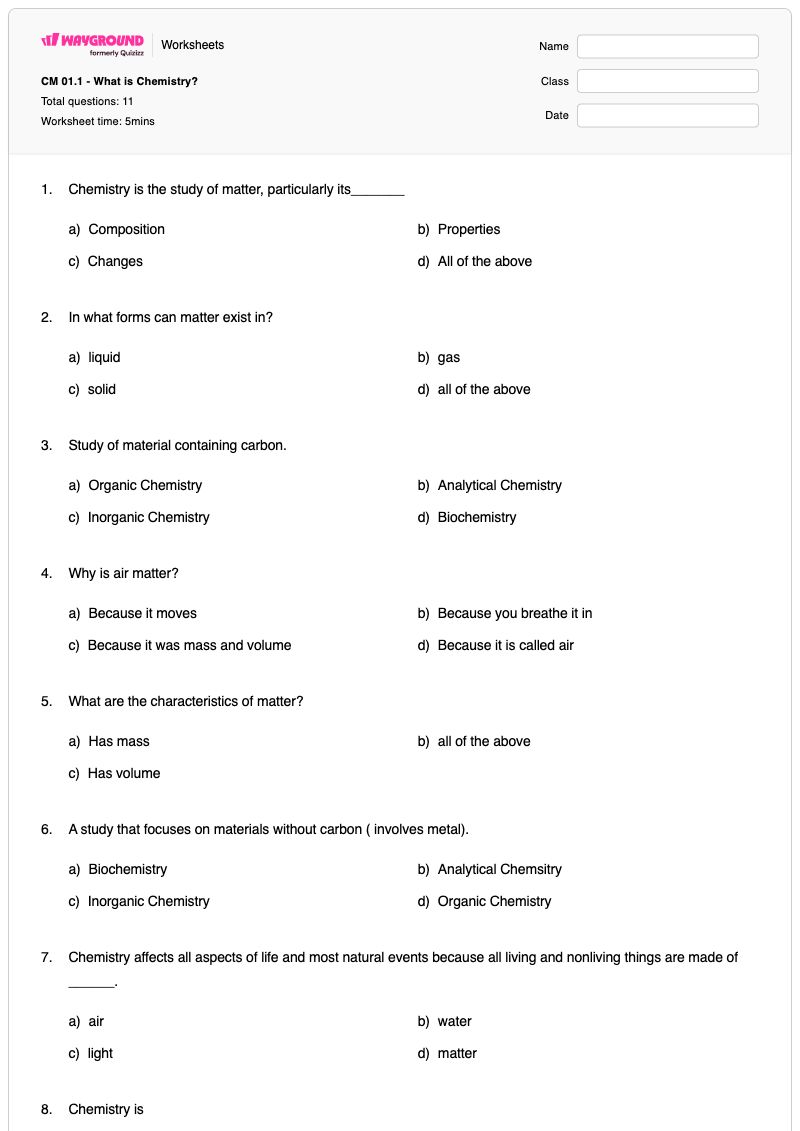
CM 01.1 - What is Chemistry? is a free printable worksheet for Grades 9–12 that introduces the foundational ideas students need for an introductory chemistry course. Through 11 multiple-choice questions, students identify chemistry as the study of matter and its interactions, recognize that matter has mass and volume and can exist as a solid, liquid, or gas, and connect chemistry to living and nonliving systems.
The worksheet also checks students’ understanding of organic and inorganic chemistry, the difference between mass and weight, and how theories and laws describe scientific knowledge. Students select answers rather than perform calculations, making the worksheet useful for an opening lesson, vocabulary review, or a quick check of prerequisite knowledge. It is available as a free printable worksheet with a complete answer key for efficient review and grading.
Worksheet settings
Font size
S
M
L
XL
Worksheets
CM 01.1 - What is Chemistry?
Total questions: 11
Name
Class
Date
1.
Chemistry is the study of matter, particularly its_______
a)
Composition
b)
Properties
c)
Changes
d)
All of the above
2.
In what forms can matter exist in?
a)
liquid
b)
gas
c)
solid
d)
all of the above
3.
Study of material containing carbon.
a)
Organic Chemistry
b)
Analytical Chemistry
c)
Inorganic Chemistry
d)
Biochemistry
4.
Why is air matter?
a)
Because it moves
b)
Because you breathe it in
c)
Because it was mass and volume
d)
Because it is called air
5.
What are the characteristics of matter?
a)
Has mass
b)
all of the above
c)
Has volume
6.
A study that focuses on materials without carbon ( involves metal).
a)
Biochemistry
b)
Analytical Chemsitry
c)
Inorganic Chemistry
d)
Organic Chemistry
7.
Chemistry affects all aspects of life and most natural events because all living and nonliving things are made of ______.
a)
air
b)
water
c)
light
d)
matter
8.
Chemistry is
a)
understanding the world around us
b)
the study of matter and its interactions
c)
atoms, elements, and mixtures
d)
hard
9.
Mass & weight are different because
a)
Weight depends on the force of gravity
b)
Mass depends on the force of gravity
c)
Weight depends on the amount of matter an object contains
d)
Mass does not depend on the amount of matter an object contains
10.
Theory or law? The cell _________ of living things: living things are made of cells, which explains how things grow and live.
a)
Theory
b)
Law
11.
Theory or Law? _________ of Thermodynamics: Matter can never be created or destroyed. Tells what happens with matter.
a)
Theory
b)
Law
Answer Key
CM 01.1 - What is Chemistry?
Total questions: 11
1.
d)
All of the above
2.
d)
all of the above
3.
a)
Organic Chemistry
4.
c)
Because it was mass and volume
5.
b)
all of the above
6.
c)
Inorganic Chemistry
7.
d)
matter
8.
b)
the study of matter and its interactions
9.
a) Weight depends on the force of gravity
10.
a)
Theory
11.
b)
Law
140 %
Browse by subjects
Browse by grades
Browse by format
FAQs
What does the “What is Chemistry?” worksheet cover?
This worksheet uses 11 multiple-choice questions to check foundational chemistry knowledge, including the definition of chemistry, the states and characteristics of matter, organic and inorganic chemistry, mass versus weight, and the distinction between scientific theories and laws. Students build core vocabulary and classification skills by choosing definitions and explanations that connect chemistry to matter and its interactions.
How can I use this worksheet to teach introductory chemistry concepts?
Introduce the worksheet by having students describe familiar examples of matter and explain how mass and volume apply to them. Then use the multiple-choice items to compare organic with inorganic chemistry and to discuss why weight, unlike mass, depends on gravity. Finish by asking students to justify the Theory and Law selections using what each scientific term explains.
What mistakes should I watch for when students complete this chemistry worksheet?
Students may choose only one characteristic of matter instead of recognizing that matter has both mass and volume, or confuse a state of matter with a chemistry branch such as organic or inorganic chemistry. They may also treat mass and weight as interchangeable. In the final two items, check that students distinguish a theory that explains how or why from a law that describes what happens, rather than selecting the terms at random.
How do I assign and grade this chemistry worksheet?
You can assign CM 01.1 - What is Chemistry? as a printable PDF or as a digital quiz on Wayground. The worksheet includes a complete answer key, and printable submissions can be graded by scanning student work with the Wayground for Teachers app. The printable format also gives schools an option for reducing screen time during introductory chemistry review.
How can I differentiate this worksheet for my students?
For the 11 multiple-choice questions and their chemistry vocabulary, use the worksheet’s Advanced Settings to adjust font spacing or font size for easier reading. You can also enable a dyslexia-friendly font or translate the worksheet into another language when students need clearer access to terms such as matter, mass, theory, and law.
Where can I find more worksheets like this on Wayground?
Wayground offers a broad collection of free printable worksheets and practice problems across subjects, with downloadable PDFs and answer keys to support mastery of essential skills and concepts. Browse more resources at https://wayground.com/en-us/worksheets.


 Worksheets