
Wayground
Density Review - Printable Science Worksheets 8th Grade - Wayground

Density Review

Whitney Price

Created by Whitney Price

15 questions

8th Grade

Science

Updated Aug 2026

Density Review is a Grade 8 science worksheet with 15 multiple-choice questions focused on calculating and interpreting density. Students identify the mass and volume measurements used in density, compare objects with different masses and volumes, calculate density from numerical data, determine volume by water displacement, and find the volume of a rectangular cube. Several questions require students to use calculated density values and reference charts to identify unknown substances or metals. This free printable worksheet provides varied practice with density problems involving regular and irregular objects, including measurements in grams, milliliters, and cubic centimeters. It helps teachers check whether students can apply the density formula, subtract initial volume from final volume, use dimensions to determine volume, and connect results to material-density tables. An answer key is included for efficient review, independent practice, homework, or science assessment.

Worksheet settings

Font size

S
M
L
XL
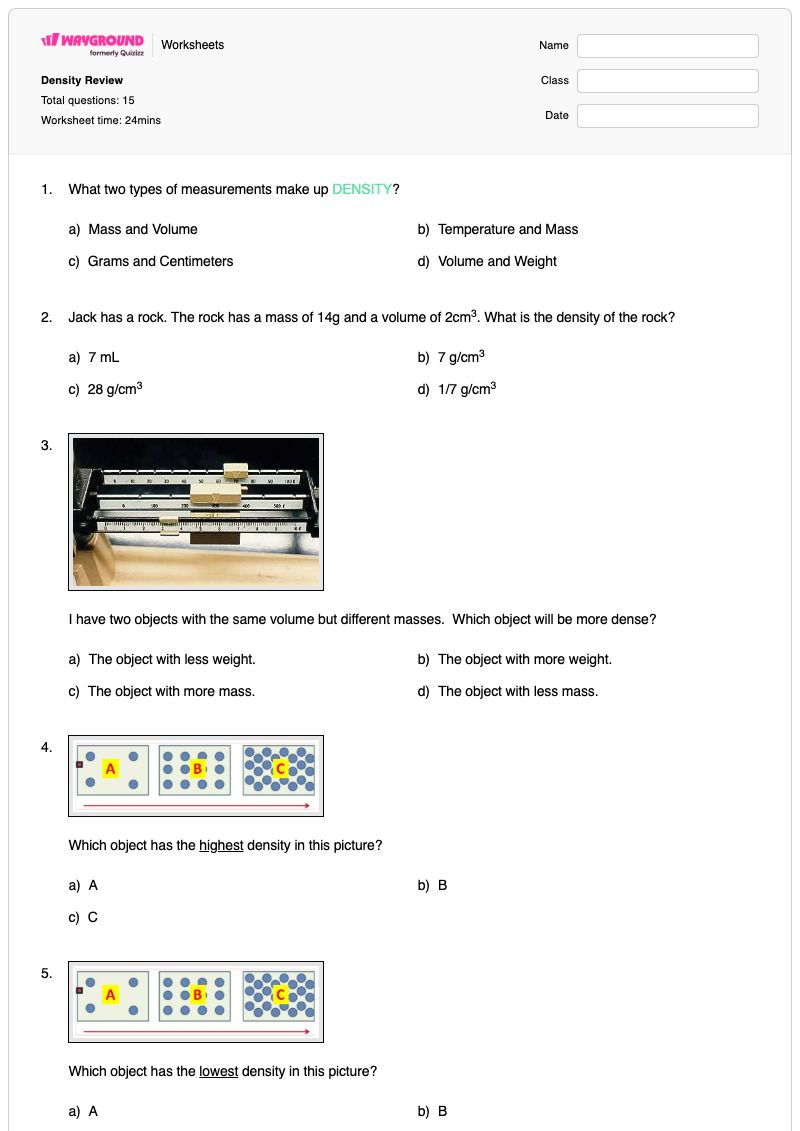
WaygroundWorksheets

Density Review

Total questions: 15

Name
Class
Date
1.
What two types of measurements make up DENSITY? 
a)
Mass and Volume
b)
Temperature and Mass
c)
Grams and Centimeters
d)
Volume and Weight
2.
Jack has a rock. The rock has a mass of 14g and a volume of 2cm3. What is the density of the rock?
a)
7 mL
b)
7 g/cm3
c)
28 g/cm3
d)
1/7 g/cm3
3.
I have two objects with the same volume but different masses. Which object will be more dense?
I have two objects with the same volume but different masses.  Which object will be more dense?
a)
The object with less weight.
b)
The object with more weight.
c)
The object with more mass.
d)
The object with less mass.
4.
Which object has the highest density in this picture?

Which object has the highest density in this picture?

a)

A

b)

B

c)

C

5.
Which object has the lowest density in this picture?

Which object has the lowest density in this picture?

a)

A

b)

B

c)

C

6.
You calculated the density of an unknown substance to be 7.8g/cm 3 . According to the chart, which of the substances doe you…

You calculated the density of an unknown substance to be 7.8g/cm3. According to the chart, which of the substances doe you most likely have?

a)

Zinc

b)

Copper

c)

Tin

d)

Iron

7.
You calculated the density of an unknown substance to be 5.7g/cm 3 . According to the chart, which of the substances do you…

You calculated the density of an unknown substance to be 5.7g/cm3. According to the chart, which of the substances do you most likely have?

a)

Aluminum

b)

Iron

c)

Tin

d)

Zinc

8.
An irregular shaped object was placed in a graduated cylinder. The initial volume was 50mL. The final volume was 75mL. What…

An irregular shaped object was placed in a graduated cylinder. The initial volume was 50mL. The final volume was 75mL. What is the volume of the irregular shaped object?

a)

25mL

b)

125mL

c)

75mL

d)

50mL

9.
Calculate the density of the object below if it has a mass of 3g. (Hint: you need to find the volume.)

Calculate the density of the object below if it has a mass of 3g. (Hint: you need to find the volume.)

a)

60 g/cm3

b)

3 g/cm3

c)

20 g/cm3

d)

0.05 g/cm3

10.
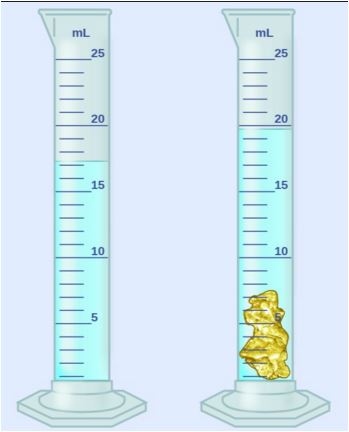
An irregularly shaped piece of gold was lowered into a graduated cylinder holding a volume of water equal to 17 ml. The…
An irregularly shaped piece of gold was lowered into a graduated cylinder holding a volume of water equal to 17 ml. The height of the water rose to 20 ml. If the mass of the gold was 27 g, what was its density?
a)
9 g/mL
b)
10.5 g/mL
c)
6.5 g/mL
d)
8 g/mL
11.
Find the density of a 2 cm x 2 cm x 2 cm cube with a mass of 64 g.
a)
6 cm3
b)
12 g/cm3
c)
128 g/cm3
d)
8  g/cm3
12.

A 99 g object is dropped in water. The water level started at 30 mL and rose to 52 mL. What is its density?

a)

0.22 g/mL

b)

1.90 g/mL

c)

3.3 g/mL

d)

4.5 g/mL

13.

Calculate the density of an object with a mass of 240 g and a volume of 12 mL.

a)

20 g/mL

b)

0.05 g/mL

c)

252 g/mL

d)

2,800 g/mL

14.
A piece of unknown metal has a mass of 240 g and a volume of 23 mL. What is the metal most likely made of?

A piece of unknown metal has a mass of 240 g and a volume of 23 mL. What is the metal most likely made of?

a)

Aluminum

b)

Silver

c)

Lead

d)

Magnesium

15.
What metal do you have if you have a mass of 225 g and a volume of 21.4 cm 3 ?
What metal do you have if you have a mass of 225 g and a volume of 21.4 cm3?
a)
Zinc- 7.13 g/cm3
b)
Copper- 8.96 g/cm3
c)
Silver- 10.5 g/cm3
d)
Mercury- 13.55 g/cm3
WaygroundAnswer Key

Density Review

Total questions: 15

1.
a) Mass and Volume
2.
b) 7 g/cm3
3.
c) The object with more mass.
4.
c)

C

5.
a)

A

6.
d)

Iron

7.
c)

Tin

8.
a)

25mL

9.
d)

0.05 g/cm3

10.
a) 9 g/mL
11.
d) 8  g/cm3
12.
d)

4.5 g/mL

13.
a)

20 g/mL

14.
b)

Silver

15.
c) Silver- 10.5 g/cm3

FAQs

What does the Density Review worksheet cover?

This Grade 8 science worksheet uses 15 multiple-choice questions to build density skills with mass, volume, and material identification. Students calculate density for regular and irregular objects, find volume through graduated-cylinder displacement or cube dimensions, compare relative density, and use density charts to identify unknown substances and metals.

How can I use this worksheet to teach density calculations?

Introduce the density relationship between mass and volume, then model one problem that uses direct measurements and another that finds volume by subtracting the initial graduated-cylinder reading from the final reading. Have students explain why the same-volume object with greater mass is denser, solve the worksheet independently, and discuss how their calculated values match the reference-chart choices for unknown materials.

What mistakes should I watch for when students complete this density worksheet?

Watch for students reversing mass and volume in the density calculation, choosing the final graduated-cylinder reading instead of the volume displaced, or using the cube's surface dimensions without first calculating its volume. Students may also confuse density with mass or select a material from the chart before comparing the calculated value with the listed densities.

How do I assign and grade the Density Review worksheet?

The Density Review worksheet is available as a printable PDF and as a digital quiz on Wayground, and it includes a complete answer key for all 15 multiple-choice questions. For printable submissions, you can grade student work by scanning it with the Wayground for Teachers app.

How can I differentiate this density worksheet for my students?

Use the worksheet's Advanced Settings to adjust font spacing or font size so the density calculations, graduated-cylinder scenarios, and answer choices are easier to read. You can also apply a dyslexia-friendly font or translate the Density Review worksheet into another language when those options support access to the science vocabulary and numerical problems.

Where can I find more worksheets like this on Wayground?

Wayground offers a comprehensive collection of free printable worksheets and practice problems across subjects, with downloadable PDFs and answer keys to support mastery of essential skills and concepts. Browse more resources at https://wayground.com/en-us/worksheets.